
Google's New Patent Bets Quantum Computers Can Train Themselves by Tuning Their Own Hardware
Google is filing patents that treat quantum hardware itself — the physical knobs that tune electromagnetic fields and laser pulses — as the training parameters for a machine learning model. It's a bet that useful quantum ML doesn't require perfect logical qubits, just well-tuned analog hardware.
What Google's quantum ML training approach actually does
Imagine trying to tune a guitar, but instead of turning pegs by hand, a computer automatically adjusts the tension of every string simultaneously until the whole instrument sounds right. Google's patent describes doing something structurally similar with a quantum computer.
Normally, you'd think of training a machine learning model as a software problem — adjust weights in code until the model performs well. Here, Google proposes doing that adjustment at the hardware level, by tweaking the physical environment of the quantum system itself: things like magnetic field strengths and microwave pulse timings.
The result is a quantum system that gradually learns to solve a task without needing the error-corrected, "perfect" qubits that full quantum computing typically demands. It's a more pragmatic approach suited to the noisy, imperfect quantum hardware that actually exists today.
How physical control parameters replace digital qubits
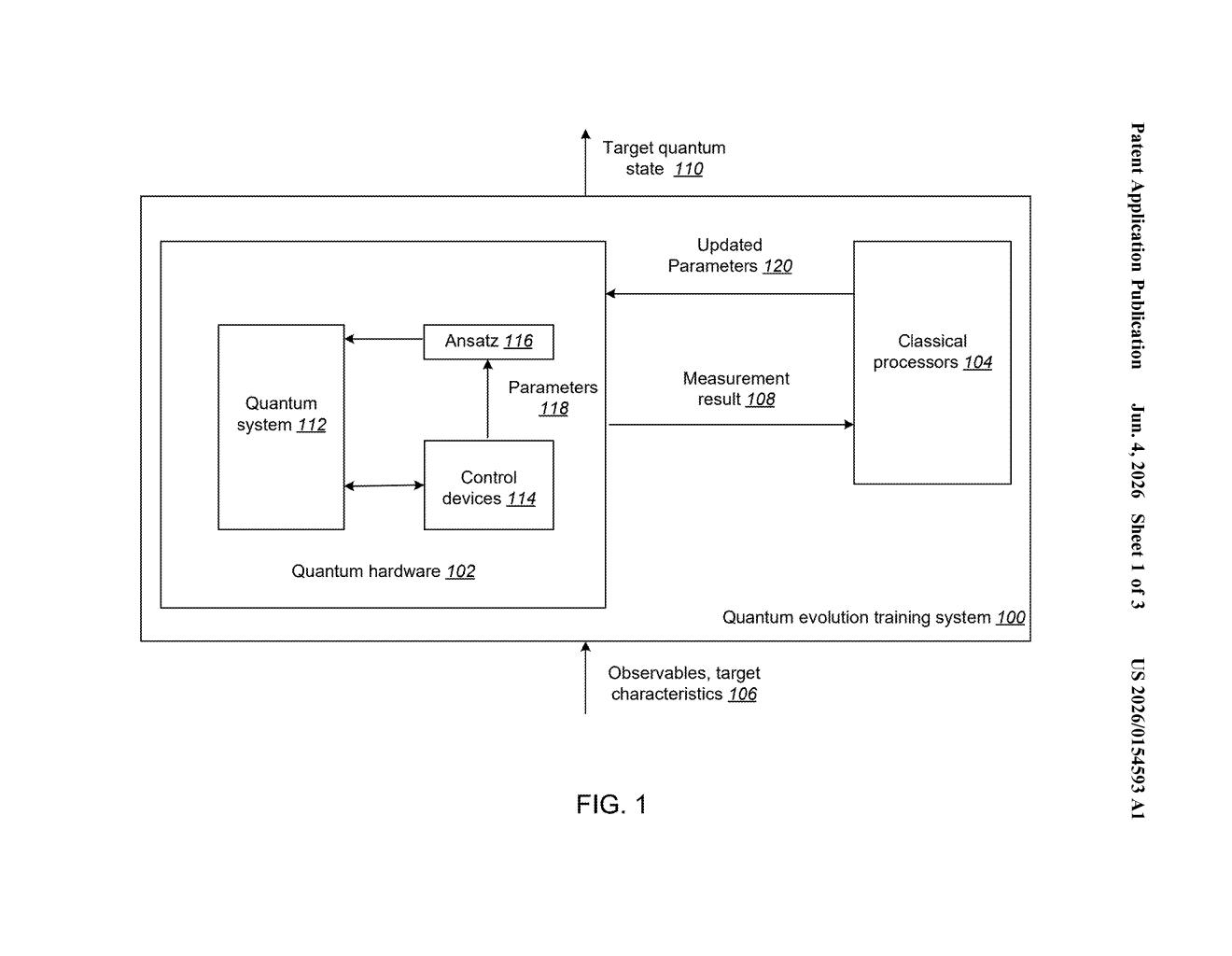
The patent describes a hybrid classical-quantum training loop. A classical computer (your regular CPU or server) repeatedly adjusts a set of physical control parameters — things like the frequency and amplitude of microwave pulses that govern how qubits behave — on a quantum processor. These parameters collectively form what the patent calls a variational ansatz (roughly: a structured, educated guess about the quantum state's shape).
The quantum system is initialized in an ansatz wavefunction — a quantum state that encodes the training data for a machine learning task. The hardware then evolves that state analogically, meaning it follows continuous physical dynamics rather than discrete gate operations. Think of it less like a digital circuit and more like a carefully sculpted wave.
The classical processor evaluates how close the evolved quantum state is to a desired target by measuring quantum observables (physical quantities you can measure, like energy or spin). It then computes a cost function — a score for how wrong the current state is — and nudges the physical parameters to reduce that score.
- Training happens at the sub-logical level, meaning below the abstraction layer of error-corrected qubits
- The optimization loop runs iteratively until a completion event (convergence, a time limit, or a target accuracy)
- Multi-level quantum subsystems are used, potentially exploiting more than just 0 and 1 states
What this means for quantum ML's near-term future
Most serious quantum computing research today is focused on building fault-tolerant, error-corrected quantum computers — a goal that's still years away. This patent stakes out a different path: making today's noisy, imperfect quantum hardware useful for machine learning by working with its physical quirks rather than against them. That's a meaningful near-term bet.
For Google, which operates some of the world's most capable superconducting quantum processors, this could serve as a bridge strategy — extracting real ML value from hardware that isn't yet good enough for full quantum advantage. Whether this produces results that beat classical ML is still an open research question, but the approach is intellectually serious and aligns with where the broader field of variational quantum algorithms is heading.
This is a genuinely interesting filing from two heavy hitters — Ryan Babbush and Hartmut Neven are among the most credentialed quantum computing researchers in the world. The core idea, treating physical hardware parameters as ML training variables, is a real research direction in the quantum computing community (often called variational quantum-classical algorithms), and Google filing a broad patent on it suggests they want IP coverage on the approach, not just the publications. Whether it produces practically useful ML models remains unproven, but this isn't a routine filing — it reflects a deliberate strategic position on near-term quantum utility.
There are more where this came from
We read every patent application Big Tech publishes and send you the ones worth knowing. Plain English, free, every week.
Want this weekly breakdown for a company we don't cover? Patentlyze Pro →