
Adobe Patents an AI Chat Interface That Answers Questions About Your Sales Leads
Spreadsheets full of sales leads are useful only if someone can read them quickly. Adobe's latest patent describes a chat interface where you type a question and an AI, working from a pre-built plain-English summary of your lead data, types back an answer.
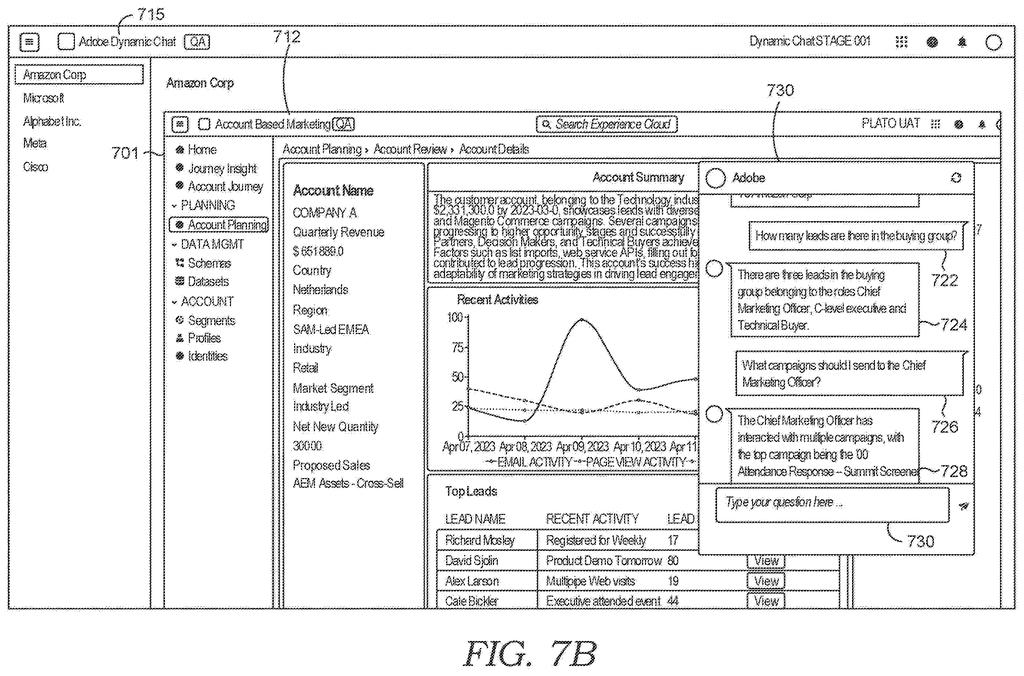
What Adobe's lead-data chat system actually does
You're staring at a dashboard packed with numbers: how many times a prospect clicked your emails, which pages they visited, how long they spent on your site. You need a quick answer, like "which of these accounts is most engaged," but the data is buried in rows and columns.
Adobe's patent describes a system that converts that raw table data into a short natural-language summary, the kind a person might write to describe what the numbers mean. An AI reads that summary, and when you type a question into a chat box, it uses the summary as context to write back a plain-English answer.
Leads (individual potential customers) and accounts (the companies they belong to) each get their own summary. The chat interface works from those summaries, so the AI isn't hunting through raw numbers every time you ask something. It's already been briefed.
accessing, from the one or more computer storage media, a summary of at least one of: lead data of a lead or account data of an account, the lead being a member of an account, the account being an organization, the summary being natural language characters that have been generated by a transformer-based language model …
Translation: The system reads a plain-English summary of your customer data generated by AI.
How the AI converts table rows into chat-ready answers
The system targets a specific workflow inside marketing and sales software: reading activity data about leads and accounts, then making that data conversationally accessible.
Here is the sequence the patent describes:
- Raw activity data (page views, email clicks, form submissions, each counted by type) is stored in tables.
- A transformer-based language model (the same family of AI behind ChatGPT-style tools) converts those table rows into natural-language sentences, producing a short summary per lead or account.
- When a user types a question into a chat interface, the system encodes both the summary and the question into numerical representations called tensors (think of them as coordinates in a mathematical space that the AI can do arithmetic on).
- The model's attention mechanism (a technique that lets the AI weigh which parts of the input matter most for the question being asked) produces an answer, which appears in the chat window.
The key design choice is the intermediary summary. Rather than feeding raw table data directly to the AI each time a question arrives, the system pre-generates a plain-English brief. That brief becomes the AI's working context for every subsequent chat exchange about that lead or account.
… deriving, via a language model, a response to a user question or command via a chat interface by providing the language model with the generated summary as input …
Translation: The AI answers questions typed into a chat window by using that customer data summary.
What this means for sales and marketing teams
For sales and marketing teams, the friction of switching between a CRM, a data dashboard, and a colleague who can interpret the numbers is real and daily. A chat interface that already knows your lead data means faster answers without exporting spreadsheets or writing SQL queries.
For Adobe specifically, this fits inside products like Adobe Marketo Engage, its enterprise marketing automation platform. Adobe's track record in AI-assisted content and data patents suggests this is part of a broader push to add conversational interfaces across its business software. Whether users actually trust AI-generated summaries of sales-critical data is a separate and important question the patent does not address.
Adobe's new application is the 28th filing we've tracked under our Language AI coverage since May, joining earlier work like one on cursor-hover prompt writing and one on cross-language font matching.
The system works by writing a short summary of a customer's activity and then letting a salesperson ask questions about that summary. The cost of that choice is freshness: the moment the underlying data changes, the summary goes stale, and any answer the chat gives reflects the world as it was, not as it is.
For a sales team moving quickly, that gap is real. A rep who asks whether a lead is still engaged might get a confident answer based on last week's numbers, with no signal that anything has shifted since.
Whether the trade is worth it depends entirely on how often the summaries get rewritten. Adobe is essentially betting that refresh cycles can stay tight enough to keep answers trustworthy. The patent describes that bet but leaves the hard part, actually winning it, to engineering.
There are more where this came from
We read every patent application Big Tech publishes and send you the ones worth knowing. Plain English, free, every week.
The drawings
14 drawing sheets from US 2026/0289844 A1 · click any drawing to enlarge


Want this weekly breakdown for a company we don't cover? Patentlyze Pro →
Be the first to weigh in