
Samsung Patents an AI System That Watches Storage Commands for Ransomware
Most ransomware defenses wait until files are already encrypted before sounding the alarm. Samsung's new patent tries to catch the attack while it's still issuing commands to the storage hardware itself.
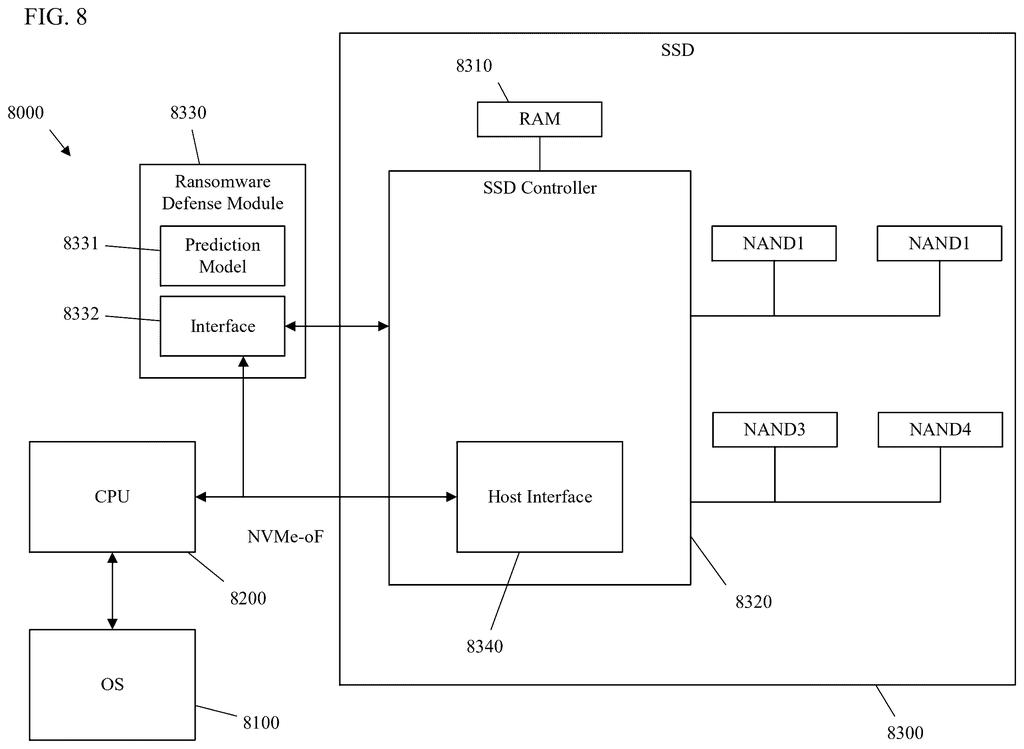
What Samsung's storage-level ransomware scanner actually does
Imagine a bank vault that doesn't just lock the door after a robbery, but watches every hand movement inside the vault in real time, looking for suspicious patterns before anything is stolen. That's roughly what Samsung is trying to do here, but for the storage drives inside servers.
When ransomware attacks a system, it sends a flood of commands to the storage hardware: read this file, overwrite it with encrypted garbage, delete the original. Samsung's patent describes an AI that watches that stream of commands as they flow into high-speed storage hardware, looking for sequences that match known ransomware behavior.
If the AI spots something suspicious, the system can trigger a recovery operation automatically, potentially stopping the attack and restoring data before the damage spreads. This happens at the storage layer itself, which is much closer to the data than traditional software-based antivirus tools.
How the AI model reads and scores NVMe command chunks
The patent targets a specific type of enterprise storage infrastructure called NVMe-oF (NVMe over Fabrics), a protocol that lets servers talk to very fast solid-state storage over a network. Data centers use this for high-throughput workloads where speed matters.
The system works in a pipeline:
- It captures the continuous stream of NVMe commands (low-level instructions like "write this block" or "trim this range") flowing between servers and storage.
- It pre-processes that stream to normalize and clean it for analysis.
- It chops the stream into chunks (short sequences of commands) and feeds each chunk into an AI inference model (a trained algorithm that classifies inputs based on learned patterns).
- If the model flags a chunk as malicious, the system triggers a memory recovery operation to roll back or protect the affected storage.
By operating at the NVMe command level rather than the file or operating-system level, the detection happens below where most ransomware expects to be watched. The AI is trained to recognize the specific command patterns ransomware generates, such as rapid sequential overwrites, which look very different from normal application I/O.
What this means for data centers defending against ransomware
Ransomware attacks on enterprise data centers have become a reliable disaster for organizations of every size. Traditional endpoint security tools live on servers and can be disabled or bypassed by sophisticated ransomware. A detection layer baked into the storage fabric is much harder to blind, because the storage system doesn't need to trust the server sending commands.
Samsung makes some of the world's most widely deployed enterprise SSDs, and a ransomware detection feature built into the storage hardware itself would be a meaningful selling point for data center buyers. For you, the downstream effect is that cloud services and enterprise applications you rely on would be less likely to go dark after a ransomware incident.
This is a genuinely interesting approach to a real and expensive problem. Pushing security intelligence down to the storage layer is not a new idea in academic circles, but a production-ready patent from Samsung, a major hardware vendor with the ability to ship it in firmware, gives this more weight than a research paper would. The real question is whether the AI model can keep false-positive rates low enough that it doesn't trigger spurious recoveries on legitimate high-write workloads like backups or database compaction.
There are more where this came from
We read every patent application Big Tech publishes and send you the ones worth knowing. Plain English, free, every week.
The drawings
13 drawing sheets from US 2026/0220265 A1 · click any drawing to enlarge


Want this weekly breakdown for a company we don't cover? Patentlyze Pro →
Be the first to weigh in