
IBM Patents a Real-Time System That Catches Unstable Industrial Loads Before They Tip
Every time a loader dumps another scoop of ore, gravel, or grain onto a pile, hidden air pockets can form — and those voids can turn a stable load into a sudden avalanche. IBM's new patent describes a system that watches the pile grow in real time and steps in to fix the imbalance before anything tips over.
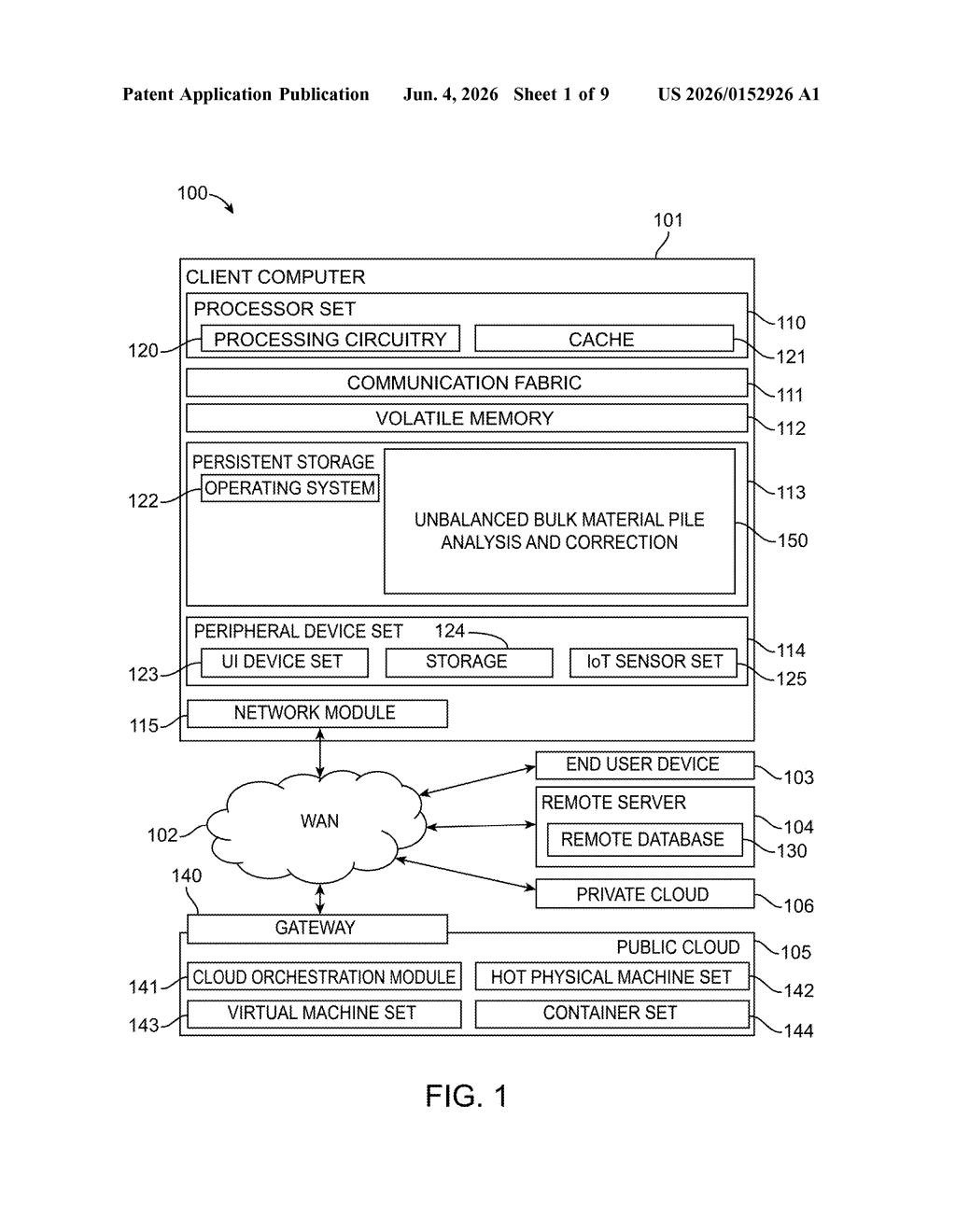
What IBM's pile-balancing safety system actually does
Imagine a dump truck being loaded at a mining site. Each scoop of material looks fine from the outside, but inside the pile, gaps and air pockets can form that weaken the whole stack. Without anyone noticing, the load can shift — or worse, topple — once the truck starts moving.
IBM's patented system keeps a live 3D scan of the pile updating layer by layer as material is added. It compares each new snapshot to the one before it, looking for those hidden internal gaps. It also calculates the forces pressing down through the pile to figure out whether the whole thing is balanced.
If the system decides the pile is dangerously uneven, it triggers a corrective action — think of it like a smart loading guide that tells the operator (or an automated loader) where to place the next scoop to bring everything back into balance. The goal is to catch the problem during loading, not after a collapse has already happened.
How the 3D scanner and force-vector engine flag dangerous voids
The system is built around three connected modules working together during an active loading operation.
The scanning module generates a continuous 3D model of the material pile, updating it in real time as each new layer is deposited. Think of it like a live point-cloud map — similar to what a LiDAR sensor produces — that captures the external shape of the pile at every stage of loading.
The force distribution module does two things: it compares the 3D model before and after each new layer is added to detect void spaces (internal air pockets or structural gaps), and it calculates force vectors — essentially a mathematical description of the direction and magnitude of gravitational and compressive forces acting through the pile at any given moment.
The unbalance prediction module then combines those two inputs — void locations and force vectors — to determine whether the pile is in an unbalanced state that could lead to slipping or collapse. If it is, the system performs a corrective action. The patent doesn't lock down a single corrective mechanism, which suggests it could range from directing a human operator to repositioning an automated arm or conveyor.
What this means for warehouse and mining safety
Industrial load failures — material piles collapsing on vehicles, workers, or equipment — are a persistent safety problem in mining, construction, and bulk freight. Most existing approaches rely on visual inspection or static weight sensors that can't see inside a pile. A system that models internal void structure and force distribution in real time would catch failure conditions those methods miss entirely.
For IBM, this patent sits at the intersection of industrial IoT and predictive safety, an area where enterprise software vendors have been pushing hard. If this technology integrates with existing fleet management or warehouse automation platforms, the corrective actions could eventually be executed without a human in the loop at all.
This is a genuinely useful industrial safety patent, not a speculative moonshot. Bulk material handling accidents kill and injure workers regularly, and the gap between 'it looks fine' and 'it's about to collapse' is exactly the kind of problem 3D sensing plus physics modeling can close. IBM filing this rather than a hardware company is the interesting angle — it suggests IBM sees the value in owning the software and analytics layer on top of whatever sensors the customer already has.
There are more where this came from
We read every patent application Big Tech publishes and send you the ones worth knowing. Plain English, free, every week.
Want this weekly breakdown for a company we don't cover? Patentlyze Pro →