
Apple Patents an Enhanced Wi-Fi Buffer Reporting System for Congested Networks
When your Wi-Fi gets slow in a crowded venue, part of the problem is that your device can't accurately tell the router how backed-up its data queue really is. Apple's new patent tries to fix exactly that.
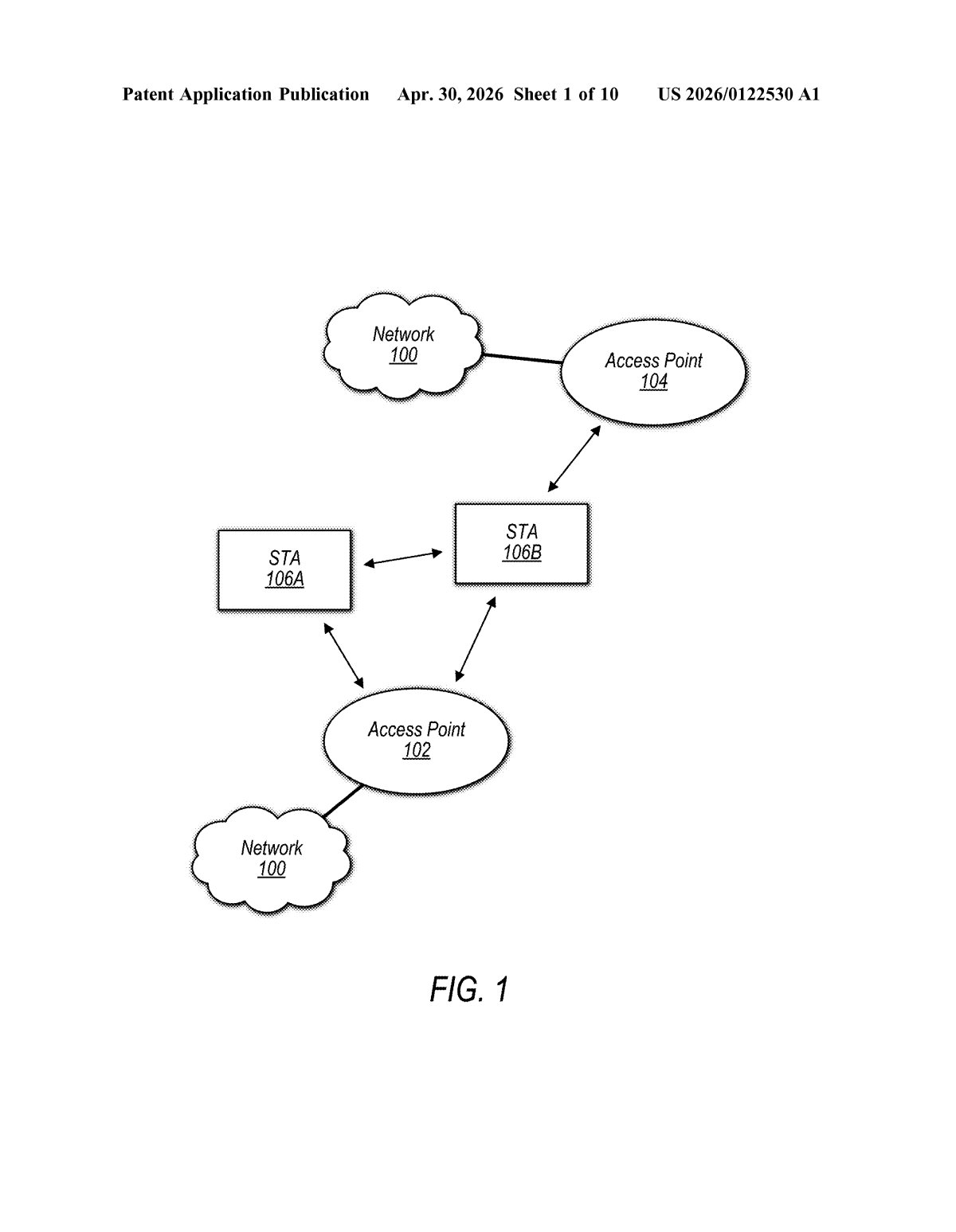
What Apple's enhanced Wi-Fi buffer reporting actually does
Imagine you're at a packed stadium trying to upload a video. Your phone is connected to a Wi-Fi access point, but so are thousands of other people. Your phone has a backlog of data it's waiting to send — think of it like a line at the post office. The router needs to know how long that line is so it can schedule who gets to send data next.
The problem is that the current Wi-Fi standard has a cap on how large a queue size your device can report. If your backlog is bigger than that cap, the router just sees the maximum number — it has no idea things are actually much worse. It's like telling the post office "my line has at least 10 people" when it actually has 500.
Apple's patent describes a smarter reporting mechanism: when your device detects its queue has blown past the reportable limit, it flags this overflow condition and sends the real queue size through a different, existing slot in the Wi-Fi data packet header. The router then gets an accurate picture and can make better scheduling decisions for everyone on the network.
How Apple's BSR overflow signaling works in MAC headers
The patent centers on a feature called the Buffer Status Report (BSR) — a small piece of data a Wi-Fi device sends to an access point to say "here's how much data I'm waiting to transmit." In the current IEEE 802.11 Wi-Fi standard, the BSR lives inside the QoS (Quality of Service) control field or a dedicated BSR subfield within the MAC (Medium Access Control) header — the MAC header being the metadata envelope that wraps every Wi-Fi data frame.
The catch: the BSR field has a fixed bit width, which means it can only represent queue sizes up to a certain maximum. Once a device's buffer exceeds that ceiling, the reported number just flatlines at the cap — the access point can't tell the difference between "slightly over the limit" and "catastrophically congested."
Apple's method works in two steps:
- Detection: The device checks its buffer and recognizes the queue has exceeded the reportable limit, using the existing BSR fields as a trigger signal.
- Overflow reporting: The device then encodes the actual queue size into the A-control field (an extensible slot in the MAC header designed for additional control information), which has room to carry larger values.
This two-field approach is backward-compatible — devices that don't understand the new overflow signal can still read the standard BSR and ignore the rest.
What this means for Wi-Fi performance in crowded spaces
Wi-Fi scheduling is only as good as the information the access point has. If an access point underestimates how congested a device's buffer really is, it will allocate transmission slots poorly — causing some devices to hog airtime while others starve. Accurate buffer reporting is the unsexy foundation that makes features like OFDMA (Wi-Fi 6/7's multi-user scheduling) actually work well in dense environments like airports, offices, and apartment buildings.
For you as a user, this kind of improvement shows up not as a feature you'd ever notice directly, but as fewer stalls, more consistent throughput, and better behavior when a dozen devices are competing for the same router. It's plumbing work — but the kind that makes the whole house run better.
This is solidly unglamorous infrastructure work, and that's not a criticism. Wi-Fi performance in dense environments is a genuine, persistent problem, and the root cause is often poor scheduling information — exactly what this patent addresses. It won't make headlines, but it's the kind of low-level fix that actually improves real-world network quality.
There are more where this came from
We read every patent application Big Tech publishes and send you the ones worth knowing. Plain English, free, every week.
Want this weekly breakdown for a company we don't cover? Patentlyze Pro →