
Apple Patents a 5G Chip System for Monitoring Shared Radio Spectrum
Shared radio spectrum is a crowded place — Wi-Fi, radar, and 5G all compete for the same frequencies. Apple is patenting a way to make iPhones act as on-the-ground sensors that report exactly who's using what.
What Apple's shared spectrum monitor actually does
Imagine a busy highway where cars, trucks, and motorcycles all share the same lanes with no traffic cop. That's roughly what happens in shared radio spectrum — the slices of wireless airwaves that 5G cellular networks share with other technologies like Wi-Fi, radar systems, or satellite links. When too many devices try to use the same frequencies, signals degrade and connections slow down.
Apple's patent describes a way for your iPhone (or any 5G device) to act as a distributed spectrum sensor. The device would receive instructions from the network about which shared frequency bands to watch, quietly monitor those bands for activity from non-cellular devices, and then report its findings back to the network.
Think of it like a neighborhood watch program for radio waves. Instead of relying on a few fixed sensors, the network gets eyes everywhere a 5G device happens to be — giving carriers a much richer, real-time picture of how shared spectrum is actually being used.
How the UE detects and reports non-3GPP radio activity
The patent describes a 3GPP UE (that's the standardized term for any 5G device, like a phone or modem) that can participate in shared spectrum monitoring — a process where the device watches designated frequency bands for activity from non-3GPP radio technologies (devices that aren't part of the cellular standard, such as Wi-Fi routers, radar systems, or unlicensed-band transmitters).
The flow works in three steps:
- The device first advertises its capability to participate in monitoring — it tells the network it can do this job.
- The network responds with a measurement configuration: a measurement object (which frequencies to watch) and a reporting configuration (when and how to send results back).
- The device monitors those bands and transmits a report on what non-3GPP devices it detected using that spectrum.
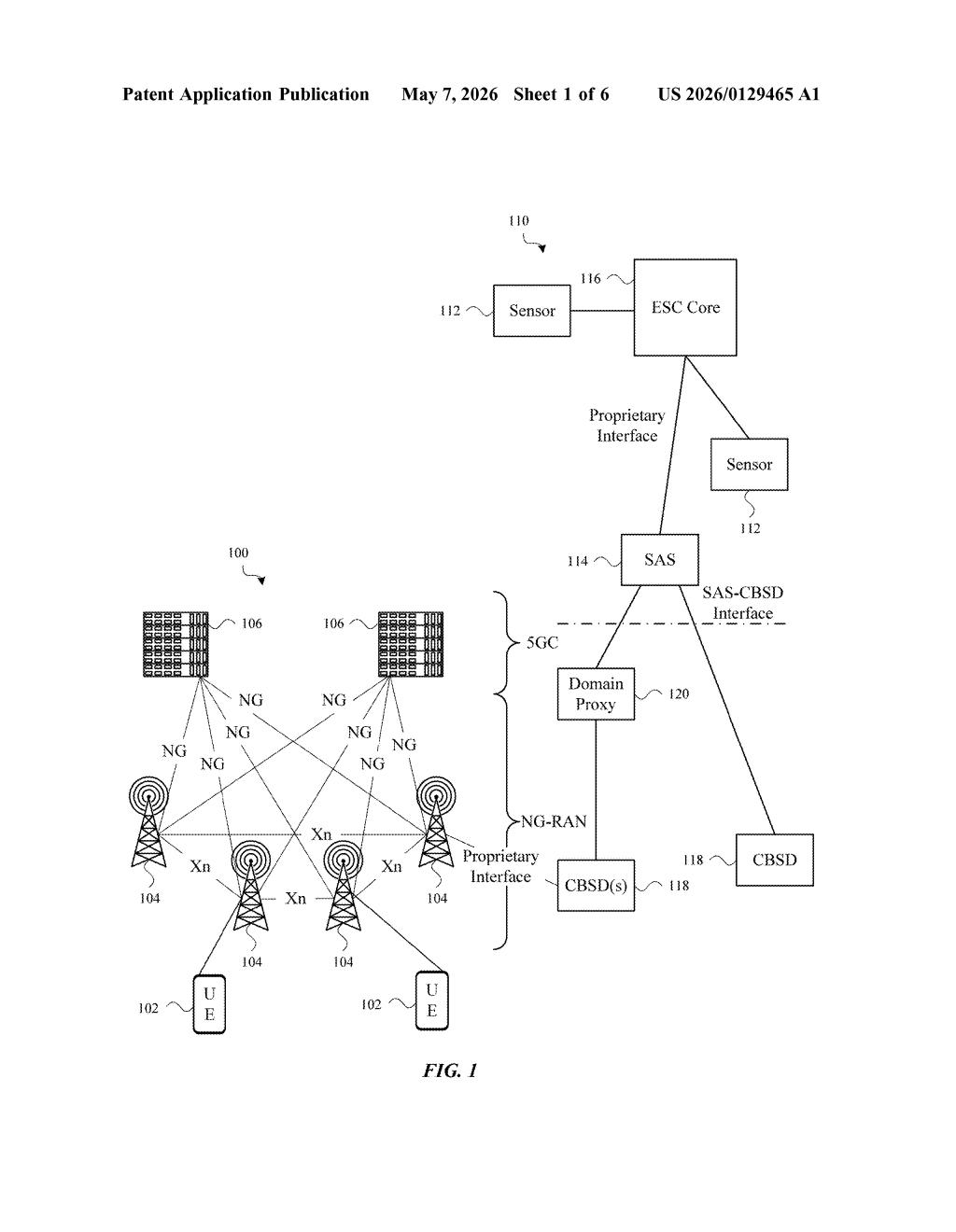
This fits into a broader 5G architecture called CBRS (Citizens Broadband Radio Service), which uses an Environmental Sensing Capability (ESC) system to protect incumbents like military radar from interference. The patent's diagram explicitly references ESC sensors, a Proxy node, and the NG-RAN (the 5G radio access network). The UE is essentially being folded into that sensing architecture as a mobile, distributed sensor node — something fixed ESC sensors can't replicate.
What this means for 5G coexistence with Wi-Fi and radar
Shared spectrum bands like CBRS (3.5 GHz) are increasingly important for private 5G networks in factories, hospitals, and campuses. Right now, monitoring who's using shared spectrum relies on fixed infrastructure sensors — which are expensive to deploy and leave geographic gaps. If iPhones and other 5G devices can contribute sensing data, carriers and enterprise network operators get a dramatically denser picture of spectrum usage at near-zero additional hardware cost.
For you as a user, the direct benefit is better, more reliable 5G in contested spectrum environments — fewer dropped connections when a nearby radar system or Wi-Fi deployment is hogging the airwaves. For Apple, embedding this capability into its modem stack positions the company's chips as first-class participants in next-generation spectrum management standards, which matters enormously as Apple develops its own in-house 5G modem.
This is a focused, standards-adjacent patent that sits squarely in the 3GPP ecosystem — not a moonshot, but genuinely useful infrastructure work. It's most interesting as a signal of Apple's in-house modem ambitions: implementing shared spectrum monitoring at the UE level requires deep integration with the baseband chip, which is exactly the kind of capability Apple needs to prove its homegrown modem can compete with Qualcomm on every dimension, not just peak speeds.
There are more where this came from
We read every patent application Big Tech publishes and send you the ones worth knowing. Plain English, free, every week.
Want this weekly breakdown for a company we don't cover? Patentlyze Pro →