
Apple Patents Smarter 5G Beam Selection to Slash Network Connection Delays
Every time your phone connects to a 5G tower, it's quietly auditioning signal beams and picking one to use. Apple wants to make that audition much smarter — and much faster.
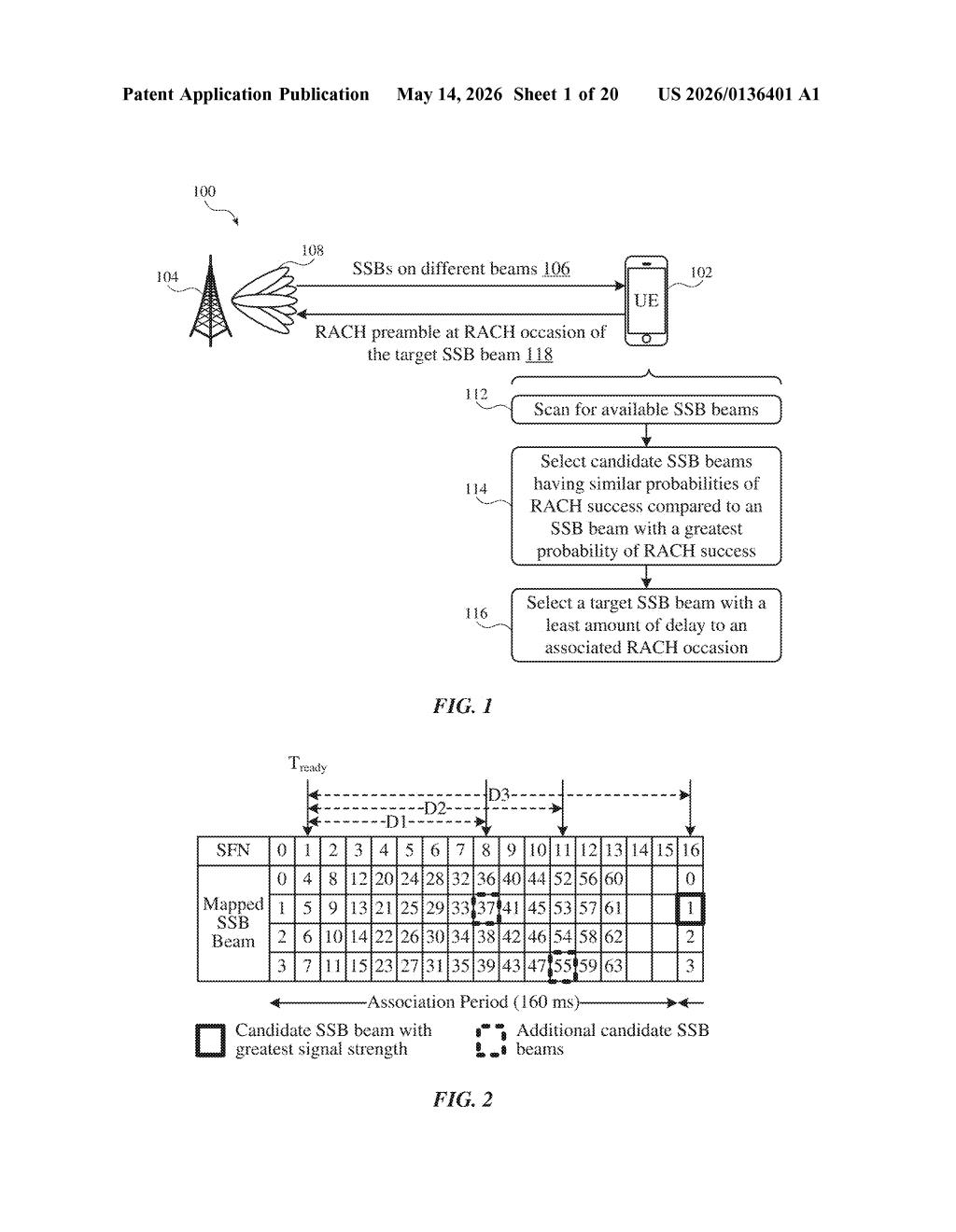
What Apple's SSB beam-selection trick actually does
Imagine you're at a crowded stadium and your phone is trying to connect to a 5G cell tower. The tower is broadcasting several directional signal beams, like spotlights sweeping across the crowd, and your phone has to pick one. Right now, most phones just grab the strongest beam available. But the strongest beam isn't always the fastest way to get connected.
Apple's patent describes a two-step approach. First, your phone identifies all the beams with roughly similar signal strength — strong enough that any of them would give you a good connection. Then, instead of stopping there, it picks the specific beam whose scheduled connection slot (called a RACH occasion) is coming up soonest. The result: you get on the network faster, even if you didn't grab the technically "best" beam.
This matters most in moments when speed counts — switching cells as you move, reconnecting after a call drop, or that frustrating pause when you walk into a building. Apple is essentially teaching your phone to be a smarter opportunist.
How Apple's baseband picks the fastest RACH occasion
The patent targets a specific bottleneck in 5G network access called the Random Access Channel (RACH) procedure — the handshake your device performs every time it needs to register with a cell tower. Each directional Synchronization Signal Block (SSB) beam broadcast by the tower is paired with a scheduled RACH occasion, a specific time slot when your device can send its connection request.
The conventional approach picks the beam with the highest RSRP (Reference Signal Received Power) — essentially the loudest signal — and then waits for that beam's RACH occasion, however far away it might be. Apple's method adds a second filtering step:
- Scan all available SSB beams and measure their signal strength.
- Filter down to candidate beams whose RSRP falls within a defined threshold of the strongest beam — meaning they're close enough in quality that success probability is similar.
- From that candidate pool, select the target beam whose associated RACH occasion arrives soonest.
- Transmit the RACH preamble (the initial connection request) at that earliest slot.
The key insight is that within that quality-equivalent candidate set, the differences in connection reliability are negligible. So you might as well take the one that gets you on the network fastest. The threshold value that defines the candidate pool is tunable, giving the baseband flexibility to balance quality versus speed depending on conditions.
What faster beam selection means for your 5G experience
For everyday users, this is about shaving off the invisible lag that happens when your phone switches towers — during a commute, in an elevator lobby, or at a packed venue. Those fractions of a second of RACH delay add up noticeably in real-time apps like voice calls, video, and gaming. A smarter beam selection algorithm means fewer dropped handshakes and faster reconnects without sacrificing signal quality.
From Apple's hardware strategy perspective, this is the kind of low-level baseband optimization that becomes increasingly important now that Apple is developing its own 5G modem chips. Owning the modem means owning the algorithms that run on it — and patents like this one sketch out the playbook Apple intends to bake into its silicon.
This is unglamorous but genuinely useful work. Baseband latency optimizations rarely get headlines, but they're exactly the kind of thing that separates a modem that 'just works' from one that feels slightly laggy in the real world. The timing — as Apple rolls out its own in-house modem — makes this more than a routine standards filing.
There are more where this came from
We read every patent application Big Tech publishes and send you the ones worth knowing. Plain English, free, every week.
Want this weekly breakdown for a company we don't cover? Patentlyze Pro →