
Apple Patent Uses UWB Technology to Verify Location Before Sensitive Data Transfers
Apple is patenting a system that won't hand over your data until it physically confirms where you are standing, using the same ultra-precise radio technology already inside the iPhone for AirDrop and car keys.
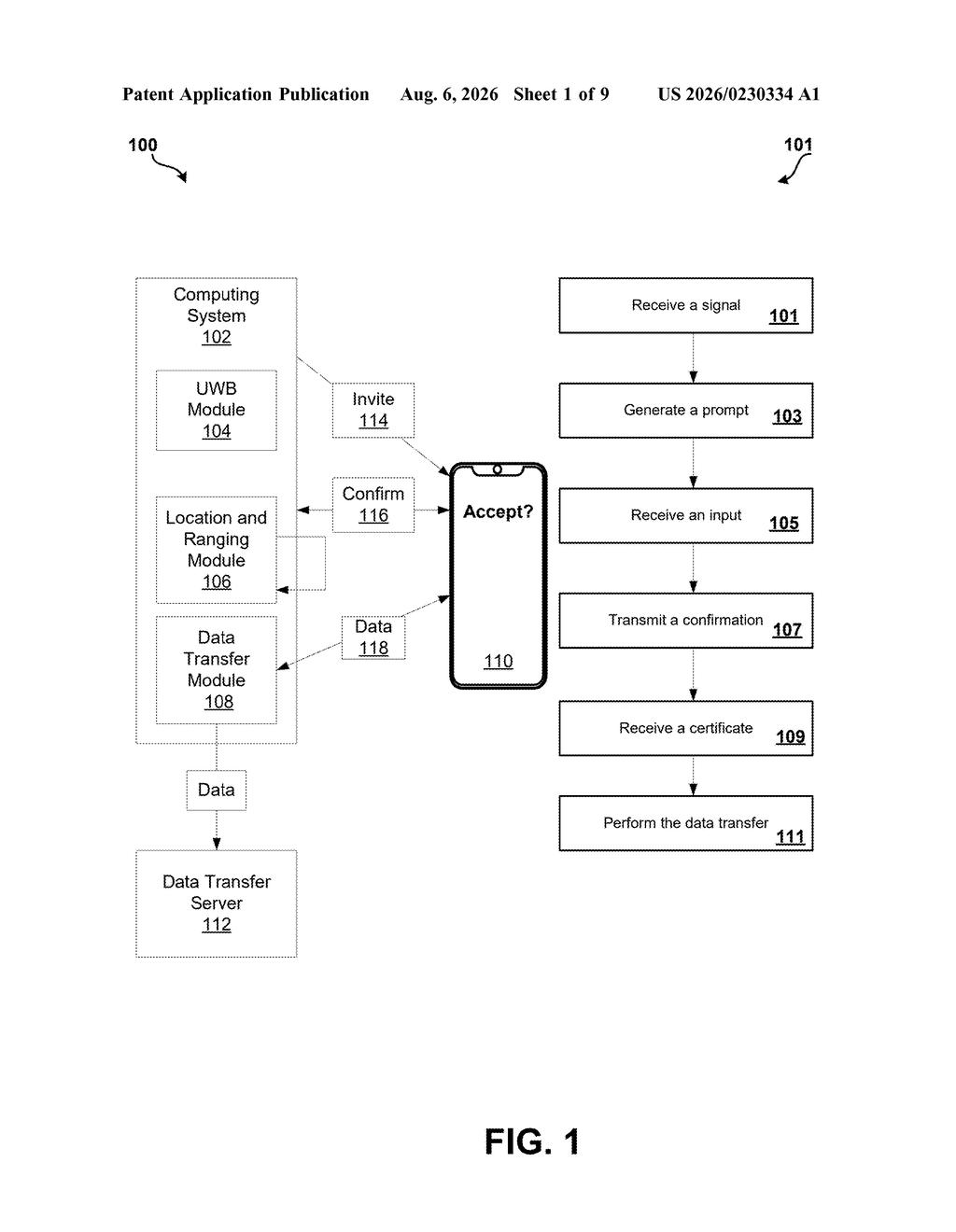
What Apple's distance-aware data transfer actually does
Imagine walking up to a kiosk at an airport to pick up your boarding pass. Before anything transfers to your phone, the kiosk needs to know that your phone is right there in front of it, not across the room or outside the building. Apple's patent describes exactly that kind of check.
The system uses Ultra Wideband (UWB), a short-range radio technology that can pinpoint your device's location to within centimeters, not just meters. When you tell your phone you want to transfer data, it sends a signal to the nearby terminal. The terminal then uses UWB to measure exactly how far away your phone is and confirms it's really you before opening a secure, encrypted connection.
Only once that physical proximity check passes does the actual data move. Think of it as a bouncer who checks your face and your ID before letting you in, rather than just waving you through based on a password alone.
… transmitting, by the application executed on the user device, a confirmation response to the computing system via UWB, the confirmation response comprising a first key; receiving, by the application executed on the user device, a certificate from the computing system via UWB …
Translation: The phone sends a security key over ultra wideband and receives a signed certificate back.
How UWB ranging triggers the encrypted handshake
The patent describes a two-step process: a location verification step using UWB radio, followed by a secure encrypted data transfer over a channel that only opens once the location check passes.
Here is how the sequence works:
- Your phone enters a data-transfer mode when you trigger it (a tap, a button press, or an app prompt).
- It sends a confirmation response to a nearby computing system over UWB, including a cryptographic key (essentially a unique digital lock).
- The computing system runs a ranging and localization process (UWB can measure distance to within a few centimeters using the time it takes radio pulses to travel) to confirm your phone is physically close and matches what it expects.
- If the check passes, the system sends back a signed certificate that combines your key with its own, establishing a mutually authenticated secure channel.
- The actual data then travels over that channel, encrypted end-to-end.
The key innovation is that the cryptographic handshake (the exchange of keys that sets up encryption) is tied directly to the physical ranging result. You can't spoof proximity remotely because the UWB timing measurement is baked into the trust chain.
… performing, by the computing system and using the UWB protocol, ranging and localization operations on the confirmation signal such that the computing system confirms that the confirmation signal originates from the user device.
Translation: The system uses ultra wideband signals to physically verify the exact location of the device before proceeding.
What this means for tap-to-pay and device sharing
This patent addresses a real weak spot in wireless data transfers: the fact that most systems authenticate who you are but not where you are. A stolen credential or a relay attack (where a bad actor intercepts your phone's signal from a distance and replays it to a terminal) could potentially fool a password-only system. Tying authentication to physical location makes that class of attack much harder.
For Apple Pay, digital ID cards, health records, or transit passes already living in the Wallet app, this kind of location-locked transfer could add a meaningful layer of assurance. It also aligns with Apple's existing UWB work in AirDrop, Precision Finding for AirTags, and the digital car key standard, suggesting this is less a standalone idea and more a building block for a broader secure-proximity platform.
This is a genuinely useful patent that solves a real problem in a clean way. Binding encryption keys to physical location measurements is not new in academic security research, but seeing Apple formalize it in a patent tied to Wallet-style data transfers suggests the company is serious about making proximity a first-class security primitive, not just a convenience feature. It deserves attention from anyone thinking about where mobile payments and digital ID go next.
There are more where this came from
We read every patent application Big Tech publishes and send you the ones worth knowing. Plain English, free, every week.
The drawings
9 drawing sheets from US 2026/0230334 A1 · click any drawing to enlarge


Want this weekly breakdown for a company we don't cover? Patentlyze Pro →
Be the first to weigh in