
Apple Patents a Sliding Optical Enclosure for Head-Mounted Displays
Apple's latest patent digs deep into the physical plumbing of a VR/AR headset — specifically, how the lens assembly slides into position to line up perfectly with each user's eyes.
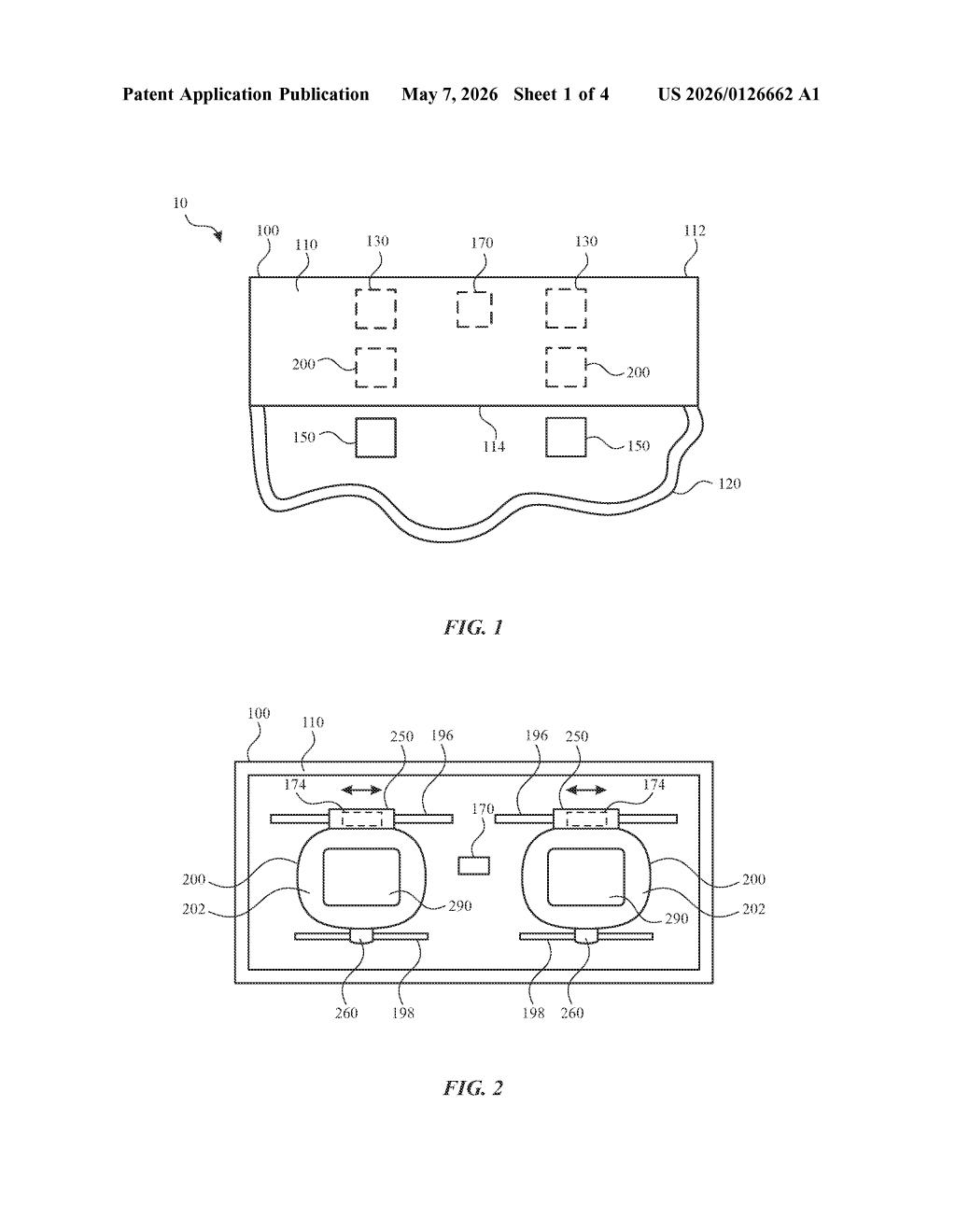
What Apple's lens barrel and guide-rod system actually does
Imagine putting on a VR headset and the lenses automatically shift to sit right in front of your eyes — not just an average user's eyes. That's a real engineering challenge, because everyone's eyes are spaced differently.
This patent describes a specially designed optical enclosure — essentially a tube-and-mount assembly that holds the display lens and lets it slide along a rod to reach the correct position. The barrel that surrounds the lens is tapered (wider at one end), and its inner surface is coated to reduce internal reflections so the image looks crisper and more contrasted.
The sliding mechanism uses small brackets called hangers that grip a guide rod. Their inner surfaces are coated with a low-friction material so the whole lens assembly glides smoothly rather than grinding or sticking. It's precise hardware work aimed at making interpupillary distance adjustment — matching the lens to your eye spacing — feel seamless.
How the tapered barrel and hanger coatings work together
The patent claims a two-part mechanical system housed inside a head-mounted device (like Apple Vision Pro or a successor).
The barrel is a hollow tube that cradles the display. Its channel is tapered — narrower at the display end and wider toward the user's eye — which is a deliberate optical geometry choice. The inside of that barrel is coated with a low-reflectance material (think matte black anodizing or similar) to suppress stray light bouncing around inside. That suppression raises the relative contrast ratio of the display, meaning blacks look blacker and the image pops more.
The hangers are bracket arms that extend from the barrel and wrap around guide rods running through the headset chassis. These rods act as rails, and the optical enclosure slides along them to adjust position — most likely for interpupillary distance (IPD) adjustment, matching the lens to the space between a specific user's pupils.
The hanger channels are coated with a low-coefficient-of-friction material (a slippery coating, like PTFE or a similar dry-film lubricant) so the enclosure glides without stick-slip judder. Both the barrel and hangers are specified as metallic, which gives rigidity and dimensional stability that plastic couldn't reliably provide at this tolerance level.
What this means for future Apple Vision headset comfort
For a device like Apple Vision Pro — which already supports motorized IPD adjustment — the quality of that sliding mechanism directly affects how well the display aligns with your eyes. Poor alignment means blurry edges, eye strain, and a degraded sense of immersion. Apple is clearly investing in the mechanical precision that makes that adjustment reliable and smooth.
The anti-reflective barrel coating is equally practical: internal lens flare and ghosting are known image-quality killers in compact optical systems. By treating this as a first-party hardware problem (rather than a software correction), Apple can improve perceived display quality without asking the GPU to do extra work. These are the kinds of under-the-hood refinements that distinguish a premium headset from a budget one.
This is deep-in-the-weeds manufacturing detail — not a headline feature, but exactly the kind of precision engineering that separates Apple's headset from cheaper competitors. The combination of anti-reflective barrel coatings and low-friction guide rod hangers in a single metal unibody enclosure suggests Apple is sweating the mechanical tolerances hard. If you care about display quality in future Apple Vision hardware, these are the unglamorous parts that make it real.
There are more where this came from
We read every patent application Big Tech publishes and send you the ones worth knowing. Plain English, free, every week.
Want this weekly breakdown for a company we don't cover? Patentlyze Pro →