
Samsung
Samsung · Display · Filed Sep 5, 2025 · USPTO published May 21, 2026 · May 21 release
Samsung Patents a Dual-Pixel Architecture for High Dynamic Range Image Sensors
Samsung is patenting an image sensor layout that uses two fundamentally different pixel types side by side — one tuned for sensitivity, the other for handling bright light without blowing out. It's a hardware-level approach to the dynamic range problem that every smartphone camera struggles with.
- Publication number
- US 2026/0143252 A1(US20260143252A1)
- Applicant
- SAMSUNG ELECTRONICS CO., LTD.
- Filed · Published
- Sep 5, 2025 · May 21, 2026
- Inventors
- Sungyoon MIN, Jeongjin Cho
- Status when we published
- Waiting for an examiner
- Document
- 20 claims
- US classification
- 348/308
How Samsung's two-pixel design captures bright and dark scenes
Imagine you're photographing a sunset: the sky is blazingly bright, but the foreground is in deep shadow. Your camera has to make a painful tradeoff — expose for the sky and lose the shadows, or expose for the shadows and blow out the sky. Most phones fake their way around this using software tricks that stitch multiple shots together.
Samsung's patent describes a sensor where two different pixel types are physically built into the same chip. The first type is designed for capturing detail in low-light or normal conditions — it uses a special capacitor that can be switched in or out to control how sensitive the pixel is. The second type is built to handle overflow: when a scene is too bright, excess charge spills into a dedicated capacitor rather than washing out the reading entirely.
By reading both pixel types at the same time, the sensor gets a wide-range picture of a scene in a single exposure — without relying entirely on software to piece it together afterward. Think of it as hardware HDR baked into the sensor itself.
How gain control and overflow capacitors split the workload
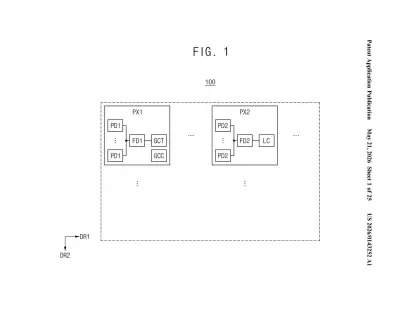
The patent describes a pixel array split into two spatially separated groups, each with a different circuit architecture optimized for a different part of the exposure range.
First pixels (the low-to-medium light specialists) each contain:
- Multiple photodiodes sharing a single floating diffusion region (the charge-collection node)
- A reset transistor and one or more gain control transistors wired in series between the power supply and that node
- One or more gain control capacitors connected to ground, sitting between the reset and gain transistors — these can be switched in to absorb extra charge and effectively reduce pixel gain, giving the circuit a wider operating range
Second pixels (the highlight-handling specialists) each contain:
- Their own set of photodiodes sharing a floating diffusion region
- A simpler reset transistor connected directly to a dedicated reset power supply voltage
- A lateral overflow integration capacitor (LOFIC) connected to a separate capacitor power supply — this structure catches excess photocharges that would otherwise saturate the pixel, dramatically extending how much light the pixel can handle before clipping
The two pixel types working together let the sensor capture detail across a much wider luminance range in a single readout cycle, rather than requiring multiple exposures.
What this means for Samsung's next camera sensors
Dynamic range is one of the last frontiers in mobile imaging, and the main battleground has been software — computational photography pipelines that merge bracketed exposures. A sensor that handles more of this challenge at the hardware level means less processing latency, fewer motion artifacts from multi-frame stitching, and potentially better performance in video where you can't always take multiple exposures.
For Samsung, this is directly relevant to its ISOCELL sensor lineup, which feeds both its own Galaxy phones and a wide swath of Android competitors. A dual-architecture pixel array like this could show up in a future high-end sensor binned for flagship use, or trickle down as a cost-effective HDR solution for mid-range devices. Either way, it signals Samsung is looking to solve dynamic range deeper in the stack.
Source: US 2026/0143252 A1 at the USPTO (PDF). Full patent text and figures are in the official publication.
Get our take in your Top Stories
Liked this breakdown? Add Patentlyze as a preferred source on Google, and our plain-English take shows up more often in your Top Stories the next time Samsung patent news breaks.
Add Patentlyze on Google
One click.
There are more where this came from
We read the new patents from Big Tech, carmakers and more and send you the ones worth knowing. Plain English, free, every week.
More from Samsung
All 1,662 Samsung patents →
More in Cell phone
All 496 Cell phone patents →
Sony
Patent: Drone Cameras Now Self-Correct Alignment Using a Guided Phone Screen
Qualcomm
Qualcomm Patents Presence Detection That Adapts to Foldable Phone Angles
Apple
Apple Patents a Hinge That Keeps a Foldable Phone Folding Smoothly
Qualcomm