
Samsung Patent Uses Eye-Tracking to Rewrite Your View in Real Time
When you wear an XR headset and turn your head, the image can lag just enough to feel wrong. Samsung's latest patent describes a system that watches your eyes, figures out exactly where you're focused, and rebuilds that part of the image before you ever notice a problem.
What Samsung's eye-tracking image fix actually does
Imagine putting on a VR or AR headset and looking at a painting on a virtual wall. The instant you shift your gaze, your brain expects the image to update perfectly, but the display's rendering pipeline is always playing catch-up. That tiny mismatch is why some headsets feel slightly "off" even when they're technically working fine.
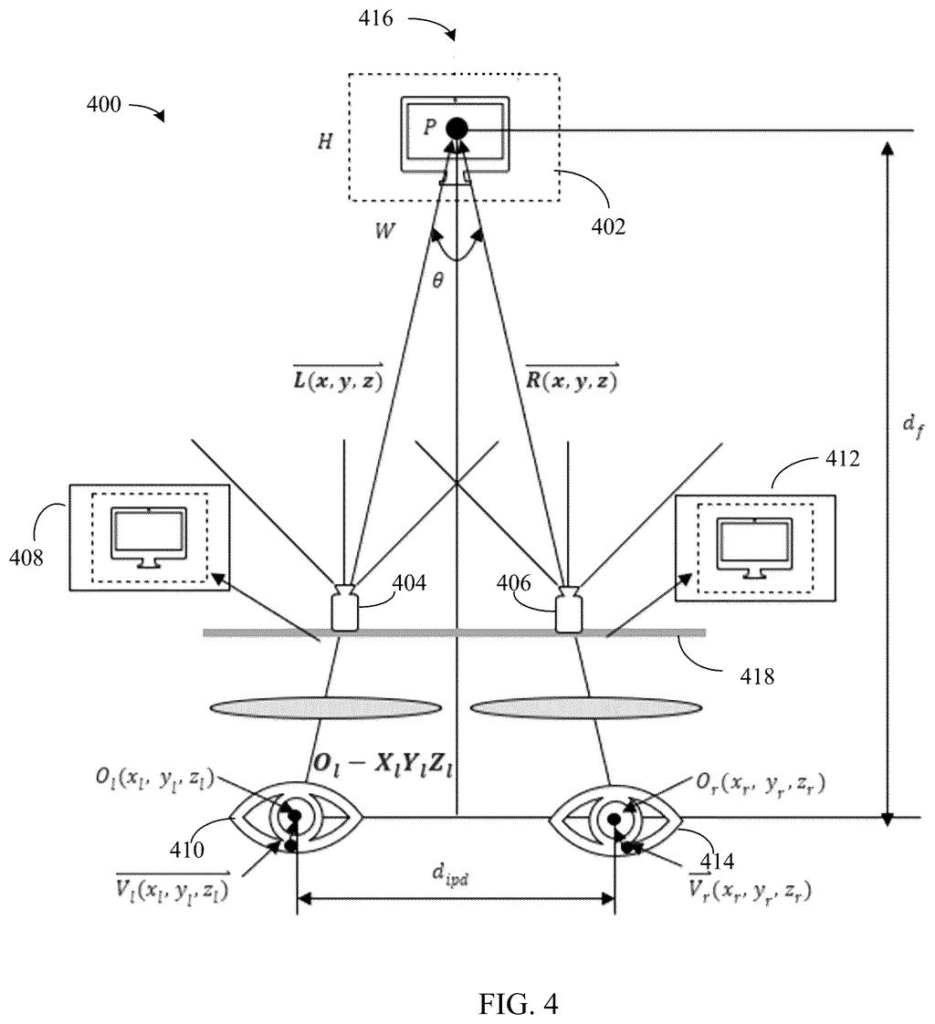
Samsung's patent describes a system that tracks where your eyes are focused in a scene, then treats that specific area as its top priority. It uses sensors to build a simple geometric map of that focus zone, essentially figuring out the flat surface your gaze has landed on. Then, instead of waiting for a full new frame, it mathematically shifts and stretches the existing image to match where your head is about to be.
The result is that the part of the scene you're actually looking at stays sharp and correctly positioned, even as your head moves. It's a targeted fix rather than a brute-force one, which matters a lot for the battery life and processing power inside a wearable device.
How the plane reconstruction and reprojection pipeline works
The patent covers a pipeline with several distinct stages that run in sequence on the device's processor.
- Eye behavior capture: Sensors (likely cameras and an eye tracker) record where the user is looking within the current image frame, producing what the patent calls "user eye behavior data."
- Focus region identification: The system marks the portion of the frame the user is actually gazing at, ignoring the periphery for this particular operation.
- Plane reconstruction: Within that focus region, the processor fits a flat geometric surface (a plane) to the scene. It calculates two key properties: the surface normal (which direction the plane is facing) and its origin point in 3D space.
- Homography mapping: A homography is a mathematical transformation (think of it as a stretching, tilting, and shifting formula) that maps the pixels from the original image onto the reconstructed plane.
- Head-pose prediction and reprojection: The system predicts where the user's head will be a few milliseconds in the future, then adjusts the mapped image to match that anticipated position, generating a corrected "modified image frame" for rendering.
The key insight is that doing this only for the gaze-locked focus region is far cheaper computationally than reprojecting the entire frame, making it practical for a device running on a battery.
What this means for Samsung's XR headset ambitions
For anyone who has tried a VR or AR headset and felt a nagging sense that the image isn't quite keeping up with their head, this is exactly the kind of fix that addresses it. The technique targets the area your brain scrutinizes most carefully, which means perceptual quality goes up without requiring a massive jump in raw processing power.
Samsung has been building toward its own XR headset platform, and patents like this one show the kind of display-quality work that happens well before a product ships. If this approach makes it into hardware, it could help Samsung close the comfort gap with more established headset makers, particularly in scenarios where users are reading text or focusing on a specific object in a mixed-reality scene.
This is genuinely interesting work in a problem space that every XR headset maker is wrestling with. Targeting the reprojection fix specifically at the gaze region is a practical engineering decision, not just a theoretical one, and it suggests Samsung is thinking carefully about the power budgets of wearable hardware. It won't make headlines on its own, but it's the kind of foundational patent that matters when a company is building a platform.
There are more where this came from
We read every patent application Big Tech publishes and send you the ones worth knowing. Plain English, free, every week.
The drawings
8 drawing sheets from US 2026/0220845 A1 · click any drawing to enlarge


Want this weekly breakdown for a company we don't cover? Patentlyze Pro →
Be the first to weigh in