
Qualcomm Patent Rebuilds Only the Changed Parts of a 3D Scene
Building a live 3D map of the world around you is expensive work, especially on a phone or headset. Qualcomm's new patent cuts that cost by figuring out which parts of the scene have actually moved, and only redrawing those.
How Qualcomm's selective 3D rebuilding actually works
Imagine you're wearing AR glasses that build a 3D map of your living room in real time. Every time you move your head, the device has to figure out what the room looks like from your new angle. Doing that for the entire room, every single frame, burns a lot of processing power.
Qualcomm's patent describes a way to cheat, in a good sense. Instead of re-scanning everything, the system chops the scene into small 3D cubes, then checks whether each cube looks meaningfully different from the last time it was scanned. If a cube hasn't changed much, it gets left alone. Only the cubes that have changed get rebuilt.
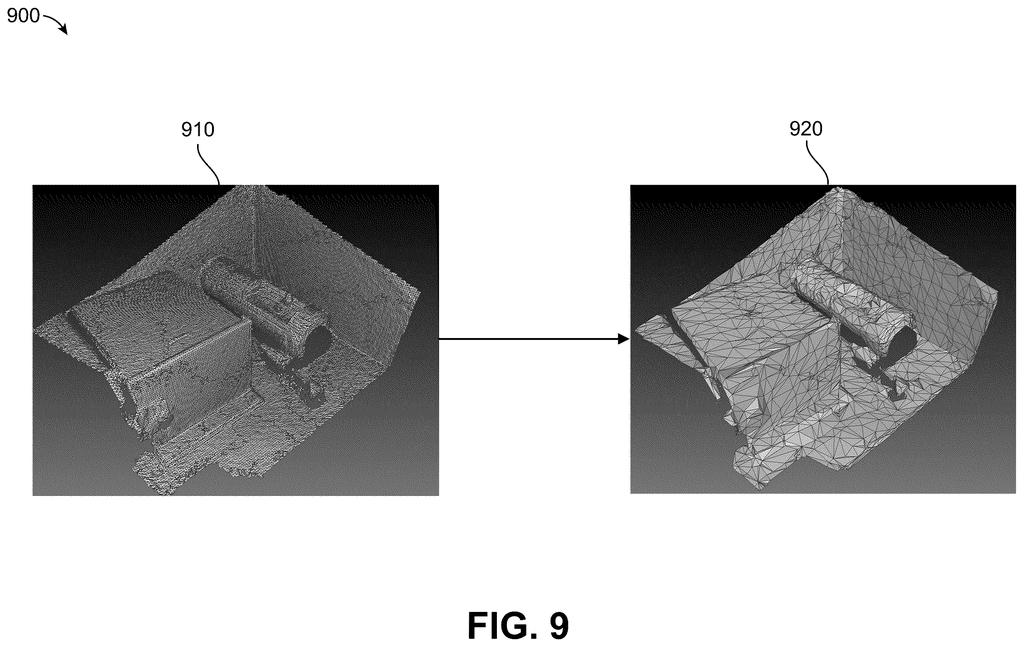
Once those changed chunks are rebuilt into a 3D shape, the system then simplifies that shape further, shaving off unnecessary detail. The result is a live 3D map that stays accurate without overwhelming the device's processor.
How the voxel comparison and mesh pipeline fit together
The system works in four main steps:
- Voxel block selection: The scene is divided into voxel blocks (think of voxels as 3D pixels, small cubes that tile space). A depth sensor and camera-pose data (the device's position and orientation in space) determine which blocks are currently visible.
- 3D representation values: For each block, the system computes a numeric value representing the geometry at that location. Qualcomm's filing points to TSDF (Truncated Signed Distance Function) style values, which encode how far each point is from the nearest surface.
- Hysteresis comparison: Each block's current value is compared against its previous value. Only blocks whose distance difference exceeds a set threshold are flagged as changed. This hysteresis approach (borrowing a term from electronics, meaning a system that only reacts when change crosses a meaningful threshold) prevents unnecessary rebuilds from tiny sensor noise.
- Mesh generation and simplification: The flagged blocks are converted into a 3D mesh (a surface made of triangles). A second pass then simplifies that mesh, reducing triangle count while preserving the overall shape.
The end product is a continuously updated, computationally lean 3D model of the environment, suitable for real-time use on edge hardware like a phone or headset chip.
What this means for AR headsets and on-device robotics
On-device 3D reconstruction is a core requirement for AR glasses, autonomous robots, and spatial computing generally. The bottleneck has always been compute: rebuilding full scene geometry every frame is feasible on a server rack, not on a chip strapped to your face. By limiting reconstruction to only the parts of the scene that actually changed, this approach makes real-time mapping practical on the kind of power-constrained hardware Qualcomm supplies for devices like the Meta Quest or XR headsets built on Snapdragon platforms.
The mesh simplification step matters equally. Downstream systems, like a collision-avoidance engine on a robot or a rendering pipeline in an AR app, work faster when the geometry they consume has fewer triangles. Less data, processed faster, with no meaningful loss in accuracy is the core value proposition here.
This is solid, unglamorous engineering work. The hysteresis trick for skipping unchanged voxels is a well-understood idea in signal processing, and applying it to 3D reconstruction is a sensible optimization rather than a conceptual leap. Its real value is in making Qualcomm's chips look attractive for AR and robotics platforms where every milliwatt counts. Don't expect a press release, but do expect this kind of technique to show up in a future Snapdragon XR platform.
There are more where this came from
We read every patent application Big Tech publishes and send you the ones worth knowing. Plain English, free, every week.
The drawings
23 drawing sheets from US 2026/0212605 A1 · click any drawing to enlarge


Want this weekly breakdown for a company we don't cover? Patentlyze Pro →
Be the first to weigh in