
Google Patents a Way for AI to Stop Guessing and Grab the Right Tool
Every AI chatbot occasionally just makes things up because it tries to answer everything from memory. Google's new patent describes a system that routes a question to the right specialized tool instead, the same way a receptionist sends you to the right department rather than guessing.
How Google stops its AI from making up answers
Every time you ask an AI assistant a question, it dips into everything it was trained on and tries to piece together an answer on the spot. That works fine for trivia, but for anything that needs a calculator, a database, or a real-time lookup, the AI is essentially freestyling, which is how you get confidently wrong answers.
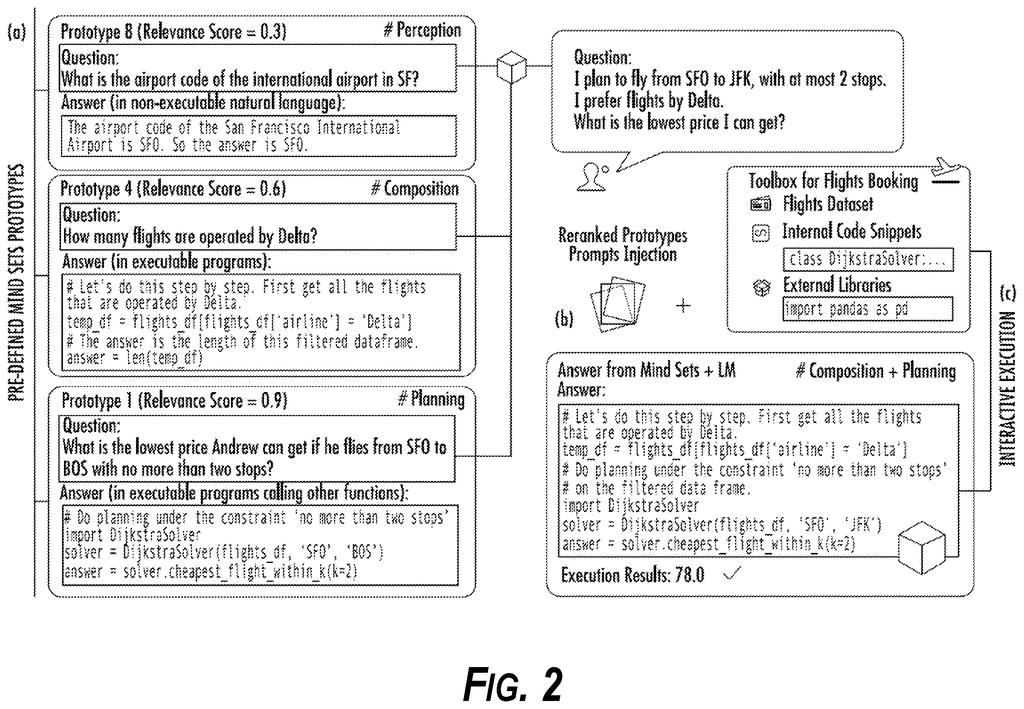
Google's patent describes a system that changes that dynamic. When a question comes in, the system converts it into a kind of numeric fingerprint and compares it to a library of previous questions whose answers required specific tools. If your question looks a lot like one that previously needed a calculator, the system routes it to the calculator, not to the model's imperfect memory.
The end result is an AI that knows when to reach for a tool rather than winging it. That makes answers more reliable without requiring the underlying AI to be retrained every time a new tool is added.
… current language models rely heavily on internal knowledge to solve all downstream tasks, which causes hallucination and ungrounded answers.
Translation: AI models usually just guess the answer from memory, which leads to completely made up facts.
How the similarity search picks the right tool
The patent describes a method called similarity-based tool routing. Here's how it works step by step:
- Query embedding: When a user submits a question, the system converts it into a dense vector (think of it as a long list of numbers that captures the meaning of the question mathematically) inside a space called a latent embedding space.
- Similarity search: The system then searches a stored library of previous query-response pairs whose vectors sit nearby in that same mathematical space. Proximity in the space means similarity in meaning.
- Prompt construction: The closest matching past examples are bundled with the new question into a structured prompt. Those examples effectively show the language model how similar questions were answered before, including which tool was used.
- Model response: The language model reads the enriched prompt and produces an answer, guided by the examples to use the appropriate tool rather than relying solely on its training data.
The approach is a form of retrieval-augmented prompting (fetching relevant past examples at query time and folding them in) specifically aimed at tool selection rather than just fact retrieval. It sidesteps the hallucination problem for structured tasks without requiring the model itself to be updated every time a new tool is added.
… performing, by the computing system, a similarity search for the query embedding within the latent embedding space to identify one or more previously-defined embeddings associated with one or more previously-defined query-response pairs; …
Translation: The system searches a mathematical space to find past examples that look similar to the current question.
What this means for AI that handles real-world tasks
For everyday users, this is about getting fewer confidently wrong AI answers. Tasks that need precise computation, live data, or structured lookups are exactly where current AI assistants stumble most visibly. A routing layer that automatically identifies those tasks and hands them off to the right tool could make AI assistants far more dependable for anything beyond casual conversation.
For developers building on top of AI platforms, the broader implication is that adding a new capability (a new tool) doesn't require retraining the whole model. You add it to the routing library and the similarity engine starts directing appropriate questions to it. That's a much cheaper and faster way to expand what an AI system can do, and it points toward modular AI architectures where the language model is a coordinator as much as a knowledge store.
Google's 21st filing we've tracked since May on AI models working together, after a document task picker and natural-sounding audio dialogue, extends the pattern to yet another task.
Claim 1 is broad. It covers any system that converts a query into an embedding, searches similar past examples, builds a prompt from those examples, and returns a model response. That description covers the core pattern behind a huge range of existing retrieval-augmented generation (RAG) systems, and if granted as written, it could create friction for any tool-routing implementation that follows this general flow.
The key question a patent examiner will ask is whether this is meaningfully different from prior art in retrieval-augmented AI, which has been published extensively since at least 2020. The claim adds the specific framing of routing queries to "pre-defined skills" (tools), but the underlying mechanics of embedding, nearest-neighbor search, and few-shot prompting are well-documented in academic literature.
That said, Google has been filing around AI tool use and agent frameworks for several years, and this fits a recognizable pattern of staking out IP around the infrastructure layer of AI agents. Whether the claim survives examination depends entirely on what prior art the examiner finds, but as a strategic filing it signals where Google sees the architectural center of AI assistants heading.
There are more where this came from
We read every patent application Big Tech publishes and send you the ones worth knowing. Plain English, free, every week.
The drawings
12 drawing sheets from US 2026/0277967 A1 · click any drawing to enlarge


Want this weekly breakdown for a company we don't cover? Patentlyze Pro →