
Google Patents a Shared AI Assistant Session That Catches Latecomers Up Automatically
What if your AI assistant could hold a conversation with a whole group at once, and automatically brief anyone who showed up late? That is exactly what Google's latest patent filing describes.
What Google's group AI assistant session actually does
Every time a group of friends tries to use a voice assistant together, one person ends up being the unofficial spokesperson while everyone else waits. Google's new patent filing is designed to fix that by letting multiple people share a single AI assistant session across their own devices.
Here's how it works in practice: your group starts a session, picks one person's device to handle the main assistant, and everyone can ask questions or make requests. Each person hears the response through their own device's speaker or headphones. The assistant stays aware of who's in the group the whole time.
The part that stands out is what happens when someone joins late. Instead of being lost, that new person gets an automatic summary of everything the group has already asked and discussed. Think of it like a meeting recap, delivered instantly by the AI the moment you connect.
… determining, subsequent to receiving one or more of the inputs from one or more of the users, that an additional user has joined the group session; and causing, in response to determining that the additional user has joined the group session, a summary of the group session to be provided to the additional user by the group automated assistant.
Translation: When a new person joins late, the AI automatically gives them a recap of what they missed.
How the assistant syncs audio and summaries across devices
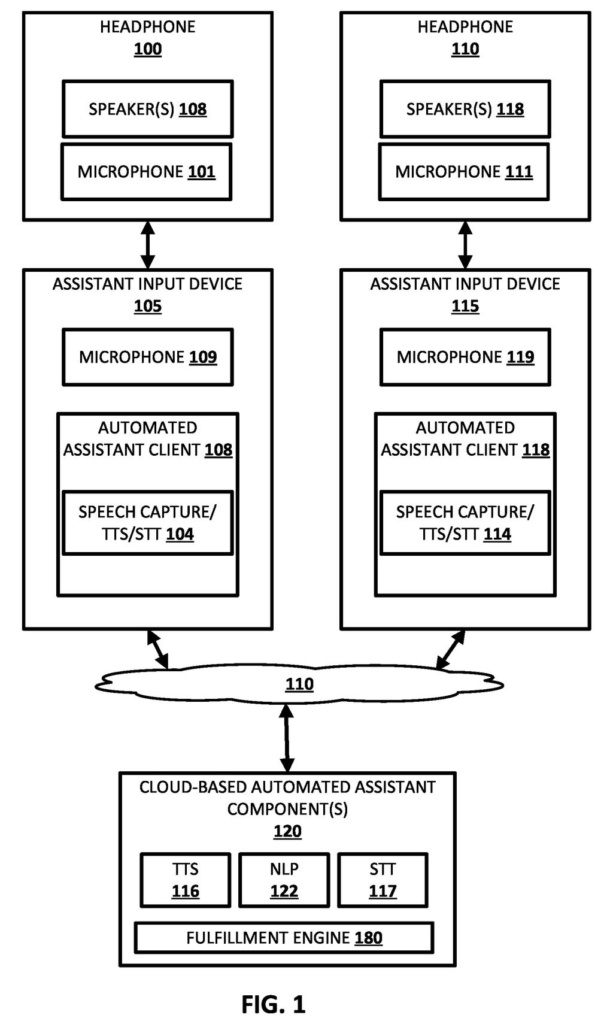
The system works by designating one device in the group as the primary host for the automated assistant. That device captures audio from its microphone, processes the request, and generates a spoken response through its own speaker.
At the same time, the host device sends fulfillment data (essentially the answer, in a structured format) to the automated assistants running on every other participant's device. Each of those assistants then renders its own local audio response, so everyone hears the reply through their own speaker or headphones simultaneously.
The patent's first independent claim focuses specifically on what happens when a new user joins mid-session. The system detects the new arrival and automatically triggers the group assistant to produce a session summary for that person. This is a distinct, discrete action, not just replaying the conversation audio.
The claim does not specify what the summary contains or how long the session can run, which keeps the scope fairly broad. It covers any scenario where a multi-user group session exists, inputs are received, and a latecomer joins and needs to be briefed.
What this means for Google Assistant's next chapter
For consumers, this filing points toward a version of Google Assistant designed for shared spaces, not just individual use. Right now, voice assistants are almost entirely one-person-at-a-time tools. A patent like this suggests Google is thinking about how its assistant fits into living rooms, classrooms, or group travel situations where several people all have questions at once.
The automatic catch-up summary is the most practically useful piece here. If granted and built, it would mean group AI sessions work more like a persistent conversation than a one-shot query, which is a meaningful shift in how people might interact with an assistant day-to-day.
Google's 52nd filing in the AI assistant and agent work we've tracked since May adds to a run that includes picking cloud vs on-device and self-critiquing before answering.
Claim 1 is written broadly enough to cover almost any multi-device AI session with a late-joining user, regardless of the assistant's underlying technology or the devices involved. That breadth is a double-edged thing: it makes the patent potentially powerful as a blocking tool, but it also makes it more vulnerable to challenges during examination, since the concept of syncing a group session and briefing latecomers is not exotic.
What the claim does not cover is equally telling. It says nothing about how the summary is generated, what form it takes, or how the system decides what counts as important enough to include. A competitor could build a group assistant product with a manually triggered or differently structured summary and likely stay clear of this claim as written.
The filing is a reasonable defensive move for Google in an area where group voice interaction is still genuinely unsolved. Whether this particular claim survives examination without significant narrowing is the real question.
There are more where this came from
We read every patent application Big Tech publishes and send you the ones worth knowing. Plain English, free, every week.
The drawings
5 drawing sheets from US 2026/0279357 A1 · click any drawing to enlarge


Want this weekly breakdown for a company we don't cover? Patentlyze Pro →
Be the first to weigh in