
IBM Patent Proposes Rival AI Panels to Evaluate Each Other for Ethics
IBM is patenting a system where an AI's output doesn't just get checked by one safety filter, but by a whole panel of different AI models, each trained differently, voting on whether the response passes an ethics test.
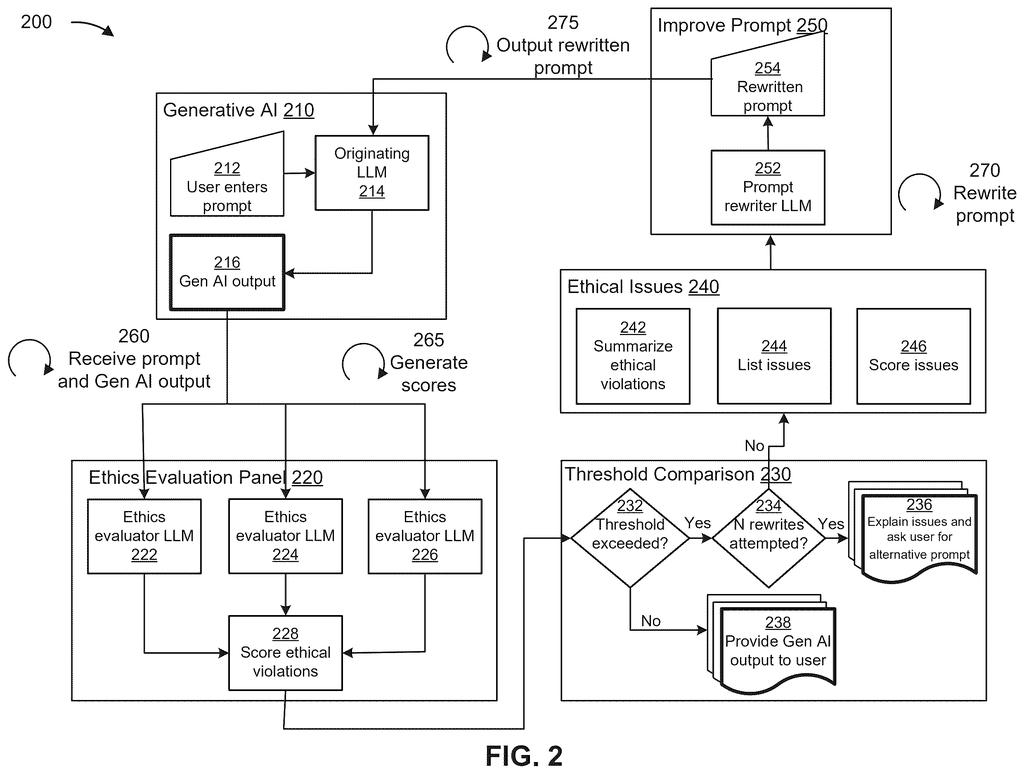
How IBM's AI-judging-AI ethics check works
Imagine asking an AI a question and, before the answer reaches you, it gets sent to a committee of other AIs for review. Each committee member has its own background and training, so they bring different perspectives. If enough of them flag a problem, the original question gets rewritten and sent back to the AI for a better answer.
That's essentially what IBM is describing here. Instead of relying on a single built-in safety filter, this system uses a diverse panel of large language models (the same kind of AI behind chatbots) to score the output for ethical issues. Each model rates how appropriate the response is.
If the scores suggest something went wrong, the system rewrites your original prompt to steer the AI toward a safer answer, then tries again. The goal is to catch problems that any single filter might miss, by getting multiple independent opinions before the response ever reaches you.
… providing, by the processor set, the output to a panel of diverse large language models (LLMs) for evaluation, wherein the panel of diverse LLMs comprises LLMs having different architectures and different training datasets; …
Translation: The system sends the AI output to a group of varied AI models to check it.
Inside IBM's multi-model scoring and prompt rewrite loop
The system sits between a user and a generative AI model, acting as an automated quality-control layer. Here's the sequence:
- A user submits a prompt and the AI generates an initial response.
- That response is forwarded to a panel of diverse LLMs (large language models), chosen specifically because they have different architectures and were trained on different datasets. Think of it like convening judges from different legal traditions rather than cloning one judge.
- Each panel member returns a score reflecting how well (or poorly) the output handles an ethical dimension, such as bias, harm, or factual integrity.
- Based on those scores and the original output, the system rewrites the user's prompt and resubmits it to the generative AI, aiming to coax a better response.
The key design choice is diversity: using models with different training backgrounds means a blind spot in one model is more likely to be caught by another. A single safety classifier can be fooled or share biases with the model it's checking; a panel with genuinely different foundations is harder to fool uniformly.
The claim covers the full loop: receive, evaluate, score, rewrite, resubmit.
The device may rewrite the prompt based on the scores and the output to generate a rewritten prompt.
Translation: The system tweaks the original instructions using feedback from the judge models.
What this means for AI safety in enterprise software
Enterprise customers buying AI tools from IBM (or anyone else) need assurance that outputs won't embarrass them legally or publicly. A single safety layer is a single point of failure. A panel-based approach raises the bar considerably, and the automatic prompt rewrite means you never have to see the bad answer or manually rephrase your question.
For IBM specifically, this fits squarely into its watsonx AI governance pitch: the idea that business AI needs auditable, trustworthy guardrails, not just speed. If this system ships in a product, it could become a selling point for regulated industries like banking, healthcare, and government contracting, where a single inappropriate AI output can carry real consequences.
This is a genuinely interesting architectural idea: using model diversity as a defense against shared blind spots is a smarter approach than stacking more layers of the same thing. The automatic prompt rewrite is the part worth watching, because it closes the loop without requiring the user to do anything. Whether IBM can make the panel fast enough to be practical in real-time applications is the open question.
There are more where this came from
We read every patent application Big Tech publishes and send you the ones worth knowing. Plain English, free, every week.
The drawings
5 drawing sheets from US 2026/0228214 A1 · click any drawing to enlarge


Want this weekly breakdown for a company we don't cover? Patentlyze Pro →
Be the first to weigh in