Salesforce
Salesforce · AI / ML · Filed May 14, 2025 · USPTO published May 21, 2026 · May 21 release
Salesforce Patents an AI Guardrail Framework That Can Block Rogue Agents Mid-Deployment
Salesforce is patenting a system where one AI agent watches other AI agents for compliance violations — and can cut off their data access when they misbehave. It's a cop car built entirely out of LLMs.
- Publication number
- US 2026/0141406 A1(US20260141406A1)
- Applicant
- Salesforce, Inc.
- Filed · Published
- May 14, 2025 · May 21, 2026
- Inventors
- Jondean Haley, Jen McClure, Bryan Ronald Wise, Justin Tauber, Gayan Benedict
- Status when we published
- Waiting for an examiner
- Document
- 20 claims
- US classification
- 706/15
- Parent application
- Claims priority from a provisional application 63721803 (filed Nov 18, 2024)
What Salesforce's AI compliance cop actually does
Imagine your company deploys a dozen AI assistants to handle customer service, sales, and HR. How do you know they're all playing by the rules — not leaking sensitive data, not violating regulations, not drifting from what they were approved to do? Right now, that's mostly a manual audit problem. Someone has to read logs and check boxes.
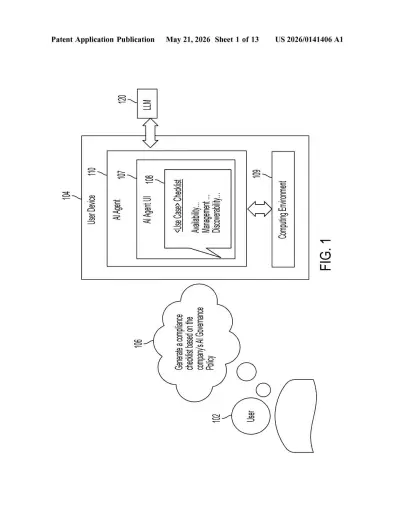
Salesforce's patent describes a system that automates that job. It uses a dedicated AI agent — called a Digital Risk and Compliance Officer (DRCO) — to continuously monitor other AI agents in your environment. The DRCO checks their behavior against a living knowledge graph of compliance rules and past use cases. If something looks wrong, it doesn't just send an alert: it can block the offending agent's data traffic entirely.
A second agent, called the Governance Ontology (GO) agent, keeps the rulebook up to date by reading conversation transcripts and updating the knowledge graph over time. The whole system is designed to stay current as both regulations and AI behavior evolve.
How the DRCO and GO agents audit each other
The patent describes a two-part framework that works together to audit AI systems in real time.
The first part is the DRCO agent, which scans a target AI deployment to detect AI assets (individual models, agents, or AI-powered features), then creates a structured object representing each one's use case. From that object, it auto-generates compliance checklists and evaluates them using a semantic similarity search (think: fuzzy matching against a database of past AI deployments and their compliance histories — so it learns from precedent rather than starting cold).
The second part is the GO agent, which is built on two LLMs working in tandem. It reads conversation transcripts produced by deployed AI agents and uses them to continuously build and update a knowledge graph — a structured map of concepts, rules, relationships, and metadata relevant to AI governance. That graph becomes the DRCO's authoritative source of truth.
The enforcement hook is notable: when the DRCO identifies a compliance violation during ongoing monitoring, the system can block data traffic to or from that AI asset — not just flag it. This moves the framework from advisory to operational.
Key components at a glance:
- AI asset detection — automatically discovers what AI is running in a target system
- Use case objects — structured representations of each AI's purpose and attributes
- Compliance checklists — auto-generated and matched against prior cases via semantic search
- Knowledge graph — living rulebook updated from real conversation transcripts
- Traffic blocking — hard enforcement, not just alerting
What this means for enterprise AI governance
For enterprises deploying AI at scale — think Salesforce's own platform customers running hundreds of Einstein agents — manual compliance review doesn't scale. Regulations like the EU AI Act and emerging U.S. federal AI policies impose real obligations on organizations to document, audit, and control their AI systems. This patent describes infrastructure to make that continuous rather than periodic.
The traffic-blocking capability is the detail worth watching. Most AI governance tools today are observability layers — they show you what happened. A system that can actively cut off a non-compliant agent without human intervention is a different category of tool. For Salesforce's enterprise customers in regulated industries like finance, healthcare, and government, that's a meaningful line to cross.
Source: US 2026/0141406 A1 at the USPTO (PDF). Full patent text and figures are in the official publication.
Get our take in your Top Stories
Liked this breakdown? Add Patentlyze as a preferred source on Google, and our plain-English take shows up more often in your Top Stories the next time Salesforce patent news breaks.
Add Patentlyze on Google
One click.
There are more where this came from
We read the new patents from Big Tech, carmakers and more and send you the ones worth knowing. Plain English, free, every week.
More from Salesforce
All 110 Salesforce patents →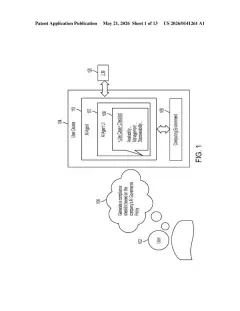
More in AI safety
All 60 AI safety patents →
Microsoft
Microsoft Patent Uses Ontology Distance Scoring to Grade AI-Generated Answers
Google
Google Patents a Content Moderation System That Looks Up Live Context Before Acting
IBM
IBM Patents a System That Baits Its Own AI Chatbots Into Saying Harmful Things
IBM