
IBM Files Patent for Speech Transcription That Arrives Already Capitalized and Punctuated
Speech-to-text models that write proper sentences, with capitals and commas, tend to make more word mistakes than ones that write plain lowercase. IBM's patent application has the plain-lowercase model coach the fancier one during training, then removes the extra equipment.
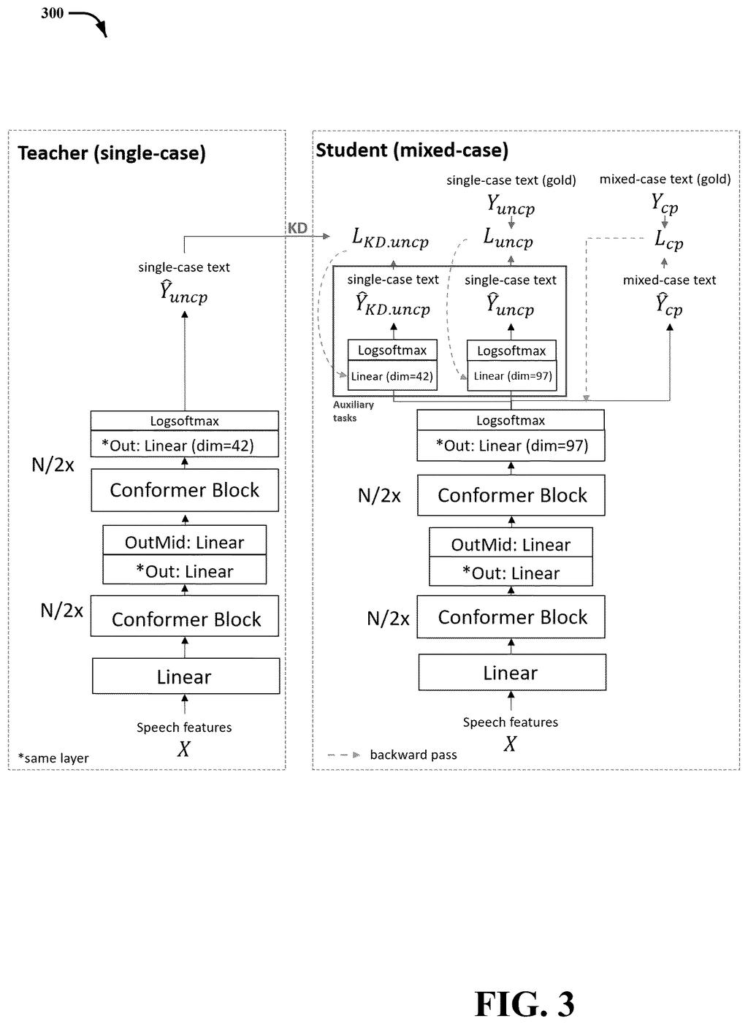
What IBM's capitalized speech-to-text does
Many speech-to-text systems hand back a wall of lowercase words with no commas or periods. That is fine for a computer, but it is tiring for you to read in a meeting transcript, a set of captions, or a medical or legal record. Systems that write proper sentences straight away exist, yet the filing says they tend to get more words wrong.
IBM's patent tackles that trade-off with a teacher and a student. The teacher is a model that only writes plain lowercase text and is very good at picking out the right words. The student writes the fully formatted version, and during practice it also tries to copy the teacher's plain version, so it learns from the teacher's skill at spotting words.
Once training is over, the extra practice piece is taken out. What is left is a model that writes capitals and punctuation in one pass, with no separate cleanup step afterward.
… a student component that utilizes a mixed-case STT model to generate a second transcription output comprising capitalized and punctuated text, and a third transcription output comprising lowercase and unpunctuated text …
Translation: The student model learns to output both normal formatted text and raw unformatted text.
How the teacher model coaches the student
The filing covers a way to train a speech-to-text model that writes mixed-case text (capitals and punctuation) straight from audio. It uses two models, a teacher and a student.
Here is what happens in training:
- The teacher, a model that writes only lowercase text with no punctuation, transcribes the audio.
- The student writes the capitalized, punctuated version. A temporary linear transformation layer (a simple extra output step) also lets it write a lowercase version.
- The gap between the teacher's lowercase text and the student's lowercase text becomes the knowledge distillation loss (a score of how far the student is from the teacher), which adjusts the student's internal settings.
The filing's example has the formatted output pick from 97 characters and symbols, while the teacher and the temporary layer use 42. The teacher's score is mixed in with the normal training score using adjustable weights. When training ends, the temporary layer is deleted.
In the filing's results, the student trained this way made fewer word errors than versions trained without the teacher, whether or not capitalization and punctuation counted. It names transformer and recurrent designs (two common model types) as options.
… a teacher component that utilizes a single-case speech-to-text (STT) model to generate a first transcription output …
Translation: An initial teacher model creates a basic unformatted transcription to guide the training process.
Why captions and transcripts could improve
If you have ever read auto-generated captions or a meeting transcript, you know how hard unpunctuated text is to follow. Systems that add capitals and punctuation in a separate cleanup step cost extra time and engineering work. This patent aims to get readable text out in one step without giving up word accuracy, which matters most where speed counts, such as live captions and virtual assistants.
The cost structure is the tidy part. The teacher and the temporary layer exist only during training, so the finished model adds no extra work when it is used, according to the filing. The filing lists captioning, meeting transcription and medical or legal documentation as target uses, though it names no IBM product.
IBM files its third voice and speech AI patent we've tracked since September, adding to earlier work on sorting documents privately and probing audio AI for weak spots.
Unpunctuated, all-lowercase text is a daily annoyance for anyone who reads captions or meeting notes, and in a legal or medical record a missing comma can change what a sentence says. Fixing that without slowing things down matters because transcription often runs live.
The size of the fix matches the size of the issue. The filing targets one measurable gap, the extra word mistakes that appear when a model also has to format its text, and it closes that gap with a training step that disappears afterward. Nothing extra ships inside the finished model.
The problem is modest in scale, since formatting can already be added by a cleanup step, and the patent claims a better way to train rather than a new product. As engineering work it is sensible and narrow, and the reported results support it on the filing's own tests.
Get our take in your Top Stories
Liked this breakdown? Add Patentlyze as a preferred source on Google, and our plain-English take shows up more often in your Top Stories the next time IBM patent news breaks.
There are more where this came from
We read every patent application Big Tech publishes and send you the ones worth knowing. Plain English, free, every week.
The drawings
5 drawing sheets from US 2026/0351259 A1 · click any drawing to enlarge


Want this weekly breakdown for a company we don't cover? Patentlyze Pro →
Be the first to weigh in