
Intel Patents Memory That Erases Itself After Being Read Once
Intel is patenting a memory chip that can be told to forget data the moment it's been read. It's a hardware-level take on the kind of 'read and destroy' logic that security engineers usually have to build in software.
What Intel's self-erasing memory chip actually does
Imagine a sticky note that vanishes the instant someone reads it. That's essentially what Intel is building into computer memory here. Certain pieces of data can be flagged so that once a program reads them, they're gone from memory automatically.
This matters because sensitive data, things like encryption keys or one-time tokens, often linger in memory long after they've served their purpose. Normally, a programmer has to write extra code to clean that up. Intel's design bakes the cleanup directly into the memory chip itself.
The chip uses a small marker called a read-once indicator attached to specific data. When anything tries to read that data, the chip hands it over and then immediately makes it unavailable for any future read. No extra software step required.
… in response to a read operation targeting data for which a read-once indicator associated with the data stored in the memory array is set: output the data; and render the data unavailable for a subsequent read operation …
Translation: When a single-use file is opened, the system displays it and then immediately deletes it.
How the read-once indicator triggers data erasure
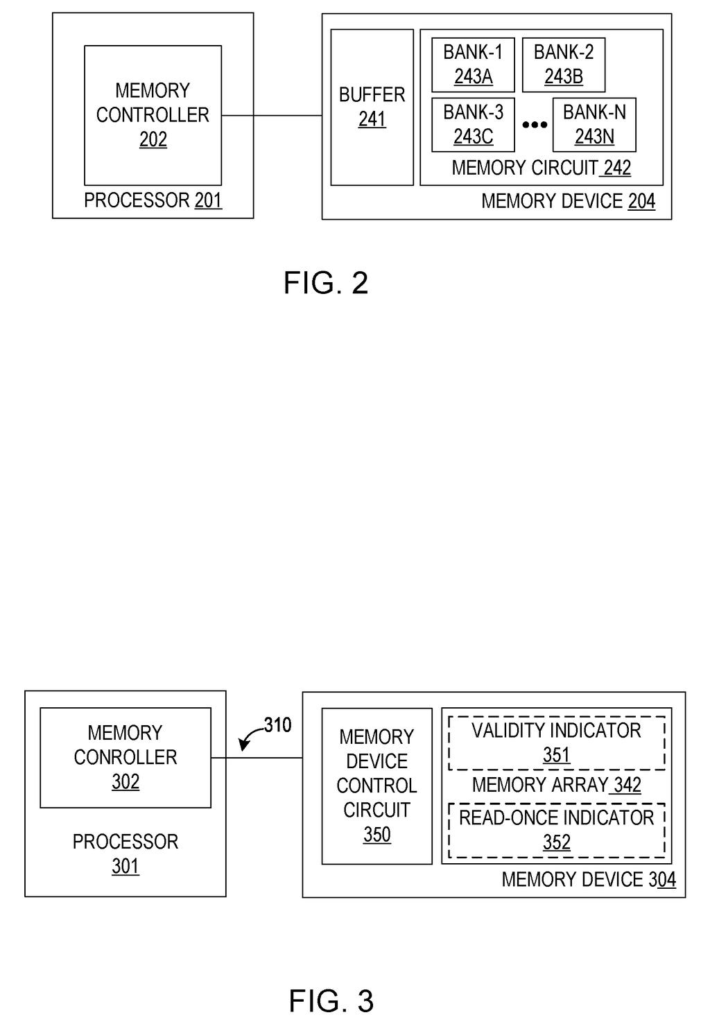
The patent describes a memory device with two main parts: a standard memory array that holds data, and a control circuit that watches over how that data is accessed.
The key feature is a per-data flag called a read-once indicator. When this flag is set on a piece of stored data, the control circuit enforces a strict rule: the data can be read exactly once. On that read, the control circuit does two things simultaneously: it outputs the data to whoever requested it, and it renders the data unavailable for any future read operation.
- Memory array: stores data normally, with optional read-once flags attached
- Control circuit: intercepts read requests and checks whether the read-once flag is set
- Erasure action: immediately makes the data inaccessible after the first successful read
The patent frames this under "memory freshness," a concept in secure computing that ensures a processor can trust that the data it receives hasn't been replayed or reused from a stale copy. By making the hardware enforce single-use data, the design removes a whole class of software bugs where sensitive values stick around in memory longer than intended.
A memory device includes: a memory array configured to store data, and a control circuit coupled to the memory array and configured to …
Translation: The hardware combines standard storage components with special logic to track how often files are opened.
What this means for chip-level data security
For security-sensitive chips, things like secure enclaves, trusted execution environments, or cryptographic accelerators, having the memory hardware enforce single-use data is a meaningful upgrade. It removes the risk of a software bug or a timing attack allowing an attacker to read a sensitive value twice before the software gets around to clearing it.
This fits Intel's ongoing work on confidential computing, where the goal is to protect data even from a compromised operating system or hypervisor. If your encryption key literally cannot be read a second time at the hardware level, an attacker who gains software-level access after the fact finds nothing there.
This is a focused, practical security patent rather than a big-picture research idea. The concept of read-once memory exists in academic literature and niche secure hardware, but putting it into a standard memory device's control circuit is a real engineering step. It's worth watching because Intel has the manufacturing scale to ship this in production silicon, not just a research prototype.
There are more where this came from
We read every patent application Big Tech publishes and send you the ones worth knowing. Plain English, free, every week.
The drawings
5 drawing sheets from US 2026/0228132 A1 · click any drawing to enlarge


Want this weekly breakdown for a company we don't cover? Patentlyze Pro →
Be the first to weigh in