
Nvidia Patents a Dedicated Chip for Correcting Distorted Camera Footage in Real Time
Every time a wide-angle camera corrects its fisheye distortion or a self-driving car straightens a skewed road view, software has to crunch a lot of math. Nvidia wants to hand that job to dedicated silicon instead.
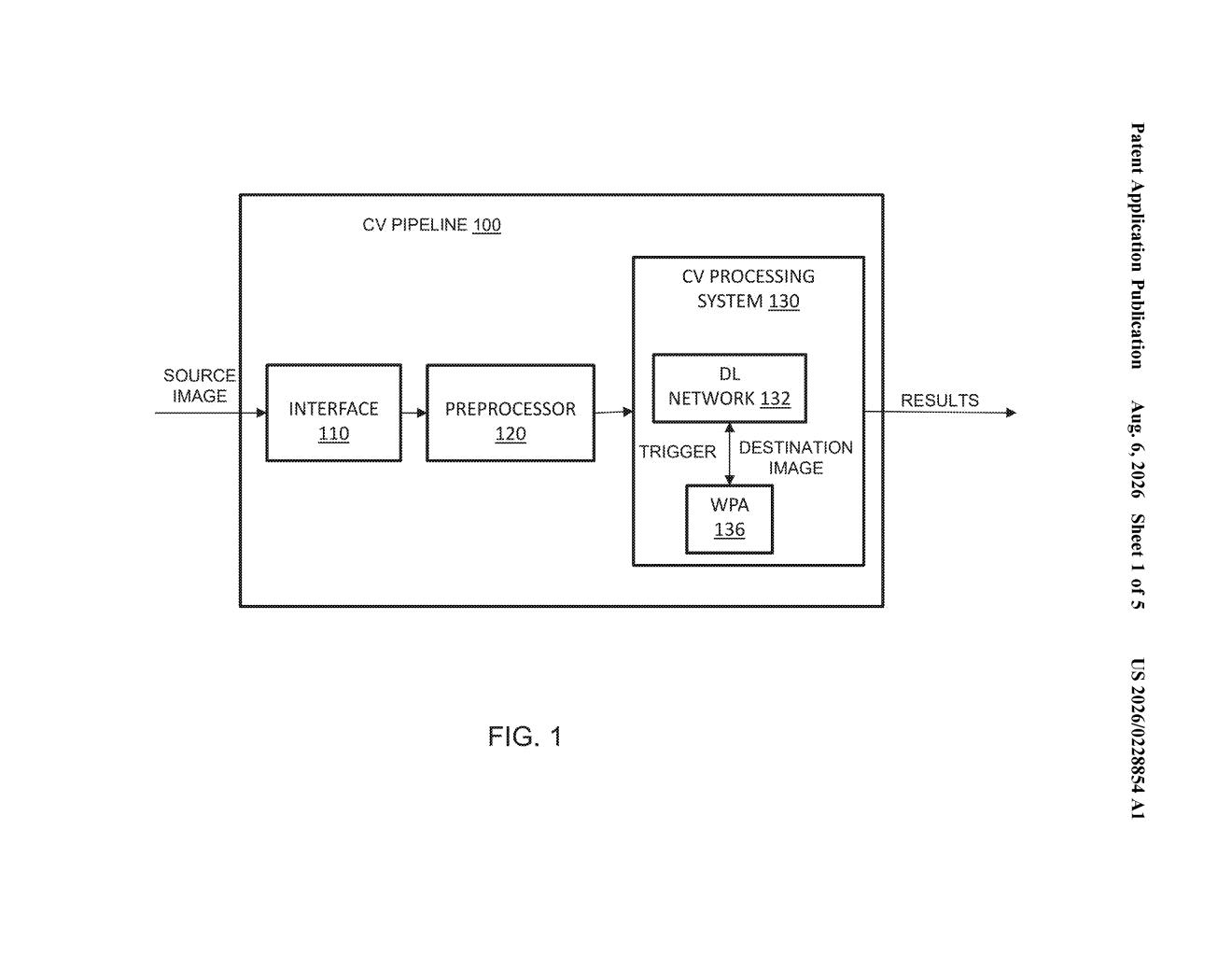
What Nvidia's image-warping chip actually does
Imagine you're holding your phone at an angle while scanning a document. The app has to digitally straighten that tilted rectangle into a flat, readable image before it can do anything useful with it. That correction is called a perspective warp, and right now it's mostly done in software, which costs time and battery life.
Nvidia's patent describes a small, specialized piece of hardware called a Warp Perspective Accelerator (WPA) that handles this job directly on a chip, without leaning on a general-purpose processor or GPU. The WPA takes a destination image, works backward to figure out where each pixel came from in the original image, and blends nearby pixels together to produce a smooth, corrected result.
The goal is to do all of that faster and with less energy than software running on a regular processor. That tradeoff matters most in devices where power is tight and speed is critical, like cameras, drones, robots, or self-driving car systems.
… warping hardware configured to perform a warping operation on the source image to obtain the destination image, wherein the warping operation determines a source coordinate of the source image based on a destination coordinate of the destination image and a transformation matrix …
Translation: Dedicated hardware recalculates pixel coordinates to fix distorted images using math formulas.
How the WPA maps pixels and blends four neighbors
The WPA is a fixed-function hardware block designed to accelerate one specific task: perspective warping, the geometric transformation that corrects distorted or angled images into a flat, properly aligned version.
Instead of processing pixels forward (source to destination), the accelerator works backward: it starts from each pixel in the output (destination) image and calculates where the corresponding point sits in the original (source) image using a transformation matrix (a set of nine numbers that encodes the geometric relationship between the two images).
Because that backward-mapped coordinate rarely lands exactly on a real pixel, the chip uses bilinear interpolation (a blending technique that mixes the four nearest real pixels in proportion to how close they are) to estimate the correct color value. Specifically:
- It identifies the four neighboring pixel coordinates around the mapped source point.
- It computes the weighted area each neighbor contributes.
- It blends those four values into a single smooth output pixel.
- It writes the result directly to memory.
The accelerator stores resolution metadata in dedicated registers (small, fast on-chip memory slots) so it can operate with minimal back-and-forth with the main processor, which is the key source of its lower power draw and latency advantage.
The disclosed warp perspective accelerator (WPA) provides improved latency and energy efficiency compared to existing software solutions.
Translation: This physical chip runs faster and uses less power than programs doing the same math.
What this means for cameras and edge AI devices
For consumer devices, this is mostly an efficiency story. A dedicated warp chip means a phone, drone, or security camera can correct lens distortion or align overhead views without waking up a bigger processor, which saves battery and reduces the delay between capture and a corrected frame.
For Nvidia specifically, this fits squarely into its work on edge AI and robotics, where computer vision pipelines run continuously and every milliwatt counts. Cameras feeding into autonomous systems need to produce geometrically correct frames at high speed. Offloading that work to a fixed-function accelerator frees up the GPU and main CPU for heavier tasks like object detection and path planning.
This is unglamorous but genuinely useful engineering. Warp correction is one of those tasks that happens constantly in computer vision systems and never gets credit. Building a lean, dedicated hardware block for it is a smart move for power-constrained edge devices, and it fits Nvidia's broader push into robotics and autonomous systems hardware.
There are more where this came from
We read every patent application Big Tech publishes and send you the ones worth knowing. Plain English, free, every week.
The drawings
5 drawing sheets from US 2026/0228854 A1 · click any drawing to enlarge


Want this weekly breakdown for a company we don't cover? Patentlyze Pro →
Be the first to weigh in