
Intel Files Patent for Voice Software That Learns Your Speech From Everyday Chatter
Teaching a gadget your voice usually means reading sentences aloud. Intel's filing has a worn device learn from ordinary conversations, like ordering lunch, instead.
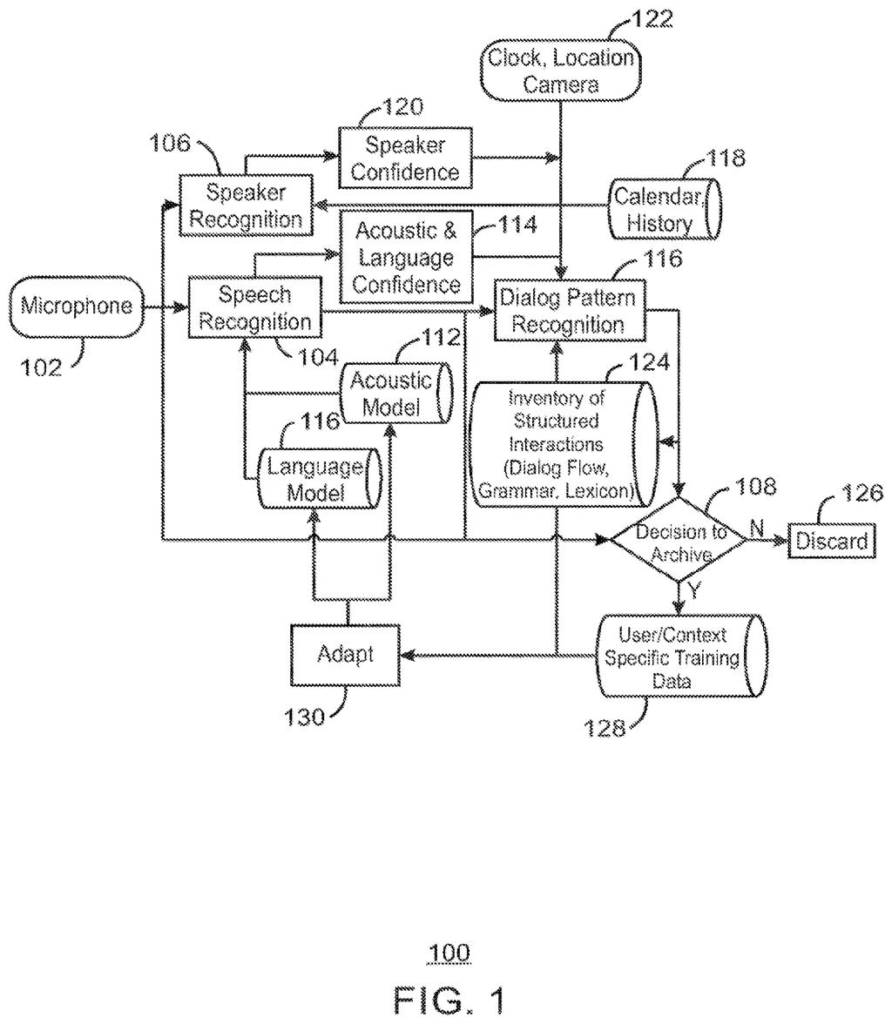
What Intel's voice-learning patent actually does
A woman walks into the same restaurant around noon every weekday and orders lunch. She says hello, asks for the usual, and pays. Nothing about that moment looks like a training session for a computer, but under this patent, it could be.
Voice recognition usually gets better at understanding you when you sit down and read a script out loud. Intel's filing describes a worn device with a microphone that skips that chore. It listens during real life, works out where you are and what kind of conversation is going on, and checks how sure it is. When it is confident, it keeps that speech as practice material.
Over time, the speech recognition adjusts to your voice and the words you actually use, like contact names, song names, and the commands you give your gadgets.
… determine a confidence score indicative of a likelihood that the speech is associated with the context; recognize a structured interaction involving the user based on the speech and the location …
Translation: The software calculates how likely your words match your current surroundings.
How the device decides a conversation is worth saving
The claims describe a pipeline that starts with a microphone picking up your speech. The software then notes where the audio was collected and uses that location to guess the context (a restaurant, a store, a street where someone is giving directions).
Next it looks for a structured interaction, which is a familiar back-and-forth with a predictable order, like a greeting, a question, a payment, and a goodbye. It compares what you said to stored reference dialogue (a dialog flow, a grammar, or a lexicon, meaning a list of expected words and phrases). From there:
- It gives the speech a confidence score, the odds that it really belongs to that context.
- It assigns a similarity metric, a measure of how closely the speech matches stored patterns.
- It classifies the speech and saves it, along with the metric, to a database.
Dependent claims add that the saved data can be used to adapt a neural network (the software brain that turns audio into text) for speech recognition. The stored phrase list can include contact names, device names, commands, song names and app names. The description also says the system can re-run recognition using the vocabulary for that situation, such as a restaurant's menu, and treat a rise in confidence as a sign it guessed right.
An apparatus for speech model with personalization via ambient context harvesting, is described herein.
Translation: This system learns your unique voice patterns by listening to your everyday environment.
Why your voice assistant might stop mishearing names
If you have ever read a list of sentences to teach a gadget your voice, or watched an assistant butcher a friend's name, this is the annoyance being targeted. The filing aims to have your device learn from normal life, including the names, songs and commands you say most. The description also says that collecting speech in the cloud compromises privacy, and it keeps the adapting model on the worn device itself.
The catch is built into the design: the description calls it an always on, always listening model, and it can also draw on calendar, location and camera data. Where that audio and those saved phrases end up, and who controls them, would matter a lot to anyone wearing it. The text gives no details on how long saved recordings are kept.
This is the sixth Intel filing we've tracked since July on on-device AI privacy, following earlier applications like controlling who joins AI training and scrubbing personal speech from audio.
Almost nothing here needs new hardware. A phone, earbuds or a watch already has a microphone and a way to find your location, so the shortest route to a product is software: a library of everyday conversation patterns, a way to score confidence, and a method to retrain the speech model on the device. The hard part is that library of dinner orders, checkout lines and game nights, which someone has to build and keep up to date.
The filing is a continuation in a chain that began with a 2017 international application, and the text still mentions older-style speech models alongside neural networks. Nothing in the document points to a product.
A privacy conversation also has to happen first, because an always-listening wearable that saves audio is a tough sell. Think of it as a plausible software feature with a long list of prerequisites.
Get our take in your Top Stories
Liked this breakdown? Add Patentlyze as a preferred source on Google, and our plain-English take shows up more often in your Top Stories the next time Intel patent news breaks.
There are more where this came from
We read every patent application Big Tech publishes and send you the ones worth knowing. Plain English, free, every week.
The drawings
5 drawing sheets from US 2026/0341271 A1 · click any drawing to enlarge


Want this weekly breakdown for a company we don't cover? Patentlyze Pro →
Be the first to weigh in