
Sony Patents a Joystick Cap That Can't Be Put On Crooked
If you've ever snapped a thumbstick cap onto an analog stick and noticed the arrow or texture is pointing the wrong way, Sony has a patent for exactly that annoyance.
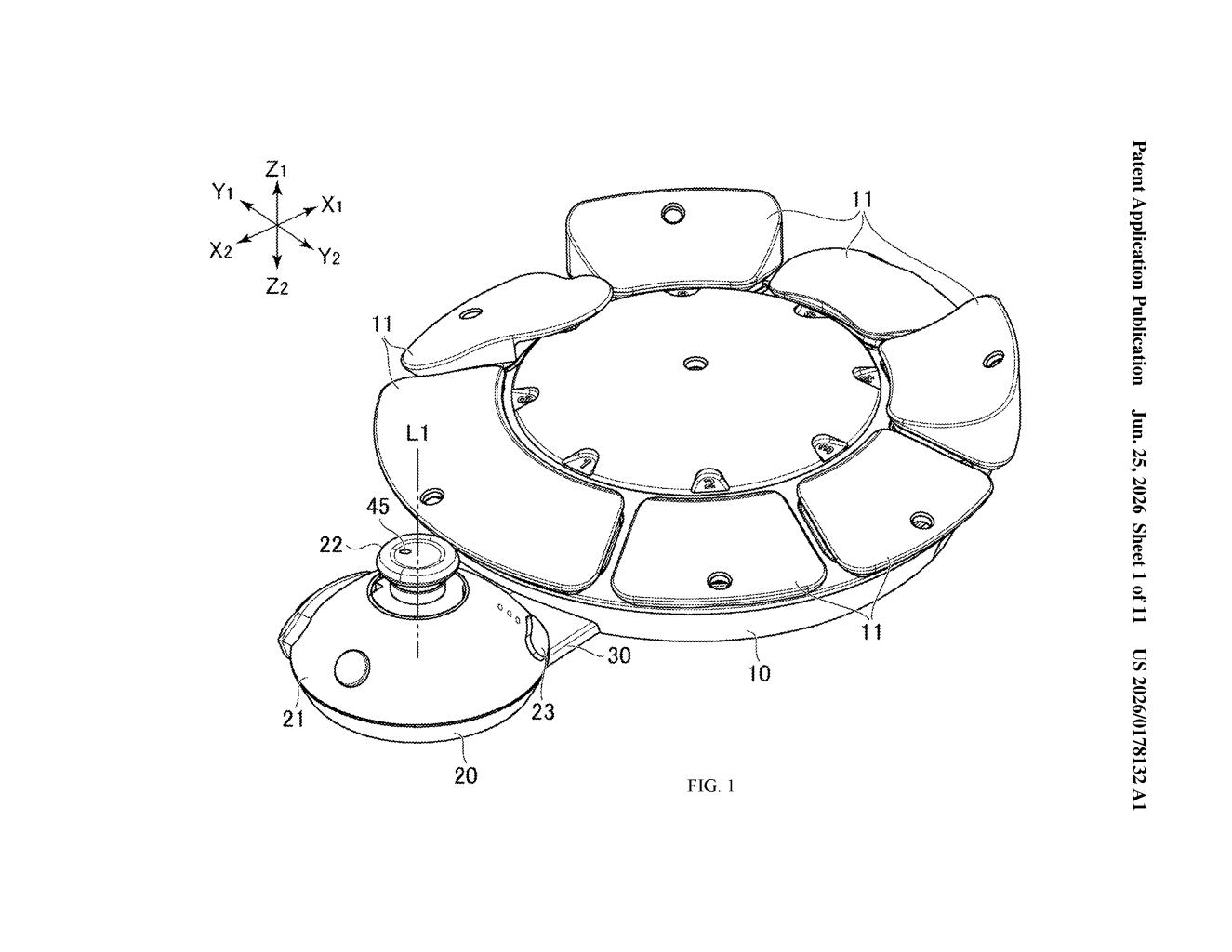
What Sony's self-aligning thumbstick cap actually does
Imagine you replace the cap on your controller's analog stick, the little dome your thumb rests on, and it goes on slightly rotated. Any directional marking or tactile arrow printed on it now points the wrong way, which is confusing if you rely on it to feel which way is "up" in a game.
Sony's patent describes a fix built right into the physical design. The cap has a small post that inserts into the stick's body, and both pieces have interlocking ridges or teeth around that post. The teeth act like a combination lock in reverse: the cap can only sit in specific rotational positions, not just any angle. You press it in, it clicks into one of those preset positions, and it stays there.
A directional marker is printed or molded onto the outside of the cap. Because the cap can only attach in fixed orientations, that marker will always end up pointing the intended direction once the cap is seated properly.
How the interlocking teeth lock the cap's rotation
The patent covers an analog stick assembly made of two parts: a top member (the cap your thumb touches) and a base member (the body of the stick that attaches to the controller mechanism).
The top member has a downward-facing post called an insertion portion that slides into the base member. Around that post, either the post itself or the inside of the base member carries a ring of first engaging portions, essentially a set of teeth or notches arranged in a circle. The other part carries at least one second engaging portion, a matching tooth or tab that can slot into any one of those notches.
This creates a rotational indexing system: the cap can only attach at specific angular positions determined by how many notches are in the ring. Once seated, it cannot rotate freely.
A directional mark (an arrow, line, or similar indicator) is molded or printed on the outside of the cap. Because the cap's rotational position is constrained by the teeth, that mark reliably ends up pointing in a known direction relative to the controller, telling the user which way the stick's "forward" is without having to guess.
What this means for PlayStation controller design
For most players, the stock thumbstick caps on a PlayStation controller don't get swapped out. But a significant accessory market exists for aftermarket caps, and Sony also ships controllers with directional indicators already on the stick surface. If those marks are misaligned after a cap replacement, players may tilt the stick in the wrong direction by instinct, especially in games where precise directional input matters.
The more interesting angle is manufacturing consistency. A locking orientation mechanism means Sony could put an asymmetric grip texture or a clear directional arrow on the cap during production and guarantee it ships correctly oriented every time, no manual alignment step needed on the factory line. That's a small but real quality-control benefit for a product Sony ships in the tens of millions.
This is a narrow, incremental fix for a real but minor annoyance. It's not the kind of patent that hints at a new product category; it's the kind that improves an existing one. If this shows up in a future DualSense revision, most players will never know it's there, which is exactly the point.
There are more where this came from
We read every patent application Big Tech publishes and send you the ones worth knowing. Plain English, free, every week.
Want this weekly breakdown for a company we don't cover? Patentlyze Pro →