Microsoft
Microsoft · Input & haptics · Filed May 29, 2025 · USPTO published Jul 9, 2026 · Jul 9 release
Microsoft Patents a Hinge That Knows Exactly What Angle It's Opened To
Most laptops have no idea how far open they are. Microsoft's new patent describes a hinge that tracks its own angle by measuring a tiny sliding piece inside the joint itself.
- Publication number
- US 2026/0197954 A1(US20260197954A1)
- Applicant
- Microsoft Technology Licensing, LLC
- Filed · Published
- May 29, 2025 · Jul 9, 2026
- Inventors
- Tung Yuen LAU, Mika Martti YLITALO, Blair M KENT, Amit KAISTHA, Devin CAPLOW-MUNRO, Eric WITT
- Status when we published
- Waiting for an examiner
- Document
- 20 claims
- US classification
- 361/807
- Parent application
- National Stage Entry of PCT/CN2022/141283 (filed Dec 23, 2022)(PCTCN2022141283)
What Microsoft's angle-sensing hinge actually does
Imagine your laptop could tell whether you've opened it to 90 degrees for typing, 135 degrees for presenting, or flat for reading, and automatically adjust the screen or software to match. Right now, most devices either can't do that at all, or use clunky sensors that aren't very precise.
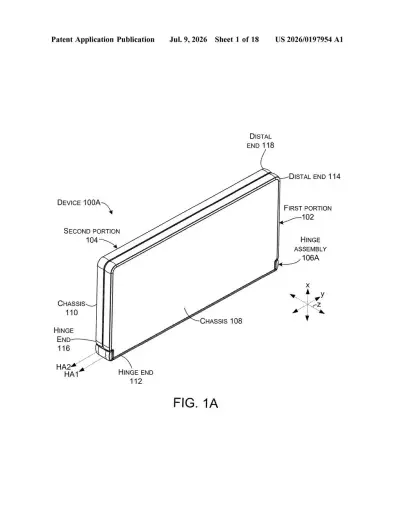
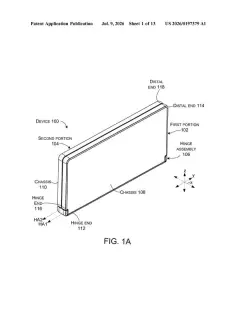
Microsoft's patent describes a hinge with a small controller piece sitting on a shaft between the two rotating arms. When you open or close the device, that piece slides back and forth along the shaft. A sensor reads where it has landed, and from that position, the device figures out your exact angle.
It's a bit like reading a ruler instead of a protractor. Converting rotation into a straight-line distance turns out to be easier to measure accurately. For foldable laptops or dual-screen devices, that accuracy could mean the difference between a screen that flips modes at the right moment and one that gets it wrong half the time.
How the sliding controller translates rotation into a position reading
The patent describes a hinged computing device with two sections (think screen half and keyboard half) each attached to its own rotating arm. Those two arms share a central shaft that runs between them.
A small component Microsoft calls a controller sits on that central shaft. When you rotate the two halves, the geometry of the hinge pushes the controller to slide linearly (in a straight line) along the shaft. The further you open the device, the further the controller moves.
A sensor then reads the controller's position along the shaft. Because the relationship between the angle of the hinge and the position of the controller is predictable and consistent, the device can infer its exact angular orientation from a simple linear measurement, which sensors handle well.
Key components described in the claim:
- First and second hinge arms, each rotating around its own axis
- Central shaft positioned between those two axes
- Controller that moves linearly along the shaft as the arms rotate
- Sensor that reads the controller's position and converts it to an angle reading
What this means for foldable laptops and dual-screen devices
For foldable and dual-screen devices, knowing the precise hinge angle lets the software do genuinely useful things: switching keyboard layouts, adjusting display brightness per panel, or snapping into a presentation mode when the screen crosses a certain threshold. Imprecise angle detection has been a real limitation on devices like Microsoft's own Surface Duo line, where the software sometimes struggles to keep up with how the user is holding the device.
From a hardware standpoint, converting rotation to linear movement before measuring it is a practical engineering choice. Linear position sensors are generally simpler and more reliable than rotary encoders in a tight mechanical space. If Microsoft puts this into a future foldable device, you might never notice the hinge itself, which is exactly the point.
Source: US 2026/0197954 A1 at the USPTO (PDF). Full patent text and figures are in the official publication.
Get our take in your Top Stories
Liked this breakdown? Add Patentlyze as a preferred source on Google, and our plain-English take shows up more often in your Top Stories the next time Microsoft patent news breaks.
Add Patentlyze on Google
One click.
There are more where this came from
We read the new patents from Big Tech, carmakers and more and send you the ones worth knowing. Plain English, free, every week.
More from Microsoft
All 681 Microsoft patents →
More in Hardware
All 2,375 Hardware patents →
Sony
Sony Patent Would Identify Gamers Through Muscle Movement Signals Alone
Sony
Sony Patents a Game Controller That Replaces Buttons with a Rotating Dial
Samsung
Samsung Patent Syncs Haptic Feedback Across Multiple Devices During Video Playback
Intel