
Sony Patents a Photon-Counting Circuit That Reduces Wasted Electrical Switching
Every time a digital circuit flips between 0 and 1, it burns a little power and generates a little noise. Sony's latest patent describes a counting circuit for image sensors designed to minimize those unnecessary flips at the hardware level.
What Sony's photon-counting circuit change actually does
Imagine a rain gauge that clicks a mechanical counter every time a drop falls. Now imagine that counter is electronic and built into a camera sensor, counting individual particles of light. The more it clicks, the more power it uses and the more electrical interference it creates inside the chip.
Sony's patent describes a smarter way to wire those counters together. Instead of each counter reacting to every signal independently, they are chained in a specific pattern so that only the minimum necessary number of switches flip for any given count. The approach is called a Johnson counter arrangement, and Sony is applying it to the kind of sensors used for detecting single photons.
This matters most in low-light or high-speed imaging, where sensors need to count an enormous number of individual light particles very quickly. Keeping the counting circuitry as quiet and efficient as possible reduces power draw and keeps the chip from interfering with its own measurements.
How the chained Johnson counter design limits state transitions
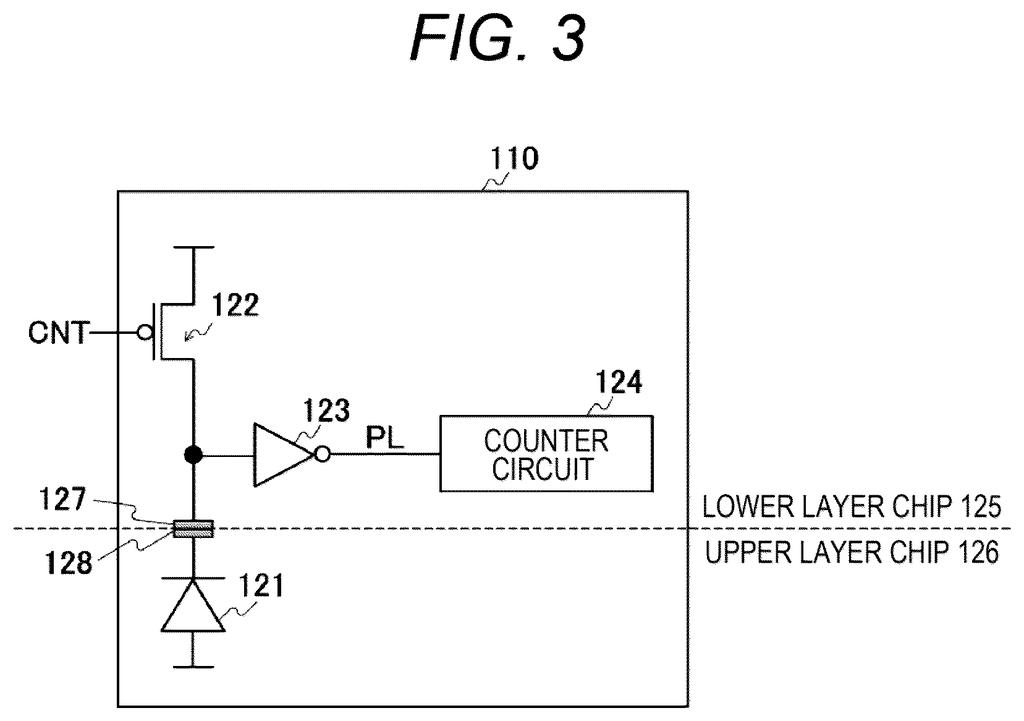
The patent covers a photodetection device built around an array of light receiving units, each of which fires a short pulse whenever a single photon lands on it. A counter circuit tallies those pulses to build up a picture of how much light hit each pixel.
The core invention is in how that counter circuit is structured. Sony uses a chain of 2-bit Johnson counters (a Johnson counter is a type of circuit that cycles through a fixed sequence of states by feeding a flipped version of its own output back to its input). The key design choice is that each counter in the chain does not respond directly to the raw pulse stream. Instead, it takes its trigger from the second bit of the output of the counter that precedes it in the chain.
This chaining arrangement means:
- Fewer circuit nodes change state simultaneously during any single count step.
- Power consumption stays lower because switching activity is the main driver of dynamic power in digital chips.
- Electrical noise inside the sensor chip is reduced, which is important when you are trying to measure signals as faint as a single photon.
Each Johnson counter internally uses two flip-flops (basic memory elements that store a 0 or 1) wired so that the inverted output of the second flip-flop feeds back into the first. This is the standard Johnson ring topology, applied here at the 2-bit scale and cascaded across the full counter chain.
What this means for next-generation Sony image sensors
Single-photon counting sensors are used in medical imaging, time-of-flight depth cameras (the kind that let your phone measure distance or scan a face), and scientific instruments. In all of these, power efficiency and low internal noise are not just nice to have; they directly affect measurement accuracy.
For Sony Semiconductor Solutions, which supplies image sensor chips to a large portion of the smartphone and camera industry, incremental improvements to counting circuit efficiency can translate into real gains in sensor performance or battery life at scale. This is not a headline product announcement, but it is exactly the kind of foundational circuit work that shows up inside the next generation of high-end camera chips.
This is deep chip-design work, not a consumer product reveal. It is the kind of incremental but genuinely useful improvement that Sony's semiconductor division does well. If you care about where low-light camera hardware is heading, it is worth a read. If you don't follow image sensor architecture, you can safely skip it.
There are more where this came from
We read every patent application Big Tech publishes and send you the ones worth knowing. Plain English, free, every week.
The drawings
28 drawing sheets from US 2026/0222709 A1 · click any drawing to enlarge


Want this weekly breakdown for a company we don't cover? Patentlyze Pro →
Be the first to weigh in