
Intel Patent: AI Tasks Automatically Route to the Fastest Available Processor
Not every core on a modern CPU is built the same, and Intel wants the chip itself to figure out which tasks go where, without you or a system administrator having to decide.
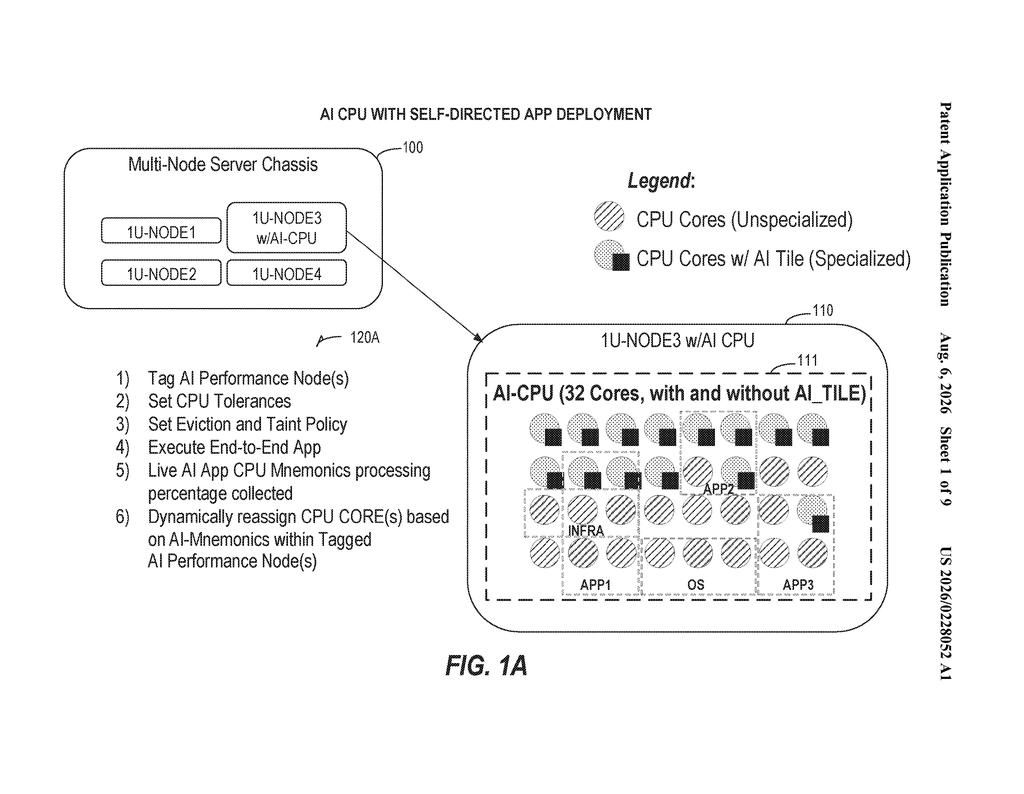
How Intel's self-sorting CPU handles AI work
Imagine a restaurant kitchen where some cooks specialize in pastry and others handle the grill. If someone accidentally sends a soufflé order to the grill station, things go sideways. Intel's patent describes a similar sorting system, but for the processors inside servers and edge devices.
Modern Intel chips can have two kinds of CPU cores: ones with built-in AI acceleration hardware, and ordinary cores without it. Right now, figuring out which software tasks should go to which kind of core usually requires manual setup or extra software layers. This patent describes a chip that watches what each task actually needs in real time and automatically steers AI-heavy work toward the cores equipped to handle it.
The goal is faster, more consistent AI performance on servers that mix different generations of hardware, without requiring someone to reconfigure the whole system every time a new workload shows up.
a first set of cores, wherein a respective core of the first set of cores is provided with a corresponding artificial intelligence (AI) computation unit; and a second set of cores, wherein a respective core of the second set of cores is provided without a corresponding AI computation unit …
Translation: Intel's processor splits tasks by putting AI hardware on some CPU cores while leaving other cores without it.
How the chip tracks workloads and assigns AI cores
The patent describes a processing device that contains two categories of CPU cores on the same chip:
- First-set cores equipped with dedicated AI computation units (Intel calls these things like Advanced Matrix Extensions, or AMX tiles, which are special math-acceleration blocks that speed up the kind of matrix calculations AI models rely on).
- Second-set cores that are standard CPU cores without that extra AI hardware.
A piece of tracking circuitry monitors what each running workload is actually doing. When it spots tasks that could benefit from AI acceleration, it flags them and allocates (assigns) those tasks specifically to the AI-capable cores. Tasks that don't need the specialized hardware can run on the ordinary cores, keeping the whole chip busy.
The system is designed for edge computing clusters, which are collections of server nodes that might include a mix of older and newer hardware. By tagging high-performance nodes and binding AI inference tasks (the process of running a trained AI model to produce results) to the right nodes, the system avoids bottlenecks caused by routing demanding AI work to hardware that isn't built for it.
… dynamically reassigning tasks based on real-time instruction-usage patterns. High-performance AI nodes can be tagged to ensure deterministic and high-quality inferencing, improving performance on nodes with native AI acceleration capabilities …
Translation: The system constantly reroutes jobs on the fly to make sure AI workloads run on the fastest available hardware.
What this means for AI at the edge of the network
As companies push AI workloads out of big data centers and into smaller, closer servers (think factory floors, retail locations, or telecom base stations), those edge environments often run a mix of old and new hardware. A system that can automatically sort tasks by core capability means better AI performance without expensive hardware upgrades or constant manual tuning.
For Intel specifically, this matters because its recent CPUs already ship with AMX hardware, but getting software to actually use those features consistently is a known challenge. If this approach ships in firmware or OS-level tooling, it could make Intel's existing AI acceleration hardware more useful in practice, which is a real competitive argument against AMD and Arm-based server chips.
This is disciplined infrastructure work, not a flashy product announcement. Intel is trying to solve a real and annoying problem: AI-capable hardware that sits idle because the software stack doesn't route work to it correctly. If this lands in production systems, it's the kind of fix that makes a measurable difference without anyone noticing, which is exactly what good chip software should do.
There are more where this came from
We read every patent application Big Tech publishes and send you the ones worth knowing. Plain English, free, every week.
The drawings
9 drawing sheets from US 2026/0228052 A1 · click any drawing to enlarge


Want this weekly breakdown for a company we don't cover? Patentlyze Pro →
Be the first to weigh in