
Meta Patent Auto-Generates Moving VR Safety Boundaries Around Users
Setting up a safe play area in a VR headset currently means walking around your room and tracing out a boundary by hand. Meta's new patent proposes skipping all of that by having the headset figure out the safe zone on its own, in real time, every time you move.
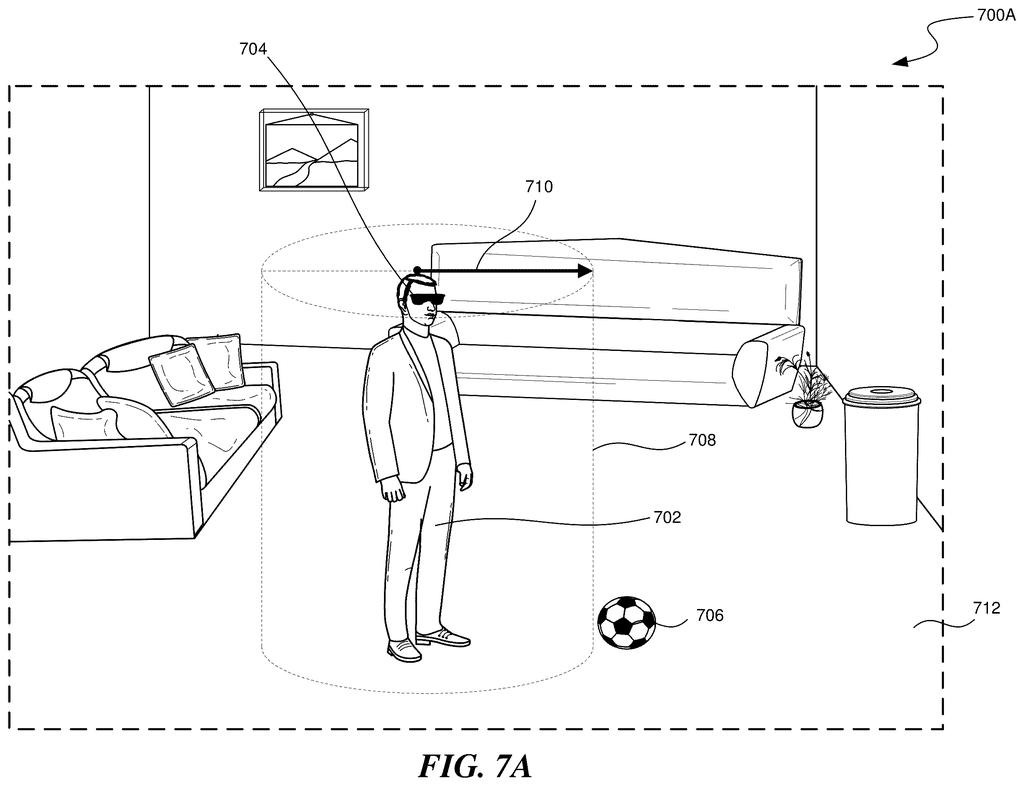
How Meta's auto-safety zone works in your living room
You're wearing a VR headset and you start walking toward your couch without realizing it. Right now, most headsets require you to manually draw a safety boundary before you ever put the headset on, a process that involves looking around the room or physically tracing the floor. If you skip it or your furniture moves, the headset doesn't know.
Meta's patent describes a system that handles this automatically. The headset uses its depth sensors to draw a fixed-size circle around you, checks whether anything inside that circle (a chair, a wall, a pet) is in your way, and then updates that circle every time you take a step. You never have to trace anything.
When the system spots a hazard inside the circle, it can show you the real world through the headset's cameras or overlay a 3D outline of the obstacle, so you can see what you're about to bump into. The whole thing runs continuously in the background while you're in virtual reality, without you doing a thing.
automatically detecting, by an artificial reality system, characteristics of a first portion of a real-world environment by at least partially scanning the depth of objects, away from the artificial reality system, in the real-world environment within a fixed radius of the artificial reality system …
Translation: The headset uses sensors to measure the distance of nearby objects within a set range to map the room around you.
How the fixed-radius depth scan updates on the move
The patent describes a method with two main jobs: draw a boundary, then keep it accurate as the user moves.
First, the artificial reality system (the headset) scans the depth of objects in the real world within a fixed radius around itself. Depth sensing here means measuring how far away surfaces are, the same basic idea as a car's parking sensors, but done with cameras or infrared. It does not need to identify what the objects are (it does not need to know "that's a lamp"), only whether something is close enough to be a hazard.
Second, when the user moves, the system re-scans a new portion of the environment using the same fixed radius centered on the new position. The boundary updates automatically to reflect the new surroundings. The claim specifically covers:
- Scanning depth within a fixed radius of the headset
- Generating a boundary from those depth readings
- Detecting movement and re-scanning the new area
- Determining whether newly detected objects are hazards
- Rendering the VR experience differently based on that hazard determination
When a hazard is detected, the headset can either show a mesh overlay (a wireframe ghost of the real object drawn into the virtual scene) or switch to passthrough mode (showing the real camera feed), triggered when the user or a body part gets too close to the obstacle.
Instead of requiring a user to look around a real-world environment with an XR system and/or trace the available floorspace for a boundary, an automatic boundary system can create a boundary of fixed size around the user by using depth sensing to dynamically identify obstacles within the boundary as the user moves.
Translation: You no longer have to manually draw a safety zone on the floor because the system automatically tracks obstacles as you walk.
What this means for everyday VR headset safety
For anyone who has ever set up a VR headset in a small apartment, the current boundary-drawing process is a real friction point. You have to do it every session, it requires enough clear floor space to walk around, and it breaks down the moment you rearrange the furniture. A system that handles this passively, every time you move, removes a step that currently discourages casual use of these devices.
From a patent-strategy angle, this filing is broad enough to cover any depth-based, auto-updating boundary system centered on a fixed radius, which is a fairly wide net. It covers the core loop (scan, generate boundary, detect movement, re-scan, update, respond to hazards) without locking in a specific sensor type or headset model, making it relevant to the full range of Meta Quest hardware and any future devices. AR headset safety boundaries are an active area of interesting tech patents, and this one stakes out the automatic, movement-triggered re-scan as distinct from manual or one-time boundary-drawing approaches.
That makes this Meta's 60th filing we've tracked since May in the AR glasses race, a list that already includes a lower-memory display sharpening idea and a self-explaining AI headset application.
Claim 1 covers a full loop of actions: the headset scans the space around a user with depth sensors, draws a circle of fixed size around that user, watches for movement, rescans, and then highlights any obstacle inside that circle as a warning. Crucially, the claim specifies none of the underlying tools, so it applies regardless of how distance is measured or how the warning is displayed.
That scope matters because it pulls in any headset that automatically refreshes a safety boundary using depth sensing and movement tracking, which describes the obvious engineering path any company would take when solving this problem. The one firm limit is the fixed circle. A boundary that flexes to fit a room's shape falls outside the claim, but a rigid circle is also the cheapest and simplest solution, so that restriction may exclude very little real competition in practice.
Get our take in your Top Stories
Liked this breakdown? Add Patentlyze as a preferred source on Google, and our plain-English take shows up more often in your Top Stories the next time Meta patent news breaks.
There are more where this came from
We read every patent application Big Tech publishes and send you the ones worth knowing. Plain English, free, every week.
The drawings
14 drawing sheets from US 2026/0253343 A1 · click any drawing to enlarge


Want this weekly breakdown for a company we don't cover? Patentlyze Pro →
Be the first to weigh in