Samsung
Samsung · AR / VR · Filed Apr 16, 2026 · USPTO published Aug 27, 2026 · Aug 27 release
Samsung Patents a System That Reads Your Virtual Conversations to Exaggerate Avatar Emotions
When you talk to someone in a virtual world, your avatar probably looks flat and unresponsive. Samsung's new patent wants to fix that by reading what you're saying in real time and making your avatar visibly, physically react to the emotional weight of the conversation.
- Publication number
- US 2026/0253271 A1(US20260253271A1)
- Applicant
- SAMSUNG ELECTRONICS CO., LTD.
- Filed · Published
- Apr 16, 2026 · Aug 27, 2026
- Inventors
- Natasha MEENA, Rajat KUMAR
- Status when we published
- Waiting for an examiner
- Document
- 15 claims
- US classification
- 345/589
- Parent application
- Continuation of PCT/KR2024/006639 (filed May 16, 2024)(PCTKR2024006639)
How Samsung wants avatars to feel more emotionally alive
You're hanging out with a friend in a virtual world, having a heated argument, and your avatar just... stands there, barely moving. The emotional gap between what you're feeling and what your character shows is one of the most jarring things about current virtual spaces.
Samsung's patent describes a system that listens to the conversation happening between avatars and figures out the emotional temperature of the moment. It factors in not just the words but the relationship between the people talking, then decides how much your avatar should physically react and how the surrounding virtual space should shift to reinforce that emotion.
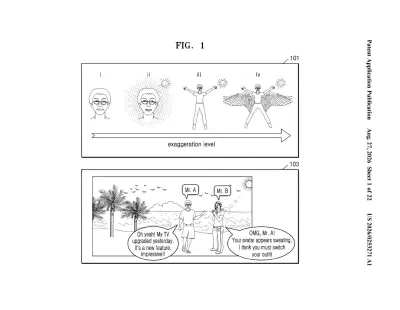
Think of it like a director adjusting the camera angle and background lighting to match a dramatic scene. The system picks an "exaggeration level" and uses that to reshape how your avatar moves and how the space around it responds, all automatically and in real time.
… determining an emotional reaction state associated with the one or more graphical representations based on a contextual analysis of the conversational data and the relational data; determining, based on a plurality of parameters associated with the emotional reaction state, an exaggeration level corresponding to the emotional reaction state …
Translation: The system analyzes what avatars are saying and how they know each other to decide how much to amplify their emotional response.
How the system maps conversation context to avatar space
The patent describes a multi-step pipeline that starts with conversational data pulled from two or more avatars talking in a virtual space. The system also pulls in relational data, meaning it accounts for who these avatars are to each other (friends, strangers, rivals) to calibrate how strong a reaction is appropriate.
From there, the system runs a contextual analysis to assign an emotional reaction state, essentially a label for what kind of emotion the moment calls for. Based on that state, it calculates an exaggeration level (how intensely the avatar should react) along with a set of emotion indicators (specific behavioral cues, like posture, gesture, or facial expression direction).
- The system maps those indicators across a grid of space points in the virtual environment, each with its own configuration values that govern how the space itself morphs or shifts.
- It then combines those space values with the avatar's starting position and pose (called initial configuration values) to get final configuration values.
- The avatar is then re-rendered in real time to reflect the emotional moment, with both the character and its surrounding virtual space adjusted together.
The result is that emotional intensity gets expressed not just through the avatar's face or limbs, but through the environment around it, a bit like how movies use wide shots, close-ups, and set design to carry dramatic weight.
The disclosed methodology further determines space configuration values corresponding to the one or more avatars, respectively, for configuring the surrounding virtual space for exaggeration of the reaction of the one or more avatars based on the emotional reaction state, the emotion indicators, and the exaggeration level.
Translation: The software changes the virtual environment itself to make the avatars' reactions look more dramatic.
What this means for social VR and avatar expressiveness
For anyone spending real time in social VR platforms, the flatness of avatar expression is a persistent frustration. Current systems can map basic facial landmarks from a camera, but they rarely capture the emotional arc of a conversation in context. Samsung's approach tries to solve that by treating the conversation itself as data, not just the speaker's face.
The filing sits at the intersection of social computing and avatar animation, an area where companies building VR and mixed-reality social spaces are actively competing. Whether this becomes part of a Samsung headset or a broader platform play is unclear, but the direction is consistent with where Big Tech patent news shows the industry moving: making virtual presence feel less like a puppet show and more like a real exchange.
That makes this Samsung's 37th filing we've tracked since May in the AR glasses race, following applications like the hand gesture fix and auto-deleting stale frames.
Source: US 2026/0253271 A1 at the USPTO (PDF). Full patent text and figures are in the official publication.
Get our take in your Top Stories
Liked this breakdown? Add Patentlyze as a preferred source on Google, and our plain-English take shows up more often in your Top Stories the next time Samsung patent news breaks.
Add Patentlyze on Google
One click.
There are more where this came from
We read the new patents from Big Tech, carmakers and more and send you the ones worth knowing. Plain English, free, every week.
The drawings · 22 sheets
22 drawing sheets from US 2026/0253271 A1 · click any drawing to enlarge


Show the other 14 sheets


More from Samsung
All 1,662 Samsung patents →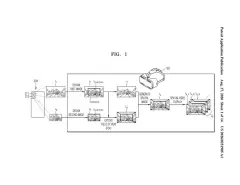
More in AR / VR
All 718 AR / VR patents →
Qualcomm
Qualcomm Patents a Way to Keep Two Spots Sharp in VR Headsets at Once
Meta
Meta Files Patent for AR Headsets That Explain Their AI Decisions
Meta
Meta Patents a Lower-Memory Way to Sharpen AR and VR Display Frames
Sony