
Meta Patents a Projector Tilt Fix That Stops Double Images in AR Glasses
If you've ever seen a faint double image floating in a heads-up display or AR headset, you know how distracting it is. Meta has filed a patent for a surprisingly low-tech-sounding fix: just tilt the projectors.
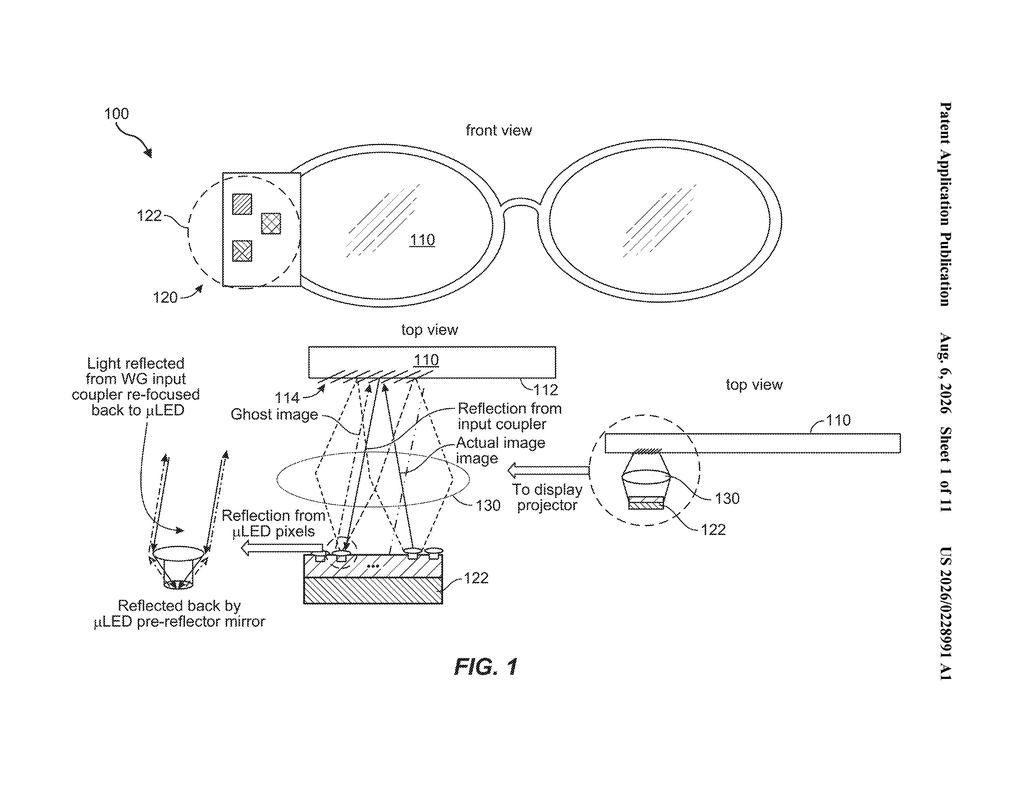
What Meta's ghost image problem in AR glasses actually is
Imagine looking through a pair of AR glasses and seeing the digital navigation arrow you need, plus a faint, ghostly copy of it hovering nearby. That ghost image isn't a software bug. It's stray light bouncing around inside the thin glass layer (called a waveguide) that carries the picture to your eye.
Meta's patent describes a way to reduce those ghost images by physically angling each tiny projector that shines light into the waveguide. Instead of pointing the projector straight at the glass, you tilt it by at least half the width of its own picture. That changes where the stray reflections end up, keeping them out of the zone your eye actually sees.
The display uses two projectors per waveguide, each aimed at its own entry point in the glass. Both get the same tilt treatment. The result, in theory, is a cleaner, crisper AR image with fewer distracting artifacts.
the first projector is oriented at a first tilt angle relative to the waveguide surface and the second projector is oriented at a second tilt angle relative to the waveguide surface, the first tilt angle is at least one-half of a field of view of the first projector …
Translation: Each mini projector is angled sharply against the glass surface to properly align the visual projections.
How the projector tilt angle blocks unwanted light bounces
AR glasses work by bouncing light through a thin transparent waveguide (essentially a flat slab of specialized glass) and then redirecting it toward your eye at the right angle. The problem is that light is messy: some of it reflects off surfaces inside the waveguide at unintended angles, creating secondary images that land where they shouldn't.
Meta's design uses two projectors (small light engines, likely microLED or LCOS-based) each aimed at a separate input optical element (a grating or coupler that funnels light into the waveguide). The key detail is the tilt angle: each projector is rotated relative to the flat waveguide surface by an amount at least equal to half its own field of view.
Why half the field of view? The field of view defines the full angular spread of the projected image. If stray light from the far edge of that spread would normally bounce back into the display zone, tilting the projector moves those stray rays outside the angular range that reaches the user's eye, which is the display field of view (FOV).
- Two projectors, each with its own entry coupler
- Each projector tilted by at least 50% of its own FOV angle
- Tilt redirects ghost-causing reflections out of the user's eyebox
- The display FOV itself is preserved
… first and second projectors respectively configured to emit first and second display light to the first and second input optical elements and couple the first and second display light into the waveguide …
Translation: Two separate projectors send light into optical channels on the glass to build the final image.
What this means for the next wave of Meta AR headsets
Ghost images are one of the most common complaints about current AR waveguide displays, and they're a real barrier to making AR glasses feel polished rather than prototype-ish. A fix that works at the hardware geometry level, without adding extra optical coatings or complex software correction, could be simpler to manufacture and more reliable across different lighting conditions.
Meta is actively building toward consumer AR glasses (the company has shown roadmap hardware publicly), and display quality is a known weak point in the category. A patent like this, filed in early 2026, fits the timeline for hardware that could ship in the next generation of Ray-Ban Meta successors or a more capable standalone AR device.
This is the kind of unglamorous optical engineering that separates AR glasses people actually wear from AR glasses that live in a demo room. Tilting a projector sounds almost too simple, but the geometry here is real and the ghost-image problem is genuinely annoying in current waveguide displays. Worth watching as a signal that Meta is sweating the details on display quality.
There are more where this came from
We read every patent application Big Tech publishes and send you the ones worth knowing. Plain English, free, every week.
The drawings
11 drawing sheets from US 2026/0228991 A1 · click any drawing to enlarge


Want this weekly breakdown for a company we don't cover? Patentlyze Pro →
Be the first to weigh in