
Plastic Film Patent Targets Heat Buildup in Lightweight Wearable Display Lenses
AR headset lenses have a heat problem: the bright light sources packed behind them can warp or degrade the optics over time. Meta may have found a fix hiding inside the plastic film itself.
What Meta's lens film actually does for AR headsets
Imagine a sheet of plastic wrap that's completely clear, stiffer than most engineering plastics, and can pull heat away from a light source without any fans or metal heat sinks. That's roughly what Meta is describing here.
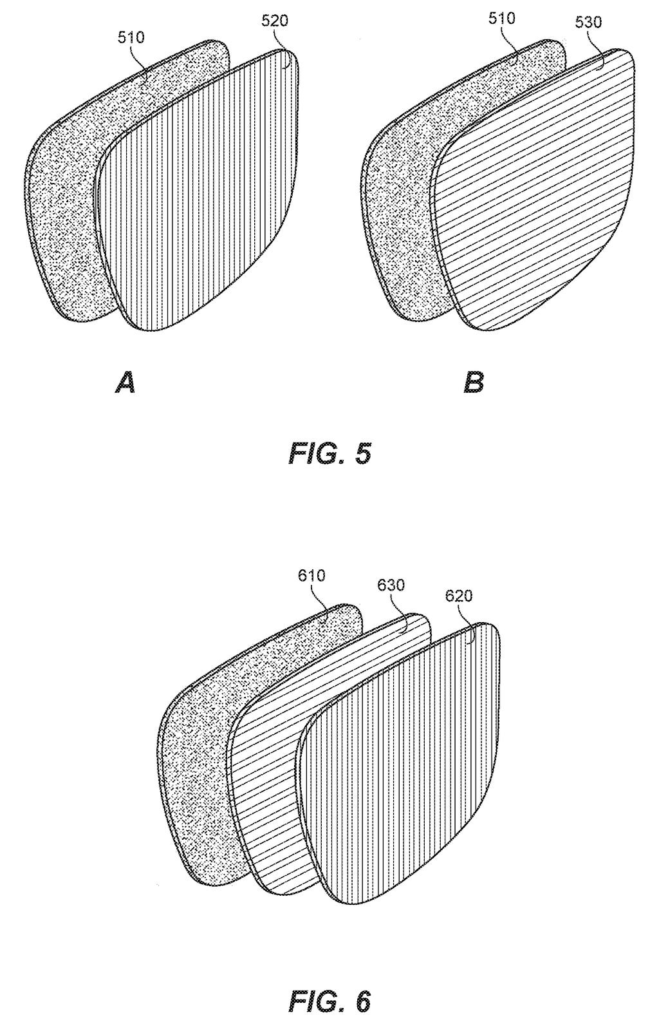
The patent covers a special film made from ultra-high-molecular-weight polyethylene, the same family of plastic used in bulletproof vests, but stretched and processed so it becomes transparent. Two or more of these films are stacked on top of each other at slightly rotated angles, a bit like crossing two window screens, which evens out the stiffness in all directions and spreads heat more uniformly.
The goal is an optical lens layer that keeps its shape under heat, adds structural rigidity without adding bulk, and stays crystal clear. For a device like AR glasses, where every gram and every millimeter of thickness matters, that's a meaningful engineering challenge to solve in one material.
How stacked polymer layers spread heat and add stiffness
The patent describes an optical element built from stacked layers of anisotropic polymer thin film (a film whose physical properties differ depending on which direction you measure them) made from ultra-high-molecular-weight polyethylene (UHMWPE), a plastic with extremely long molecular chains that give it unusual stiffness and thermal conductivity.
Each film layer must hit three targets simultaneously:
- Transparency: at least 80% of visible light passes through
- Low haze: less than 5% scattering, so images stay sharp
- Stiffness: an in-plane elastic modulus of at least 10 GPa (for comparison, most ordinary plastics land between 1 and 4 GPa; this is in the range of aluminum)
The key structural trick is the rotational misorientation of stacked layers. Each film's crystalline axes are oriented in a specific direction, like the grain in wood. By rotating one layer relative to the next by an angle between just above 0 and 90 degrees, the stiffness and thermal conductivity are distributed more evenly across the whole element rather than concentrated in one direction.
The thermal conductivity piece matters because light-emitting devices in AR optics (such as micro-LED arrays) generate heat that has to go somewhere. This film is designed to conduct that heat laterally away from the source, acting as a passive heat spreader without added metal layers or bulk.
What this means for thinner, cooler AR glasses
AR and mixed-reality headsets face a brutal set of trade-offs: powerful displays need to be packed close to the eye, which generates heat and requires stiff, precise optics, but the whole device also has to be light enough to wear comfortably. Metal heat spreaders add weight; thick lenses add bulk. A film that handles stiffness and thermal management in a layer thinner than a human hair is the kind of materials shortcut that can actually move a product forward.
For Meta's Ray-Ban smart glasses and its Quest and Orion AR headset lines, thermal management in the lens stack is a real engineering constraint. This patent suggests Meta is working on optical components that do more structural and thermal work passively, which could translate to lighter frames, brighter displays, or longer run times before heat becomes a problem for you as the wearer.
This is a genuine materials science patent, not a software abstraction, and the numbers cited (10 GPa stiffness, under 5% haze, at least 80% transmission) are specific enough to suggest real lab work behind it. It's not the most headline-grabbing filing, but it's exactly the kind of foundational component patent that separates companies that build their own hardware stacks from those that buy off-the-shelf parts.
There are more where this came from
We read every patent application Big Tech publishes and send you the ones worth knowing. Plain English, free, every week.
The drawings
22 drawing sheets from US 2026/0217955 A1 · click any drawing to enlarge


Want this weekly breakdown for a company we don't cover? Patentlyze Pro →
Be the first to weigh in