
Microsoft Patent Lets AI Remix Game Sound Effects in Real Time
Imagine being able to turn every gunshot in every shooter you own into a cartoon "pew" sound, or swap all horror-game screams for something less startling, without installing a mod or waiting for the developer to add the option. That's the core idea behind this Microsoft patent.
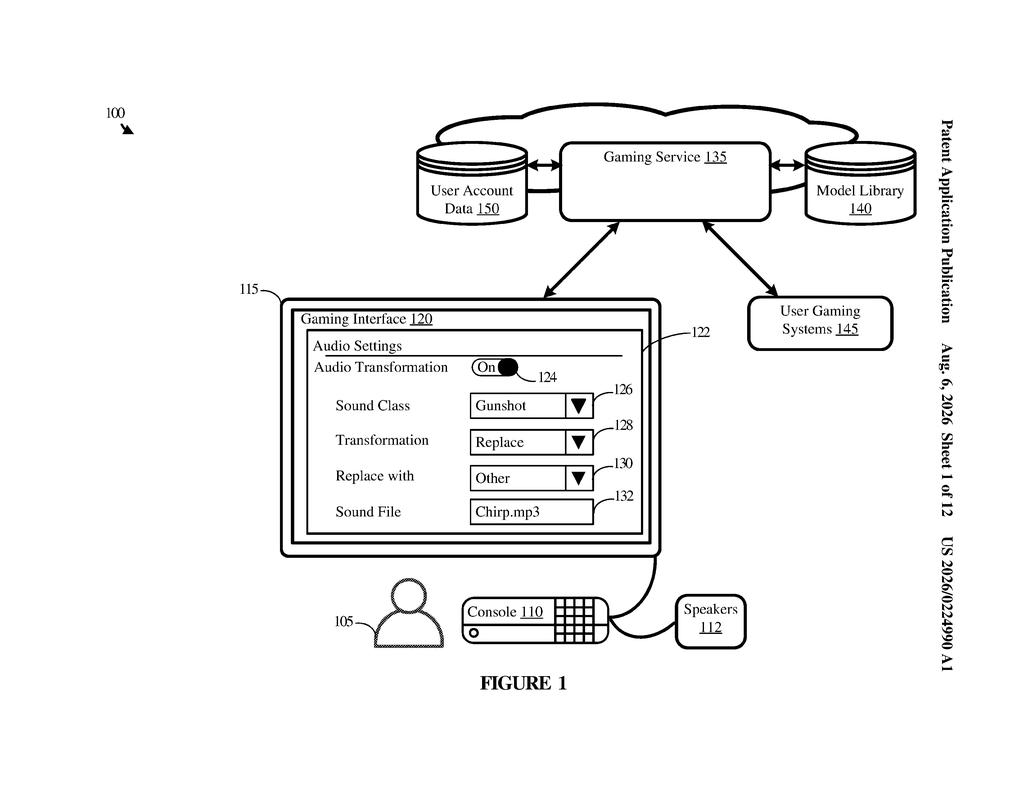
What Microsoft's AI audio filter actually does for gamers
Picture this: you're sensitive to loud explosion sounds, or you just find a game's default gunfire grating after hours of play. Right now, your only options are to turn the volume down (losing everything else) or hope the developer shipped a sound pack. Microsoft's patent describes a different approach: a system-level AI filter that sits between the game and your speakers and rewrites specific sounds on the fly.
You'd pick a sound category (say, "gunshots" or "footsteps") and a transformation style (quieter, cartoonish, muffled, futuristic), and the AI handles the rest, in every game you play, automatically, without needing any special support from the game itself.
The key detail is that the setting follows your account, not any individual game. Set it once, and the system applies your audio preferences across your entire library.
receiving, at a gaming device, a user selection of a sound class and a transformation type, wherein the user selection applies to all gaming instances instantiated by the gaming device and associated with a user account of a user associated with the user selection …
Translation: Players can pick specific sound categories and effects that apply globally to all their games.
How the generative AI model intercepts and rewrites audio
The patent describes a pipeline that intercepts a game's live audio output before it reaches your speakers or headset. A generative AI model (a neural network trained to understand and recreate audio) monitors the stream in real time, identifies sounds that belong to a chosen sound class (a category like "explosions," "environmental ambience," or "voice dialogue"), and applies a transformation type (a stylistic change the user specified upfront).
The system generates a text-or-structured prompt from the user's settings and feeds it to the pretrained AI model each time a new game starts. That prompt tells the model what to listen for and how to alter it. The transformed audio stream then replaces the original as the game's audio output.
What makes this different from existing equalizers or audio presets:
- It operates at a semantic level, the AI distinguishes a gunshot from a door creak, not just by frequency but by what the sound is.
- It works across any game without game-specific programming or modding.
- Settings are tied to a user account, so they persist across sessions and devices.
The model is described as "pretrained," meaning Microsoft would train it on a large library of game audio beforehand, and users would just configure preferences rather than train anything themselves.
The described technology allows for processing and transforming all dynamic audio streams on a system without specific programming for a particular application or game.
Translation: The system modifies game audio universally without needing developers to update individual titles.
What this means for game audio accessibility and customization
For gamers with sensory sensitivities or hearing conditions, this kind of system-level audio control could be a genuine accessibility tool. Today, studios implement (or skip) custom audio settings game by game, which means accessibility options are inconsistent. A platform-level filter that works everywhere changes that calculus entirely.
For Microsoft specifically, this fits neatly into the Xbox ecosystem's existing accessibility focus. If this technology were built into an Xbox console or Windows gaming mode, it would give the platform a differentiated feature that game developers get for free. That's a meaningful incentive for both players and publishers. The broader question is latency, real-time AI audio transformation is computationally expensive, and the patent doesn't specify how the system handles that tradeoff.
This is a genuinely useful idea with an obvious home on Xbox. The accessibility angle is real, not marketing spin, and the system-wide approach solves a fragmentation problem that has frustrated players for years. Whether Microsoft can make the AI fast enough to avoid any audible lag is the only thing standing between this patent and a feature worth shipping.
There are more where this came from
We read every patent application Big Tech publishes and send you the ones worth knowing. Plain English, free, every week.
The drawings
12 drawing sheets from US 2026/0224990 A1 · click any drawing to enlarge


Want this weekly breakdown for a company we don't cover? Patentlyze Pro →
Be the first to weigh in