
Xilinx Patents a Multi-Ring Light Modulator for Faster On-Chip Data Links
Xilinx has filed a patent for a new kind of optical modulator that uses multiple tiny light-bending rings wired together to push data faster through silicon chips while losing less signal along the way.
What Xilinx's multi-ring optical modulator actually does
Imagine your phone's cellular signal getting weaker the moment you walk into a building. Something similar happens inside data center chips: when you try to send data faster over a light-based connection, the signal gets distorted and weakened. That tradeoff has been a persistent headache for chip designers working with photonics.
Xilinx's patent describes a way to wire up several small ring-shaped light modulators (devices that encode data onto a beam of light) so they work together as a team. By connecting them through a shared electrical component called an inductor, the design lets them run at higher speeds without the usual signal penalty.
The practical result is a chip building block that could send more data across optical links inside servers and networking hardware, using less power to do it. There are also built-in heaters with a clever substrate design to keep the rings tuned to the right frequency as temperature shifts.
How the inductor and junction wiring boost signal speed
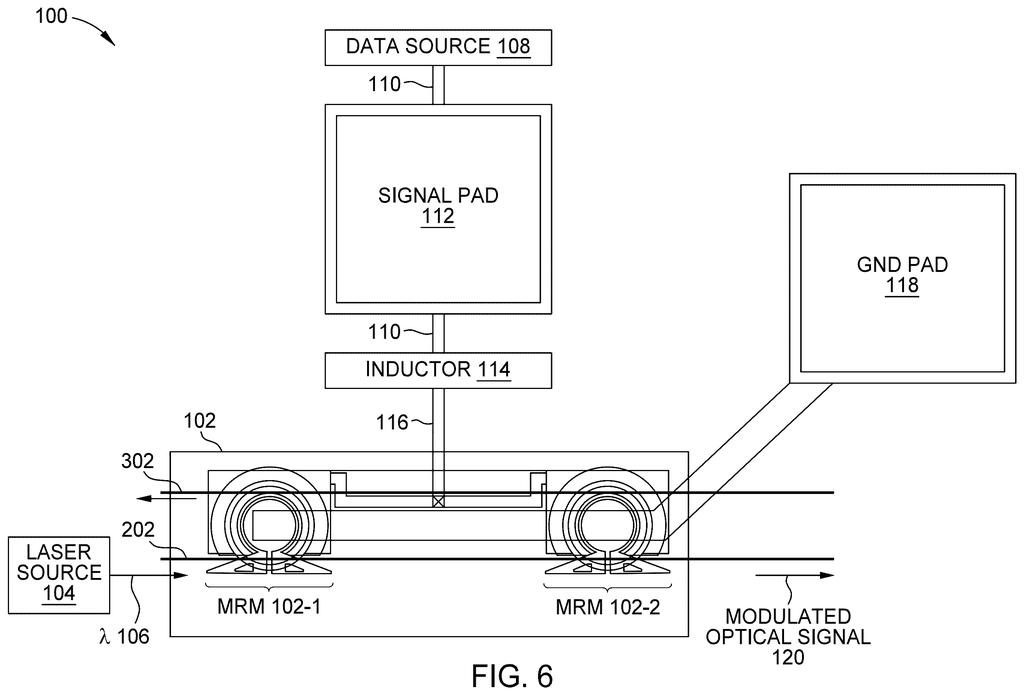
The patent describes an integrated circuit device built around a throughput waveguide (a tiny channel that guides a beam of light across the chip) with several micro-ring modulators (MRMs) sitting alongside it.
Each MRM is a microscopic ring of silicon that can be switched electrically to change how it interacts with the light passing through the waveguide, encoding a 0 or 1 onto the beam. The key innovation here is how those rings are wired up:
- The P junctions (positive-side electrical contacts) of all the MRMs are tied together.
- The N junctions (negative-side contacts) are also tied together.
- An inductor (a coiled electrical component that resists rapid changes in current) connects the signal input pad to those shared N junctions.
This LC-style circuit (inductor plus the capacitance of the junctions) creates a resonance that effectively extends the modulator's usable bandwidth, letting it encode data at higher frequencies than a single ring could manage alone. The patent also specifies that all the rings are tuned to the same optical wavelength, and heater elements with recessed substrate features keep them thermally stable, since even small temperature changes can knock a ring out of tune.
What this means for data center chip interconnects
Silicon photonics (using light instead of copper wires to move data inside and between chips) is a key piece of how data centers are trying to keep up with the bandwidth demands of AI workloads. Modulators are the components that actually put data onto the light, so their speed and efficiency directly cap how fast an optical link can run. A design that gets higher speed without a proportional increase in signal loss is genuinely useful engineering.
Xilinx (now part of AMD) makes FPGAs and data center acceleration chips that are already used in high-speed networking gear. A more capable on-chip optical modulator would fit directly into that product line, potentially improving the bandwidth of chip-to-chip or rack-to-rack links in AI and cloud infrastructure.
This is solid, specific photonics engineering aimed at a real bottleneck in data center silicon. It won't make headlines the way a consumer AI feature would, but the problem it solves (bandwidth versus signal loss in optical modulators) is one that chip designers working on high-speed interconnects genuinely care about. Worth watching if you follow AMD's data center ambitions post-Xilinx.
There are more where this came from
We read every patent application Big Tech publishes and send you the ones worth knowing. Plain English, free, every week.
The drawings
19 drawing sheets from US 2026/0219523 A1 · click any drawing to enlarge


Want this weekly breakdown for a company we don't cover? Patentlyze Pro →