
Nvidia Patents a Rendering System That Remembers Which Lights Matter Most
Every frame in a ray-traced scene forces a GPU to guess which of hundreds of lights is worth calculating. Nvidia's new patent teaches the renderer to stop guessing and start remembering.
How Nvidia's light-memory trick speeds up 3D rendering
Imagine you're lighting a huge concert stage with hundreds of spotlights, and you have to decide in a split second which ones to actually bother aiming a camera at. Most of them won't matter for any given shot. Nvidia's patent describes a system that tracks, frame by frame, which lights in a 3D scene actually contributed brightness to each pixel, then uses that history to make smarter choices on the very next frame.
The key idea is that this information is stored per pixel, so the system knows not just which lights matter for the whole image, but which lights matter for your corner of it. A dark alleyway on the left side of the screen gets different guidance than the bright storefront on the right.
The result is that the renderer spends its limited calculation budget on lights that are likely to matter, rather than randomly sampling across all of them. That means better-looking images in the same amount of time, or the same quality at a lower cost.
How the reservoir system tracks and reuses light statistics
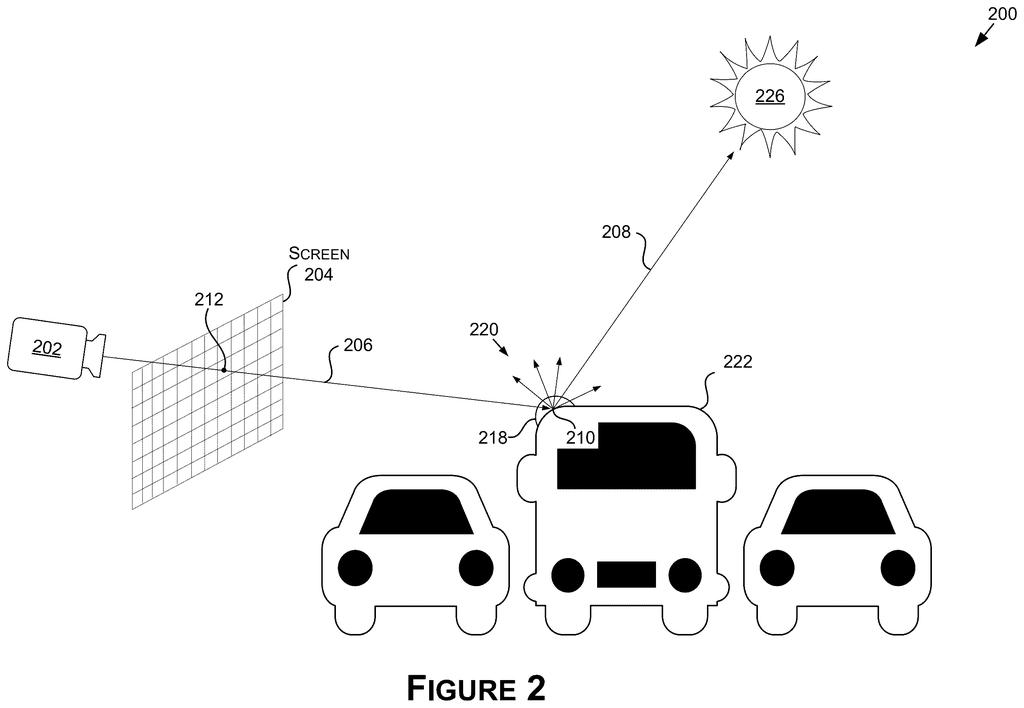
The patent describes an image-space adaptive sampling system for light transport simulation, the math-heavy process at the heart of ray tracing. When rendering a frame, the GPU fires virtual rays from each pixel and checks which light sources in the scene actually contribute brightness to that point. This is called Next Event Estimation (NEE), a standard technique where the renderer explicitly samples light sources rather than hoping a ray accidentally hits one.
What's new here is how Nvidia proposes to remember and reuse that information. The system uses weighted reservoir sampling (a statistical method for picking the most important items from a stream of data without storing all of it) to record, per pixel, which lights contributed the most radiance. Think of a reservoir as a small bucket that holds the "winners" from a weighted lottery.
From those per-pixel statistics, the system generates two types of sampling distributions for the next frame:
- A global distribution covering the whole frame, capturing which lights matter scene-wide
- Local distributions for smaller tiles of pixels, capturing region-specific lighting priorities
Those distributions then guide where the renderer focuses its sampling effort when drawing the next frame. Over successive frames, the system continuously updates its statistics, adapting as lights, objects, and the camera move.
What this means for real-time ray tracing in games and film
Ray tracing is the most expensive part of modern real-time rendering, and light sampling is a major chunk of that cost. The more lights a scene has, the harder it is to know which ones to bother calculating. Nvidia's approach turns the work of one frame into useful guidance for the next, which is a meaningful efficiency gain in scenes with many light sources, like a city at night or a stadium full of fixtures.
This patent fits into Nvidia's broader push around ReSTIR, its family of reservoir-based resampling algorithms already used in games and production renderers. The tile-based local distributions are a practical addition: they let the system handle scenes where lighting varies dramatically across the frame without forcing a one-size-fits-all sampling budget.
This is solid incremental work on a real problem in ray tracing, not a headline-grabbing breakthrough. Nvidia has been building out its ReSTIR ecosystem for years, and this per-pixel, tile-aware sampling approach is a logical extension. If it ships in a future version of RTX or in production rendering tools, it will make complex lit scenes faster without anyone noticing the mechanism.
There are more where this came from
We read every patent application Big Tech publishes and send you the ones worth knowing. Plain English, free, every week.
The drawings
22 drawing sheets from US 2026/0220873 A1 · click any drawing to enlarge


Want this weekly breakdown for a company we don't cover? Patentlyze Pro →
Be the first to weigh in