
Nvidia Patents a Way to Pre-Build the Maps Its GPUs Use to Trace Light
Ray tracing looks incredible, but it forces your GPU to constantly rebuild complex data structures from scratch. Nvidia's new patent describes a way to pre-bake those structures so the GPU can skip straight to rendering.
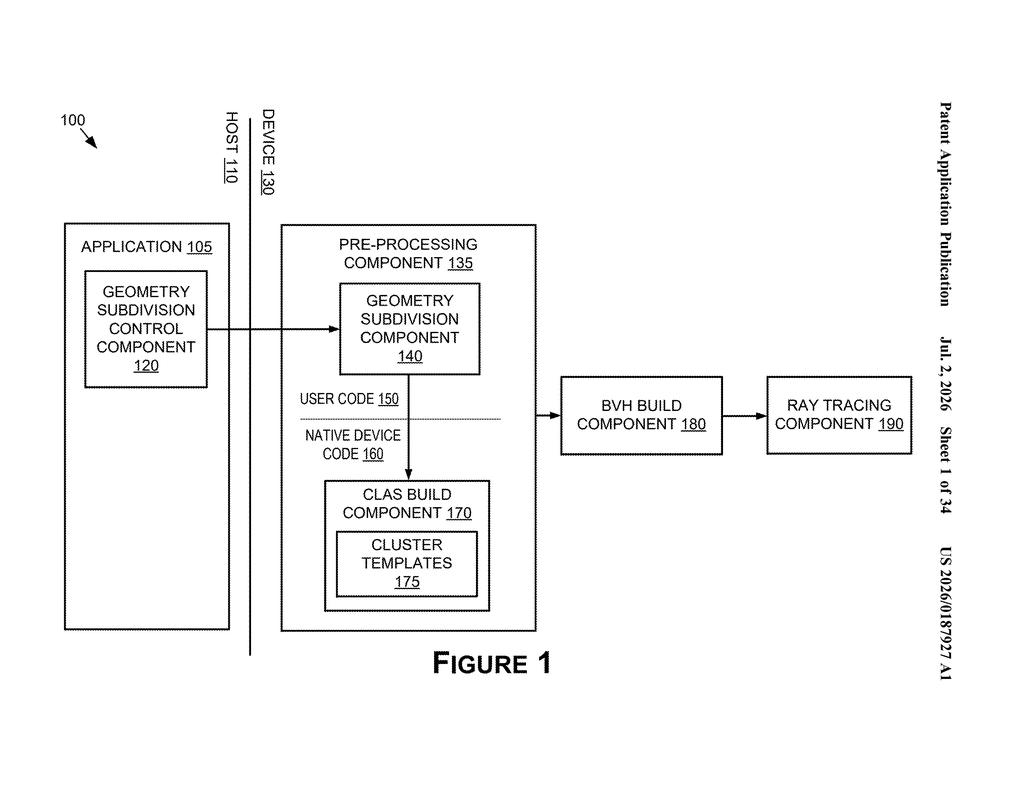
What Nvidia's triangle-cluster shortcut actually does
Imagine a GPS app that has to recalculate the entire road network from raw coordinates every time you ask for directions, instead of loading a pre-built map. That's roughly what modern GPUs do with ray tracing: they spend real time figuring out how 3D geometry is organized before they can even start calculating how light bounces.
Nvidia's patent describes a system where that organizational work is done ahead of time. Groups of triangles (the basic building blocks of 3D objects) get packaged into pre-optimized templates, called cluster templates, that the GPU can grab and use immediately. The system also figures out the best level of compression for each group, either automatically or with a hint from the application.
The result is that the GPU spends less time doing bookkeeping and more time doing actual rendering. For you, that could mean faster frame rates or more detailed scenes in games and other real-time 3D applications that use ray tracing.
How the cluster templates and triblock layout work together
Ray tracing works by testing whether rays of simulated light hit any surfaces in a scene. To do that quickly, the GPU needs a bounding volume hierarchy (BVH), essentially a tree-shaped index that lets the GPU rapidly narrow down which triangles a ray might hit, rather than testing every triangle individually. Building that tree is expensive.
This patent introduces cluster templates: pre-computed BVH subtrees for common triangle arrangements. Instead of building the tree structure at render time, the GPU looks up the right template from a library, copies it into memory, and slots in the actual vertex positions. The heavy structural math is already done.
The system also handles different compression levels for vertex data (the coordinates that define where each triangle sits in 3D space). A CPU application can specify how much compression to apply, or the GPU can figure it out on the fly by inspecting the geometry. This means tighter data packing where precision is less critical, freeing up memory bandwidth.
The pre-computed layout the patent calls a triblock is a specific memory arrangement designed to match how Nvidia's parallel processors expect to read triangle data. Aligning the data to that layout in advance means fewer stalls when the GPU actually processes it.
What this means for real-time ray tracing in games and AI
Ray tracing has been a standard GPU feature since Nvidia's Turing cards in 2018, but BVH construction overhead remains one of the key bottlenecks in dynamic scenes where geometry moves every frame. A template-based approach that pre-computes the structural work could reduce that overhead significantly, which matters most in games with dense geometry or in professional rendering and simulation workloads.
For everyday users, the practical signal is smoother ray-traced performance without needing more expensive hardware. For developers, offloading BVH structure decisions to a pre-computed library also simplifies what they have to optimize manually. This kind of low-level acceleration work is exactly the sort of thing Nvidia bakes into its driver stack and hardware interfaces before a new GPU generation ships.
This is unglamorous but genuinely important GPU plumbing. BVH construction overhead is a real, well-documented pain point for real-time ray tracing, and pre-computing structural templates is a logical and practical solution. The compression-level selection feature, where the GPU can choose on the fly, is the most interesting part because it suggests this could adapt to scene complexity without developer intervention.
Get our take in your Top Stories
Liked this breakdown? Add Patentlyze as a preferred source on Google, and our plain-English take shows up more often in your Top Stories the next time Nvidia patent news breaks.
There are more where this came from
We read every patent application Big Tech publishes and send you the ones worth knowing. Plain English, free, every week.
Want this weekly breakdown for a company we don't cover? Patentlyze Pro →