
Nvidia Patents Technology That Fixes Color Distortion Its Own Image Processing Creates
Every time a camera chip tweaks a pixel to look better — adjusting for infrared light, for example — it quietly makes the image noisier. Nvidia's new patent describes a system that tracks exactly how much noise each of those tweaks adds and cancels it out on the fly.
What Nvidia's self-correcting camera noise fix actually does
Imagine your camera is taking a photo in a dimly lit parking garage. The chip inside isn't just capturing raw light — it's constantly making tiny adjustments to individual pixels to improve color accuracy, filter out invisible infrared light, and compensate for sensor quirks. The problem is that each of those adjustments adds a little bit of visual noise, like static on an old TV.
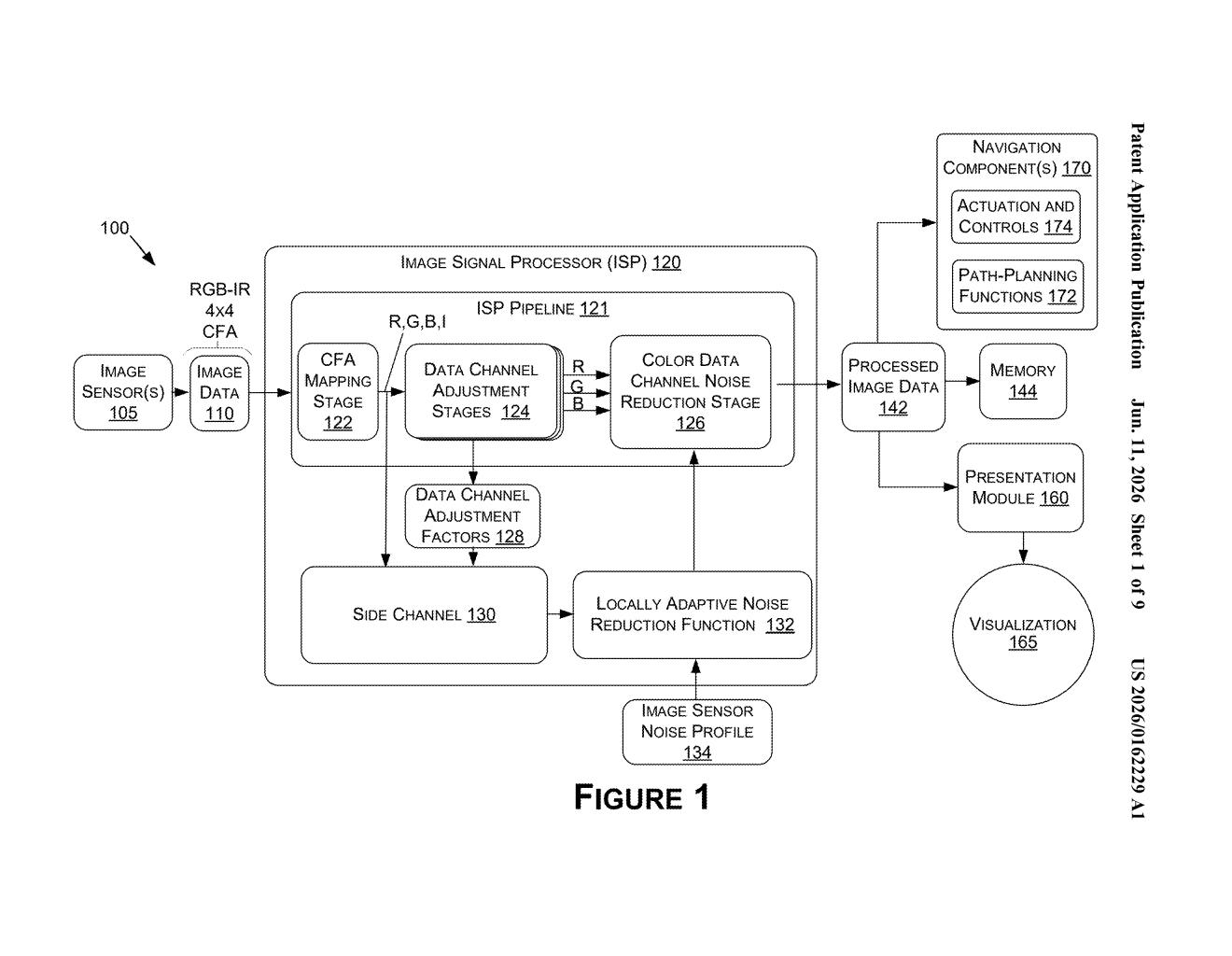
Nvidia's patent describes a smarter cleanup step built right into that adjustment process. Instead of applying a one-size-fits-all noise filter at the end, the system keeps a running log — a kind of "noise map" — of exactly how much extra noise each pixel-level tweak introduced. That map is then fed directly into the noise-reduction stage so it can cancel out precisely what went wrong.
The result is that the noise filter always knows the full picture of what it needs to fix, rather than guessing based on a generic sensor profile. You get cleaner images without the blur or washed-out detail that comes from over-aggressive filtering.
How the noise gain map drives the correction stage
The patent targets what's called an Image Signal Processor (ISP) — the dedicated chip (or software pipeline) inside a camera that transforms raw sensor data into a finished image. Modern ISPs apply dozens of adjustments per frame, and Nvidia's focus here is specifically on a tricky one: IR subtraction, where infrared light bleeding into the color channels gets removed pixel by pixel.
The problem is that these locally adaptive adjustments — meaning corrections that vary from pixel to pixel rather than applying uniformly — each carry their own noise penalty. The existing noise-reduction stage only knows about the sensor's baseline noise profile, so it has no idea that some pixels just got hit with extra noise from an aggressive IR correction.
Nvidia's solution is a two-part mechanism:
- An adaptive noise gain map that accumulates noise-amplification factors as each adjustment is applied across the pipeline.
- A noise model adjustment function that reads that map and computes supplemental corrections on top of the baseline sensor profile, producing what the patent calls a composite noise map.
That composite map is what actually gets handed to the noise-reduction stage. Because it reflects both the sensor's innate noise and all the noise introduced by processing steps, the filter can be precisely targeted rather than broadly applied.
What this means for cameras in cars and low-light devices
This kind of patent is squarely aimed at automotive and robotics cameras — exactly the kind Nvidia's DRIVE platform relies on. Cameras in self-driving systems work in wildly varying light conditions and lean heavily on IR filtering, so accumulated pixel-level noise is a real engineering headache, not a theoretical one.
For consumer devices, the same logic applies to any camera that does heavy computational photography — night mode, portrait depth sensing, or multi-spectrum capture. If Nvidia's approach works as described, it could mean cleaner low-light images without the soft, over-smoothed look that aggressive noise filtering typically produces. That's a trade-off photographers and phone-camera users run into constantly.
This is unglamorous but genuinely useful signal-processing work. The core insight — that noise introduced by adaptive adjustments should be tracked and corrected adaptively too, not patched over with a generic filter — is elegant and practically motivated. It's the kind of patent that quietly ends up in every camera chip Nvidia ships for cars and robots.
There are more where this came from
We read every patent application Big Tech publishes and send you the ones worth knowing. Plain English, free, every week.
Want this weekly breakdown for a company we don't cover? Patentlyze Pro →