
Nvidia Patents an AI That Powers Down Idle Data-Transfer Connections Automatically
Datacenters burn enormous amounts of electricity keeping network ports switched on even when nothing is passing through them. Nvidia wants an AI to watch the traffic and decide, port by port, when it's safe to power down.
How Nvidia's AI manages datacenter power ports
Imagine a highway with hundreds of on-ramps. Most of them sit empty at 3 a.m., but the lights stay on anyway. Datacenters have the same problem: their network switches keep every connection port fully powered whether or not any data is moving through it.
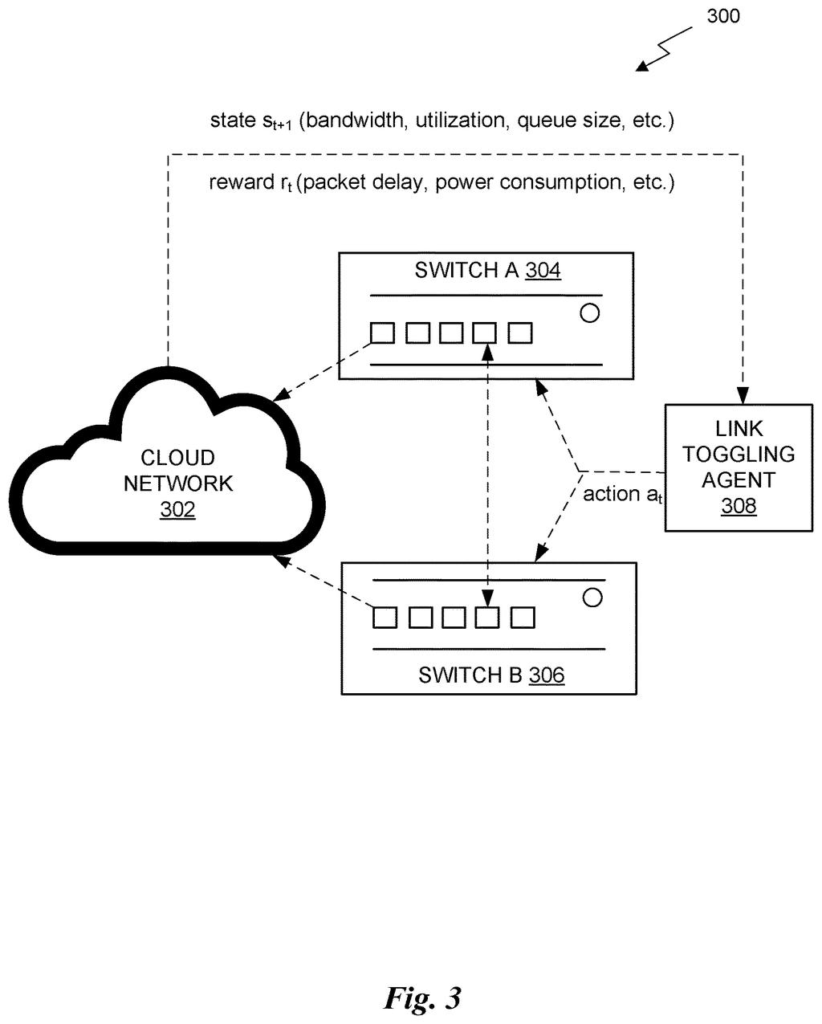
Nvidia's patent describes an AI that watches what's actually happening across all those ports and learns when it's safe to put a quiet port into a low-power mode, then wake it back up when traffic picks up again. The system trains itself by looking at real traffic patterns from network cards across the whole datacenter, not just one port at a time.
The result is a system that adapts to whatever mix of busy and idle traffic your network happens to have at any given moment, rather than following a fixed schedule someone programmed in advance.
How the neural network picks a port's power mode
The patent describes a reinforcement learning system (a type of AI that learns by trial and reward, the same basic idea behind game-playing AIs) applied to network switch port management.
Here's the core process:
- The system collects operational data from multiple network interface cards (NICs), the hardware components that physically connect servers to the network.
- A neural network is trained using that data to build a policy, essentially a rulebook the AI develops on its own, for deciding which power mode each port should be in at any given moment.
- Once trained, the neural network watches live state information from one or more ports and outputs a mode decision: stay active, go to low power, or something in between.
- The switch then actually changes the port's operating mode based on that decision.
The key difference from existing approaches is scope. Current power-saving systems typically handle one traffic type or one port in isolation. This system looks across many devices simultaneously and adapts its decisions based on the full picture of what the network is doing.
What this means for datacenter electricity bills
Network switches are everywhere in datacenters, and even small reductions in per-port power consumption multiply across thousands of ports and thousands of racks. For hyperscale operators running hundreds of thousands of servers, the electricity savings from smarter port management could be meaningful at scale.
For Nvidia specifically, this patent fits into a broader push to make its networking hardware (including the Spectrum switch line it acquired through Mellanox) more energy-efficient. As AI training workloads create spiky, bursty traffic patterns that traditional fixed power policies handle poorly, an adaptive AI-driven approach becomes more attractive.
This is unglamorous but genuinely useful infrastructure work. Power management in datacenters is a real cost problem, and applying reinforcement learning to port-level decisions is a logical extension of how AI is already being used to optimize cooling and workload placement. It's not a flashy consumer product, but it's exactly the kind of filing that ends up in shipping hardware.
There are more where this came from
We read every patent application Big Tech publishes and send you the ones worth knowing. Plain English, free, every week.
The drawings
5 drawing sheets from US 2026/0222245 A1 · click any drawing to enlarge


Want this weekly breakdown for a company we don't cover? Patentlyze Pro →
Be the first to weigh in