
Nvidia Patents an AI Model That Animates Game Characters From Simple Instructions
Nvidia has patented an AI system that can animate a virtual character on the fly, taking simple cues like a destination or an action and producing natural-looking movement without a human animator touching it.
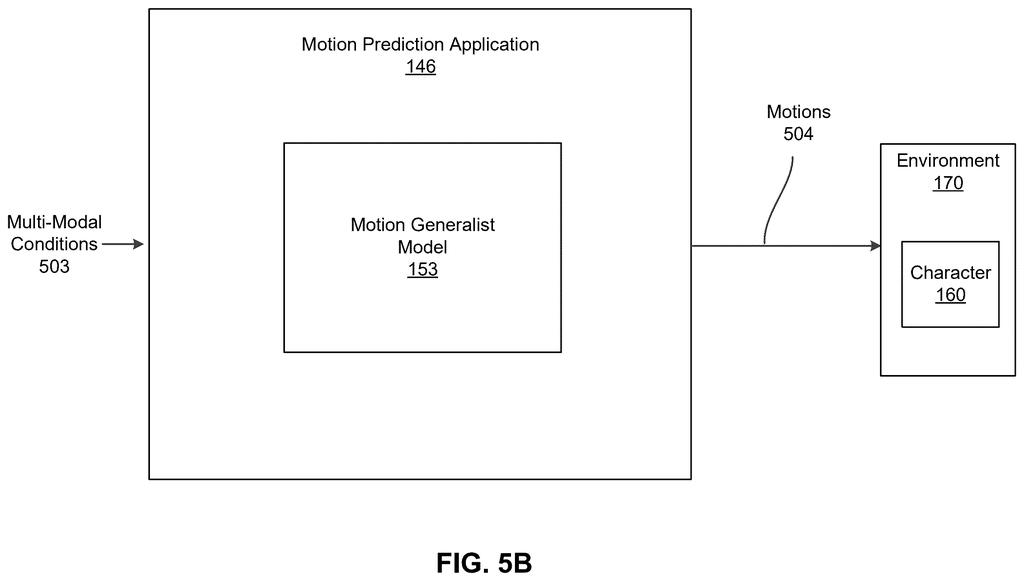
How Nvidia's motion AI turns instructions into character movement
Imagine you're playing a video game and your character needs to climb a wall, dodge an obstacle, or wave at another character. Traditionally, animators record or hand-craft every one of those movements in advance. Nvidia's new patent describes a system where an AI model handles that job instead, generating movement in real time based on whatever the game needs at that moment.
The key idea is that the same AI can work in two different modes. When speed matters most, it produces a motion estimate in a single step, like a quick sketch. When quality matters more, it takes multiple passes to refine the result into something more polished and natural-looking. You get a dial between fast-and-good-enough and slow-and-great, controlled automatically.
This kind of flexibility could let game studios create characters that move more naturally without pre-recording thousands of animation clips, and could make virtual characters in simulations or robotics training feel far less robotic.
How the diffusion model switches between speed and quality modes
The patent describes a trained machine learning model that takes in one or more conditions (inputs like a goal position, a scene description, or a desired action) and outputs a full motion for a character. The model is built on a diffusion architecture, the same family of AI techniques behind image generators like Stable Diffusion, but applied to movement data instead of pixels.
Diffusion models work by learning to remove noise from data step by step. In this system, that process can run in two modes:
- Single-step mode: The model skips most of the refinement and produces a motion estimate in one pass. This is fast but may be less precise, useful for real-time applications where latency is critical.
- Multi-step mode: The model iterates through several denoising passes to produce a more carefully refined, higher-quality motion sequence.
Nvidia frames this as a motion generalist model, meaning it is designed to handle a wide range of character types and motion tasks from a single trained system, rather than requiring separate specialized models for walking, jumping, grasping, and so on.
The patent is fairly broad at the claim level, covering the core loop of receiving conditions, running the model in either mode, and applying the resulting motion to a character.
What this means for game animation and real-time characters
Game and simulation studios today rely heavily on pre-recorded motion capture libraries. An AI that can generate convincing movement on demand from high-level instructions would reduce the cost and time of building animated characters, and could make non-player characters feel far more responsive and lifelike than clip-based systems allow. Nvidia's position in both gaming hardware and AI infrastructure makes this a natural area for them to claim territory.
The single-step versus multi-step flexibility is the practical angle worth watching. Real-time games need instant responses; offline rendering or cutscene generation can afford slower, higher-quality passes. A single model that covers both modes is useful in ways that separate specialized tools are not, and could feed directly into Nvidia's existing work on physics-based character simulation and robotics training environments.
This is a solid, strategically sensible filing from Nvidia. The dual-speed diffusion approach is the genuinely interesting piece: it is a real engineering tradeoff that matters in production, not a theoretical nicety. The claim language is broad enough to cover a lot of ground, which is either a strength or a vulnerability depending on what prior art exists in this space.
There are more where this came from
We read every patent application Big Tech publishes and send you the ones worth knowing. Plain English, free, every week.
The drawings
11 drawing sheets from US 2026/0212578 A1 · click any drawing to enlarge


Want this weekly breakdown for a company we don't cover? Patentlyze Pro →