
Nvidia Patents Speed Boost for Encryption Math Using AI Accelerator Hardware
Nvidia's GPUs are packed with matrix-math engines built for AI, and a new patent describes how to put that hardware to work on a totally different class of problem: the modular arithmetic that underpins cryptography and certain privacy-preserving computations.
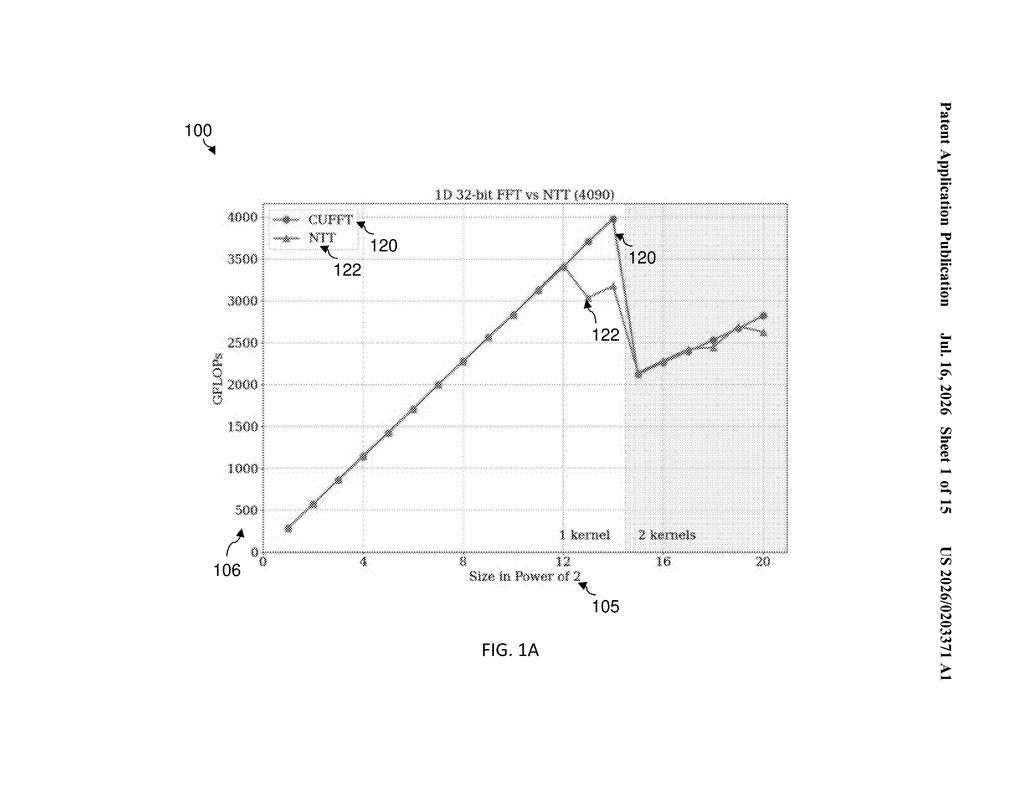
How Nvidia's matrix cores handle number-theory math
Imagine your GPU is like a large office where most desks are staffed by matrix-math specialists, people hired specifically for AI work. A new Nvidia patent asks: what if, during the slow moments, those same specialists could handle a different kind of problem that happens to look similar on paper?
The problem in question is modular multiplication, a type of arithmetic where you multiply two numbers and care only about the remainder. It sounds obscure, but it's the engine inside most modern encryption, digital signatures, and emerging privacy-preserving AI techniques. Right now, that math typically runs on general-purpose parts of the chip, leaving the powerful matrix units idle.
Nvidia's idea is to reframe the modular math problem so it can be fed directly into the same matrix-multiplication hardware that already handles neural network training. You get the answer you need, and you get it using processing power that would otherwise sit unused.
How modular ops get mapped to matrix multiplication inputs
The patent describes a pipeline with several distinct steps:
- Decompose: Take an incoming arithmetic operation (say, a large modular multiplication used in a cryptographic protocol) and break it down into a form the matrix engine can accept.
- Redundant representation: Convert the numbers into a redundant integer vector, a way of expressing a single value as a list of smaller numbers that, together, encode the same information. This is similar in spirit to how a mixed-radix number system works, where you express a value as hours, minutes, and seconds rather than one giant count of seconds.
- Map to matrix inputs: Arrange those integer vectors as rows and columns of a matrix so the chip's existing multiply-and-accumulate hardware can process them in one batch operation.
- Recombine: After the matrix operation finishes, reassemble the partial results (which may be offset to account for place values) into the final answer and return it to the calling thread.
The key insight is that matrix multiplication is already a highly optimized, massively parallel operation on modern GPUs. By expressing modular arithmetic in a form that maps cleanly onto matrix inputs, Nvidia can use that existing throughput instead of waiting for slower general-purpose integer units.
What this means for AI chips doing encryption work
For most consumer GPU buyers, this patent won't change anything visible. But for data-center workloads that mix AI inference with cryptographic operations, think confidential computing, homomorphic encryption experiments, or zero-knowledge proof generation, the ability to run modular math on the same tensor-core hardware that handles the AI work could meaningfully raise throughput without adding new silicon.
Homomorphic encryption (a technique that lets you run computations on encrypted data without ever decrypting it) is notoriously slow, and modular multiplication is its main bottleneck. If Nvidia can offload that bottleneck onto idle matrix hardware, it brings privacy-preserving AI a step closer to practical deployment on standard GPU clusters.
This is a genuinely clever piece of computer-architecture thinking: instead of building a dedicated cryptography accelerator, Nvidia is asking whether the hardware it already ships can be repurposed with the right mathematical framing. The redundant-representation trick is the real innovation here, and it's the kind of low-level work that tends to show up in future CUDA libraries rather than in any product announcement.
There are more where this came from
We read every patent application Big Tech publishes and send you the ones worth knowing. Plain English, free, every week.
Want this weekly breakdown for a company we don't cover? Patentlyze Pro →