
Nvidia Patents a Way to Transcribe Group Conversations Without Mixing Up Who Said What
Getting a transcript of a meeting where people talk over each other is one of the messiest problems in speech technology. Nvidia's new patent describes a system that figures out who is speaking at every moment and separates their words without needing a reference audio clip.
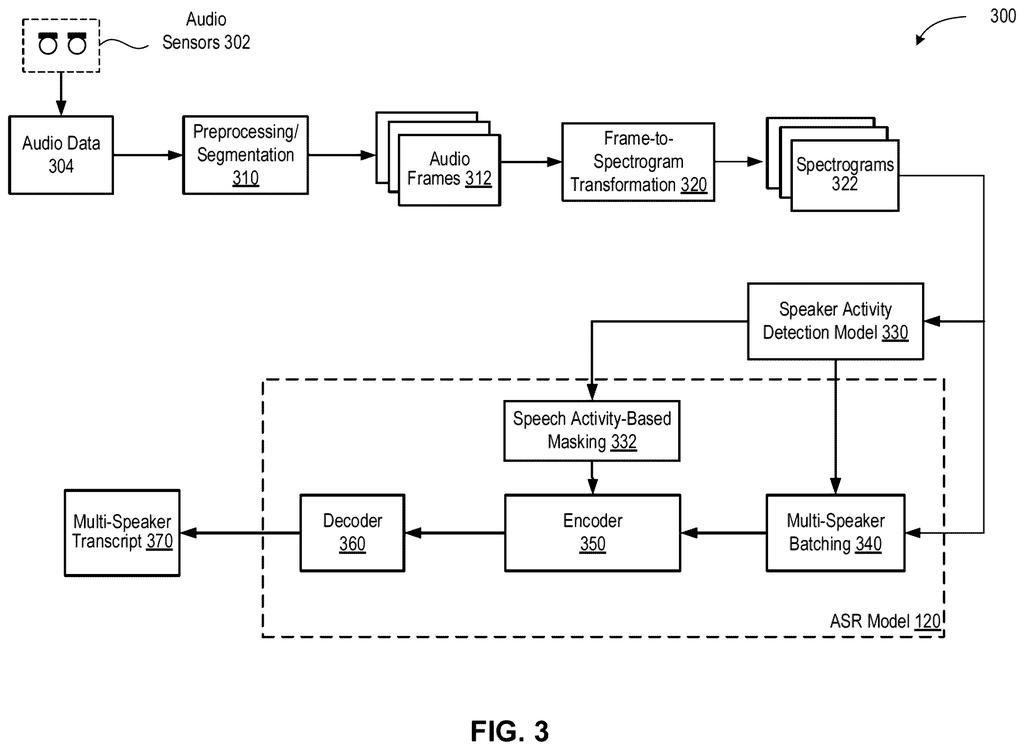
How Nvidia separates voices in a crowded conversation
You're in a video call with five colleagues, and two of them start talking at the same time. The auto-transcript just mushes their words together into one block of text, labeled "Speaker 1" for the whole thing. If you weren't there, you have no idea who said what.
Nvidia's patent describes a system that solves this by tracking when each person is speaking throughout the recording, then using that timing information to pull each speaker's words apart into separate transcripts. Those individual transcripts are then stitched together into one clean record of the whole conversation.
The key part is that the system does this without needing a pre-recorded sample of each person's voice to compare against. It figures out the speaker boundaries on its own, directly inside the speech recognition process. That's a meaningful step toward transcripts that actually reflect who said what in messy, real-world conversations.
… modifying, using a second set of NN layers of the ASR model, the IF to obtain a plurality of modified IFs, wherein an individual modified IF of the plurality of modified IFs is obtained using speaker activity data associated with a corresponding speaker of a plurality of speakers and identifying times when the corresponding speaker speaks in the multi-speaker speech episode …
Translation: The system uses a second layer of AI to isolate specific voices by tracking exactly when each person is talking.
How the neural network tags each speaker's words
The patent describes a modified automatic speech recognition (ASR) model that handles multi-speaker audio in two stages inside a single neural network.
First, a set of neural network layers processes the raw audio and produces what the patent calls an intermediate feature (IF), essentially a compressed mathematical summary of everything happening in the audio. Think of it as a rough sketch of the whole conversation before any words are identified.
Next, a second set of layers modifies that sketch once for each speaker. The system uses speaker activity data (a timeline of exactly when each person is talking, including overlapping stretches) to create a separate, speaker-specific version of the audio summary. Each version, called a modified IF, emphasizes one speaker and suppresses the others.
Finally, each modified IF is decoded into a full transcript for that speaker. The individual transcripts are then combined into one final document:
- Stage 1: shared audio processing produces one general audio summary
- Stage 2: speaker activity data reshapes that summary, once per speaker
- Stage 3: each reshaped summary is decoded into words
- Stage 4: individual transcripts are merged into a single final transcript
The approach avoids the need to supply a reference audio sample (a "query") for each speaker, which is where the "query-less" name comes from.
Disclosed are apparatuses, systems, and techniques for implementing efficient transcription of multi-speaker speech with overlapping utterances using speaker activity detection.
Translation: Nvidia has developed a way to accurately transcribe group meetings even when people talk over each other.
What this means for meeting software and call centers
Meeting transcription is one of the fastest-growing features across enterprise software, and the gap between what AI promises and what actually gets delivered is nowhere more obvious than in crowded, overlapping conversations. Every major video conferencing and note-taking tool has some version of speaker labels, and most of them fall apart the moment two people talk at once. A system that handles overlapping speech without needing pre-registered voice samples could make transcripts reliable enough to act on, not just glance at.
For call centers, legal depositions, medical consultations, and any setting where accurate attribution matters professionally or legally, the difference between "all words present" and "correct speaker labels" is enormous. Nvidia's background in AI infrastructure means this kind of model architecture is likely aimed at powering cloud or on-device services rather than a consumer app, and it fits into a broader wave of new tech patents in the speech AI space that are moving from single-speaker to multi-speaker as the baseline expectation.
Nvidia's 407th filing we've tracked in our Nvidia coverage since May joins earlier work like adding sound to 3D scenes and mapping road hazards.
Call centers, medical offices, and meeting software lose real money every time a transcript puts words in the wrong person's mouth. That problem, sorting out who spoke when voices overlap, has been the hardest part to fix.
This approach tackles the mix-up at the exact moment it happens inside the software, rather than trying to clean it up afterward. That is a smarter place to intervene.
Whether the improvement is worth the extra complexity is a question the patent does not answer. But the ambition to fix the problem at its root shows the right level of seriousness about real costs.
There are more where this came from
We read every patent application Big Tech publishes and send you the ones worth knowing. Plain English, free, every week.
The drawings
15 drawing sheets from US 2026/0245547 A1 · click any drawing to enlarge


Want this weekly breakdown for a company we don't cover? Patentlyze Pro →
Be the first to weigh in