
Nvidia Patents a Parallel-Thread Method for Flipping Matrices Faster
Flipping a grid of numbers sounds trivial, but at the scale of modern AI calculations it's a genuine bottleneck. Nvidia's new patent tries to fix that by having multiple processor threads tackle the job at the same time.
What Nvidia's matrix-flipping shortcut actually does
Imagine you're reorganizing a huge spreadsheet by swapping its rows and columns. If one person does it cell by cell, it takes a while. But if you split the spreadsheet into sections and hand each section to a different worker simultaneously, you finish much faster. That's the core idea here.
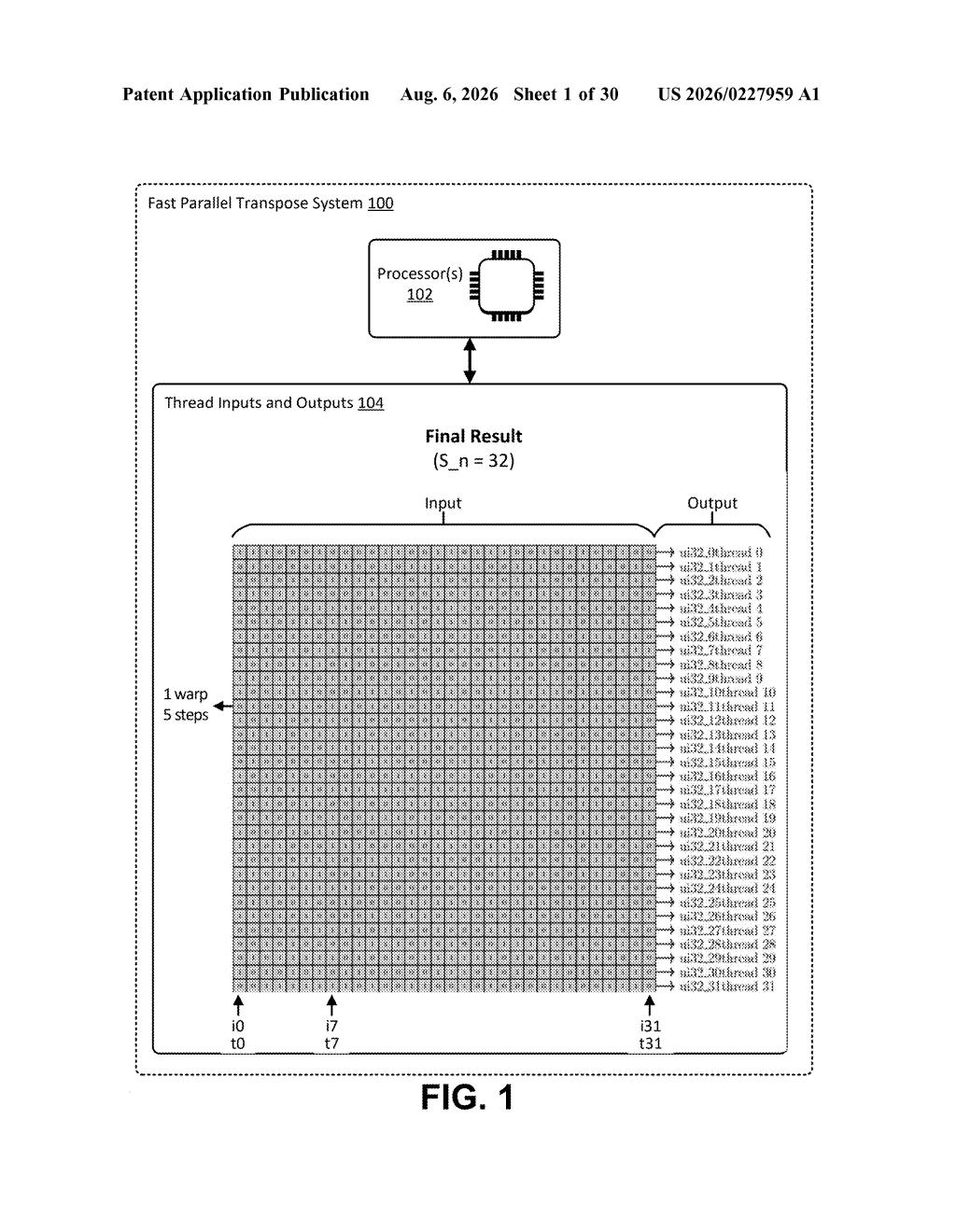
Nvidia's patent describes a processor design that splits a matrix (a grid of numbers central to nearly every AI calculation) into chunks, then loads those chunks using multiple software threads running at the same time. The goal is to speed up a process called transposition, which is just rotating that grid so its rows become columns and vice versa.
This sounds deep in the weeds, but matrix transposition happens constantly inside AI models. Shaving time off it, especially across thousands of parallel operations on a GPU, adds up quickly.
one or more circuits to cause one or more matrix operands to be transposed based, at least in part, on two or more portions of the one or more matrix operands being loaded by two or more software threads concurrently.
Translation: Hardware circuits flip matrix data faster by using multiple software threads at the same time.
How concurrent threads split and load matrix portions
Matrix transposition is a fundamental operation in linear algebra: you take an M-by-N grid of numbers and produce an N-by-M grid where rows and columns are swapped. GPUs do this constantly while running neural networks, graphics pipelines, and scientific simulations.
The patent describes a processor with one or more circuits that orchestrate the transposition by splitting the matrix into two or more portions. Each portion is assigned to a separate software thread, and those threads load their portions concurrently (that is, at the same time rather than one after another). The combined result is a transposed matrix assembled from all the parallel work.
- Concurrent loading: multiple threads fetch different slices of the matrix simultaneously, reducing idle time.
- Bit-matrix scope: the abstract specifically mentions transposing a bit matrix, suggesting this may target low-precision or binary data paths common in AI inference.
- Hardware-software co-design: the approach lives at the circuit level, meaning it could be baked directly into a future GPU or tensor-processing unit rather than handled purely in software.
The single independent claim is deliberately broad, covering any processor that achieves transposition through concurrent multi-thread loading.
Apparatuses, systems, and techniques to transpose a bit matrix by performing threads concurrently.
Translation: This invention speeds up matrix flipping by running multiple threads at once.
What this means for Nvidia's AI chip performance
Matrix operations are the bread and butter of every AI workload running on Nvidia hardware, from training large language models to real-time image generation. Even a modest reduction in the time spent on transposition, multiplied across billions of such operations per second, translates into real throughput gains or lower power draw for the same output.
The specific mention of bit matrices is worth noting. Low-precision arithmetic (using 1-bit or 4-bit numbers instead of 32-bit floats) is a growing trend in AI inference because it lets chips pack more computation into the same silicon area. A faster transposition primitive tuned for that precision tier could make Nvidia's next-generation inference chips measurably more efficient for your AI-powered apps.
This is foundational chip-engineering work, not a headline feature. A single patent on parallel matrix transposition won't ship as a product announcement, but it's exactly the kind of low-level optimization that separates a fast GPU from a faster one. If you follow Nvidia's hardware roadmap, it's worth adding to the pile of signals that the company is squeezing every cycle it can out of low-precision AI inference.
There are more where this came from
We read every patent application Big Tech publishes and send you the ones worth knowing. Plain English, free, every week.
The drawings
30 drawing sheets from US 2026/0227959 A1 · click any drawing to enlarge


Want this weekly breakdown for a company we don't cover? Patentlyze Pro →
Be the first to weigh in