
Nvidia Patents a System That Speeds Up 3D Graphics by Recycling Stored Shape Data
Nvidia is patenting a way for its GPUs to skip redundant geometry calculations by storing ready-made 3D building blocks and snapping new scene data onto them. It's a caching strategy for one of the most expensive steps in rendering.
What Nvidia's triangle-cluster templates actually do
Imagine a game engine has to figure out how light bounces around a forest with thousands of identical trees. Right now, the GPU largely treats each tree as a new problem to solve from scratch. Nvidia's idea is to pre-solve the hard parts of common shapes once, store those solutions as templates, and then reuse them whenever a matching shape shows up.
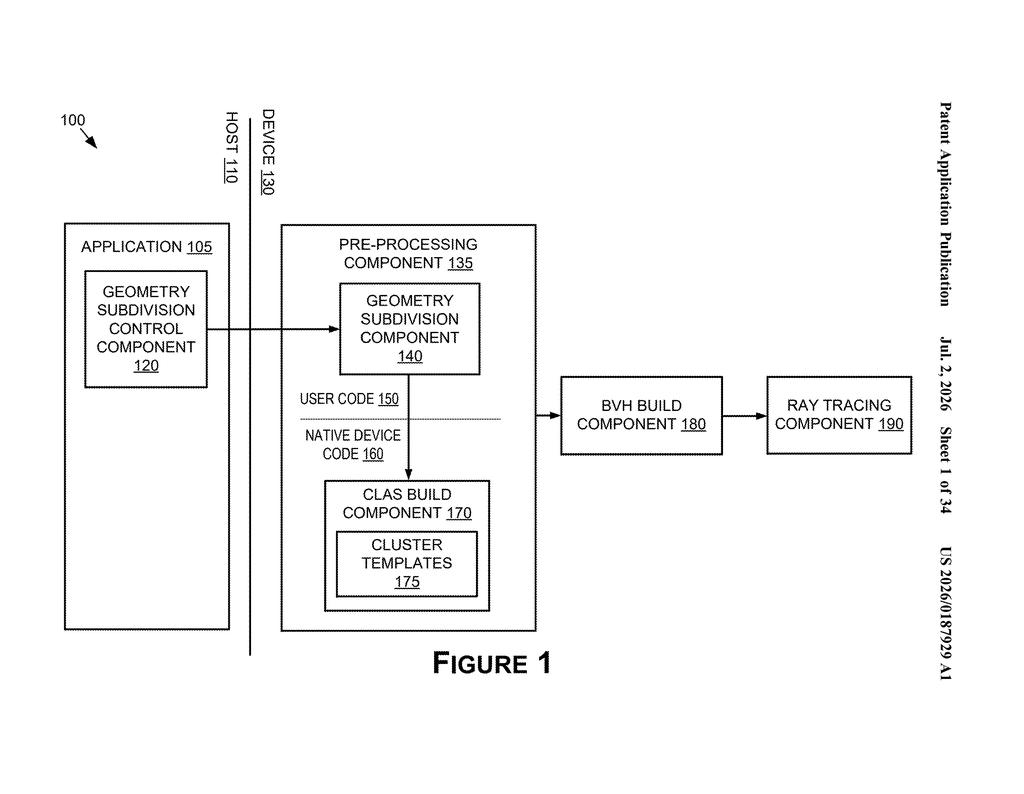
The patent describes a system where the GPU can ask: "What standard shape templates do you have available?" A game or graphics program picks the right templates, then hands over only the specific position and surface data for each object. The GPU slots that data into the pre-solved template instead of rebuilding everything from the ground up.
The result is that building the internal maps the GPU uses to trace rays through a 3D scene, a step that normally takes real time to compute, can happen much faster. Less redundant work means more frames per second, or more complex scenes at the same speed.
How the GPU picks and applies precomputed templates
The patent covers a GPU interface (a set of API calls, meaning the programming instructions a game or app sends to the graphics card) for working with precomputed cluster templates. A cluster here is a small group of triangles, the basic polygon unit of 3D graphics, arranged in a known pattern like a regular grid.
The core system works in two steps:
- A first API call asks the GPU which triangle-cluster patterns it supports. The GPU returns identifiers, essentially catalog numbers, for its library of precomputed templates.
- A second API call hands over the actual vertex data (the specific coordinates of each point in the scene) along with the chosen template identifiers. The GPU then builds the BVH (bounding volume hierarchy, the tree-shaped spatial index that ray tracing uses to quickly find which surfaces a light ray hits) by slotting that vertex data into the precomputed template structure rather than computing the tree from scratch.
The templates themselves are optimized ahead of time by testing many different ways to group and assign triangles, scoring each arrangement by an estimated traversal cost (how long it would take a ray to navigate through that structure), and keeping the best result. That upfront optimization work is done once and baked in, so the GPU doesn't have to repeat it at runtime.
What this means for real-time 3D rendering performance
Ray tracing is the rendering technique behind photorealistic reflections, shadows, and lighting in modern games and professional 3D software. Building the spatial index for a complex scene is one of the most time-consuming parts of that process, especially when geometry changes every frame. Any system that lets the GPU skip or shortcut that step has a direct impact on frame rates.
For developers, this kind of API-level optimization means less custom tuning per scene: if your geometry fits a supported pattern, you get the performance benefit automatically. For end users, that translates to either smoother frame rates in games or faster preview renders in creative tools. It also fits squarely into Nvidia's ongoing push to make ray tracing practical at real-time speeds, which has been a central theme across its GPU architectures since Turing.
This is infrastructure work, not a flashy feature, but it's exactly the kind of low-level optimization that compounds into real performance gains. Nvidia is essentially building a smarter shortcut into the ray-tracing pipeline, and given that BVH construction is a well-known bottleneck, this is a sensible place to invest. Don't expect a press announcement, but do expect something like this to show up in a future driver or hardware generation.
Get our take in your Top Stories
Liked this breakdown? Add Patentlyze as a preferred source on Google, and our plain-English take shows up more often in your Top Stories the next time Nvidia patent news breaks.
There are more where this came from
We read every patent application Big Tech publishes and send you the ones worth knowing. Plain English, free, every week.
Want this weekly breakdown for a company we don't cover? Patentlyze Pro →