
Nvidia Patent Shows How Machines Can Learn to Correct for Unexpected Disturbances
When a robot arm bumps into something unexpected, or a self-driving vehicle hits a patch of ice, its internal model of the world is suddenly wrong. Nvidia's new patent describes a system that continuously catches and corrects that gap before it causes a mistake.
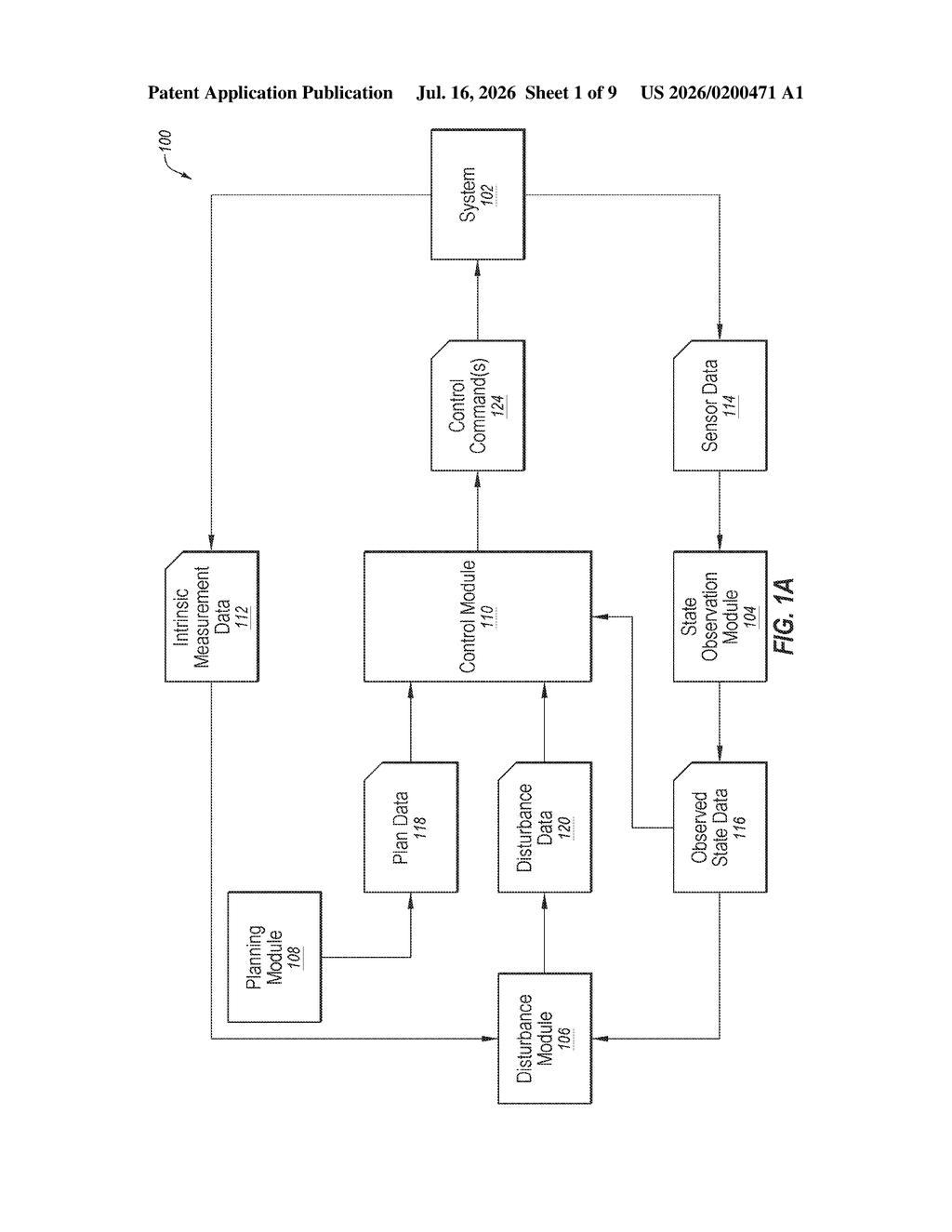
How Nvidia's self-correcting robot control system works
Imagine you're carrying a tray of glasses and someone bumps your arm. Your brain immediately notices the tray has shifted and adjusts your grip without you having to think about it. Robots and autonomous machines need to do the same thing, and right now, most of them are not very good at it.
Nvidia's patent describes a control system that constantly compares what a machine expected to happen with what actually happened, based on sensor readings. The gap between those two things, whatever unexpected force or condition caused it, gets measured and folded back into the machine's next command so it can compensate on the fly.
Think of it like a thermostat that doesn't just check the temperature once but continuously recalculates based on how far off it was last time. The result is a machine that handles surprises, wind gusts, slippery floors, unexpected weight, without needing a human to step in.
How the system compares predictions to reality and adjusts
The patent describes a closed-loop control architecture built around what engineers call a state space formulation (a mathematical model that tracks everything a machine knows about itself and its environment at any given moment).
Here's the core loop:
- The machine uses its internal model to predict what state it should be in (position, speed, orientation, etc.).
- Its onboard sensors generate an observed state, what is actually happening right now.
- The system computes the difference between those two readings and packages it as disturbance data.
- That disturbance data updates special correction terms inside the state space model, and a new control command is issued that accounts for whatever threw the machine off.
The patent specifies that this all runs on a combination of CPUs, GPUs, and dedicated hardware accelerators, which suggests the system is designed to run fast enough for real-time physical control, not just analysis after the fact.
The approach is general enough to apply to any machine following a plan, whether that's a robotic arm on an assembly line, a legged robot navigating terrain, or an autonomous vehicle following a route.
What this means for robots operating in messy real-world conditions
Most robot controllers are designed around the assumption that the world behaves the way the model predicts. When reality diverges, whether from a sensor glitch, an unexpected surface, or an external force, the machine either fails, stops, or needs a human to intervene. A system that automatically measures and compensates for those deviations makes machines meaningfully more reliable in uncontrolled environments.
For Nvidia, which has been building out its Isaac robotics platform and pitching itself as the compute backbone for physical AI, this kind of disturbance-handling patent fits directly into that strategy. You don't see it in the final product, but it's the kind of foundational capability that separates a robot that works in a clean lab from one that works in a warehouse or on a sidewalk.
This is not a flashy patent, but it's exactly the kind of low-level control infrastructure that makes or breaks real-world robotics. Disturbance rejection is a well-studied problem in control theory, but Nvidia's angle here is building it into a GPU-accelerated, plan-aware pipeline, which is the architecture their Isaac platform already uses. Worth paying attention to if you follow physical AI.
There are more where this came from
We read every patent application Big Tech publishes and send you the ones worth knowing. Plain English, free, every week.
Want this weekly breakdown for a company we don't cover? Patentlyze Pro →