
Nvidia Patents a Way to Process Camera Frames Before They're Fully Captured
What if your car's computer didn't have to wait for a full camera frame before it started making sense of what it sees? Nvidia is patenting exactly that kind of shortcut.
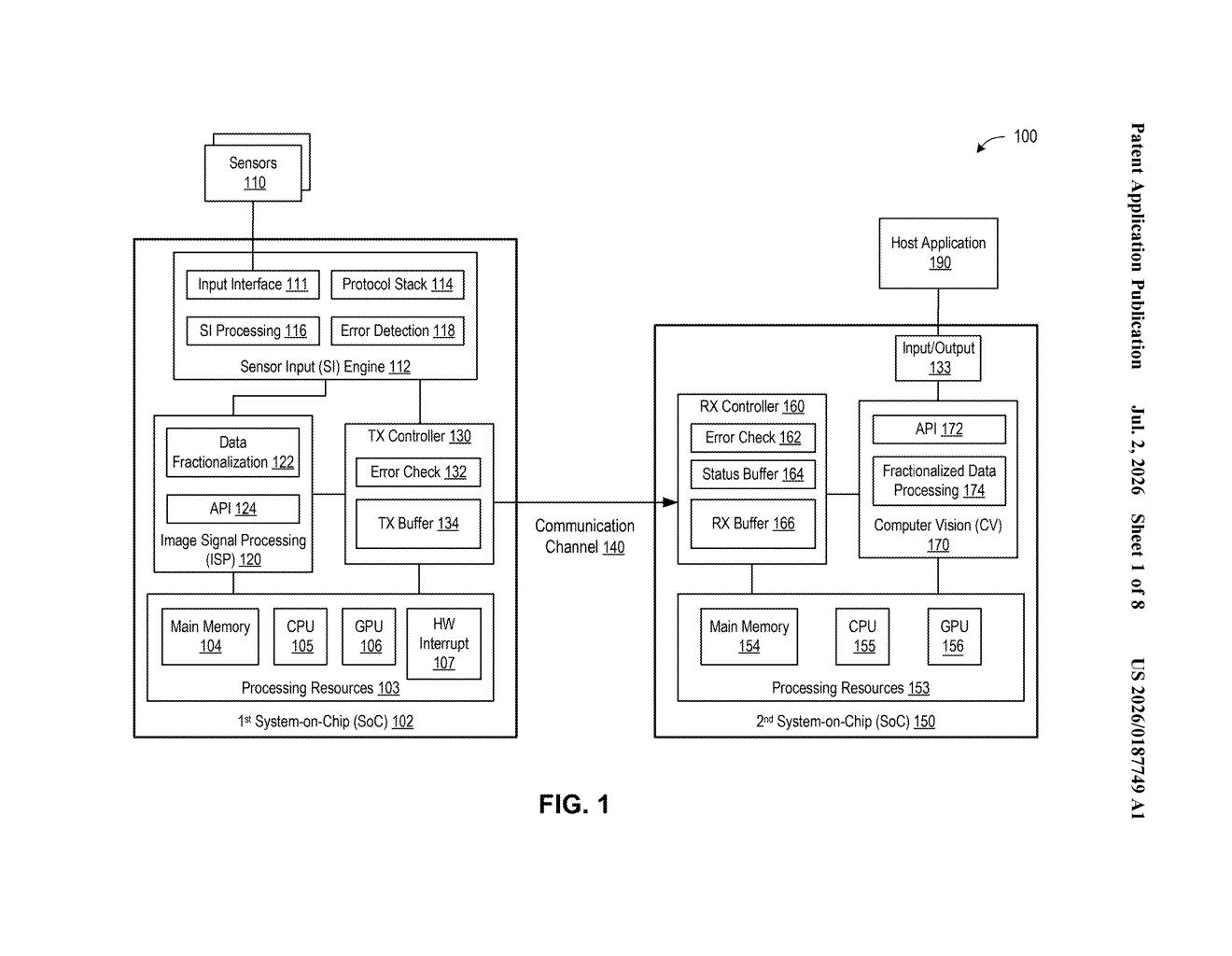
How Nvidia splits a frame across two processors at once
Imagine a security camera feeding footage to an AI that watches for intruders. Right now, most systems wait until a complete image frame has been assembled before handing it off for analysis. That tiny delay adds up, especially when you need split-second decisions.
Nvidia's patent describes a different approach: as soon as part of a frame is ready, a flag goes up telling a second processor, "your slice is here, start working." The second chip doesn't wait for the rest of the image. It grabs its piece and starts processing immediately, while the first chip keeps generating the remaining slices.
The result is that two processors are working in parallel on different parts of the same frame at roughly the same time. For applications like self-driving vehicles, robotics, or real-time video analysis, shaving milliseconds off each frame cycle can make a meaningful difference in how fast (and safely) a system reacts.
How the completion-indicator handoff actually works
The patent describes a fractionalized data transfer scheme between two processing devices, such as two chips on the same board or in the same system.
- A first processor captures or generates an image and immediately cuts it into predetermined slices (fractions of the full frame).
- As each slice is written to memory, the first processor sets a completion indicator (essentially a flag in shared memory saying "this chunk is ready").
- A second processor monitors those flags. The moment a flag flips, it retrieves that slice and begins its image processing operation on it, without waiting for later slices.
The key technical insight is pipelining across chips: the two processors overlap their work on the same frame. By the time the first processor finishes producing the last slice, the second processor has already worked through most of the earlier ones. This shrinks the total latency (the delay from capture to finished analysis) compared to a hand-off-the-whole-frame model.
The claim is deliberately hardware-agnostic. The "processors" could be CPUs, GPUs, dedicated image signal processors, or FPGAs, and the "memory" could be on-chip buffers or shared DRAM. That breadth suggests Nvidia sees this as a general building block rather than a fix for one specific product.
What this means for real-time vision and robotics pipelines
In perception-heavy applications, including autonomous vehicles, industrial inspection cameras, and robotics, latency is safety. A pipeline that starts acting on the top half of a frame while the bottom half is still being captured can respond faster to obstacles or anomalies. Nvidia already sells the Orin and Thor chips that power many of these systems, so a patented method for reducing inter-chip frame latency fits directly into its existing product roadmap.
For you as a consumer, the most visible downstream effect would be faster, more reliable real-time AI responses in anything from a dashcam with built-in intelligence to a warehouse robot avoiding forklifts. The patent doesn't promise a specific speedup, but the architectural approach is sound and the use cases are real.
This is quiet infrastructure work, not a flashy AI model, but it's the kind of low-level optimization that actually determines whether a self-driving or robotics product meets its latency targets. Nvidia is essentially patenting a well-engineered assembly-line trick for sensor data. It's not surprising coming from the company whose entire business model depends on chips talking to each other as fast as possible.
Get our take in your Top Stories
Liked this breakdown? Add Patentlyze as a preferred source on Google, and our plain-English take shows up more often in your Top Stories the next time Nvidia patent news breaks.
There are more where this came from
We read every patent application Big Tech publishes and send you the ones worth knowing. Plain English, free, every week.
Want this weekly breakdown for a company we don't cover? Patentlyze Pro →