
Google Patents a Fingerprint Scanner That Fixes Blurry Scans Caused by Moving Your Finger
You press your thumb on your phone's screen a little too fast, and it fails to recognize you. Google is patenting a way to fix that by mathematically un-smearing the blurry fingerprint scan your moving finger leaves behind.
Why your fingerprint sometimes fails, and how Google wants to fix it
Imagine pressing your thumb on your phone screen while your hand is still in motion, the way you naturally do when you're in a hurry. The fingerprint sensor captures a smeared, stretched version of your print, and the phone says "try again." That friction is something most of us have hit dozens of times.
Google's patent describes a system that watches for that finger movement as it happens and uses the motion data to work backward, calculating what your fingerprint would have looked like if your finger had been perfectly still. The result is a cleaned-up, reconstructed scan that the phone's matching system can actually compare against the version stored when you set up your device.
The whole process happens automatically during the normal unlock attempt, so there's nothing extra for you to do. Instead of asking you to press again, the phone tries to salvage the scan it already has.
How Google's sensor tracks finger motion to reconstruct a clean print
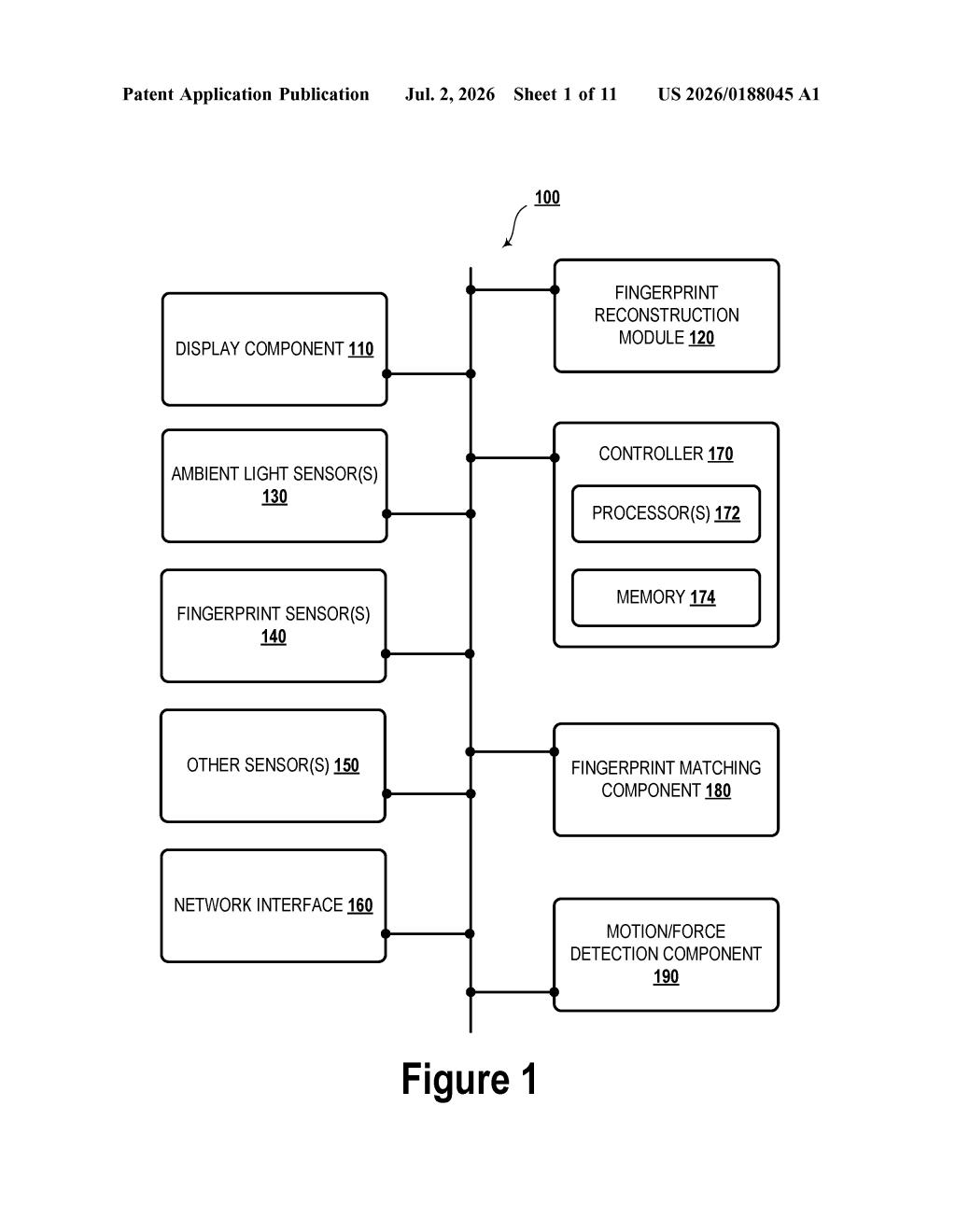
The patent covers an under-display fingerprint system with two linked capabilities: motion detection and distortion correction.
First, the device's processor detects that the finger is moving during the scan, not just resting still. It measures both the fact of motion and its direction and magnitude, which together define the shape of the distortion introduced into the fingerprint image.
Second, the system computes an "estimated fingerprint distortion" based on that motion data. Think of it like un-blurring a photo by knowing exactly which direction the camera moved when it shook. The processor applies an inverse correction to the raw scan, producing a reconstructed fingerprint that approximates what the sensor would have captured from a stationary finger.
That reconstructed image is then handed off to the fingerprint matching component, which compares it against the stored template the user enrolled at setup. The claim is specifically about reducing smudging enough to make the print "detectable" by the matcher, not necessarily producing a perfect image.
What this means for under-display fingerprint reliability on Android phones
Under-display optical fingerprint sensors are already standard on most mid-range and premium Android phones, including Google's own Pixel line. Their biggest real-world weakness is exactly what this patent targets: failed reads when the finger isn't held perfectly still. Fewer failed reads means less friction every time you unlock your phone, which compounds across dozens of unlocks a day.
For Google, this also has a security angle. A system that recovers a clean print from a messy scan rather than just rejecting it is doing more sophisticated identity verification, not less. If the correction algorithm is accurate, you get faster unlocks without sacrificing the match quality the stored template was designed to enforce.
This is a genuinely practical problem that affects everyone who uses an in-screen fingerprint sensor, and Google's approach of correcting for motion rather than just demanding a do-over is the right instinct. Whether the math works well enough in practice to make a noticeable difference is the real question, but the problem being solved is real and the approach is sensible.
Get our take in your Top Stories
Liked this breakdown? Add Patentlyze as a preferred source on Google, and our plain-English take shows up more often in your Top Stories the next time Google patent news breaks.
There are more where this came from
We read every patent application Big Tech publishes and send you the ones worth knowing. Plain English, free, every week.
Want this weekly breakdown for a company we don't cover? Patentlyze Pro →