
Qualcomm Files Patent for Video That Hides Faces Unless You Have the Key
Qualcomm describes a way to blur the people in a video for everyone else while keeping their real faces locked inside the very same file. Hand over the key and the original comes back.
What Qualcomm's one-file video privacy does
Imagine your car's dashcam films a busy street, and you need to share the footage with an insurance company without exposing anyone's face. The usual fix is to blur the faces and keep a second, untouched copy for yourself. That means storing and sending the video twice.
Qualcomm's filing describes one file that does both jobs. The faces are blurred or blocked out in the picture everyone sees, while the real face pixels are scrambled with a secret key and tucked into the same file. Without the key, you just see the blurred version. With it, the original comes back.
The blurred areas also get squeezed harder than the rest, since nobody needs them to look good. That saves space and lets the visible parts of the picture keep more detail.
encrypt one or more regions of interest (ROIs) of an input image frame to generate encrypted ROI content; mask the one or more ROIs in the input image frame to generate a masked image frame; …
Translation: The system scrambles sensitive parts of the video and hides them behind a blank cover.
How the masked video and locked faces share a file
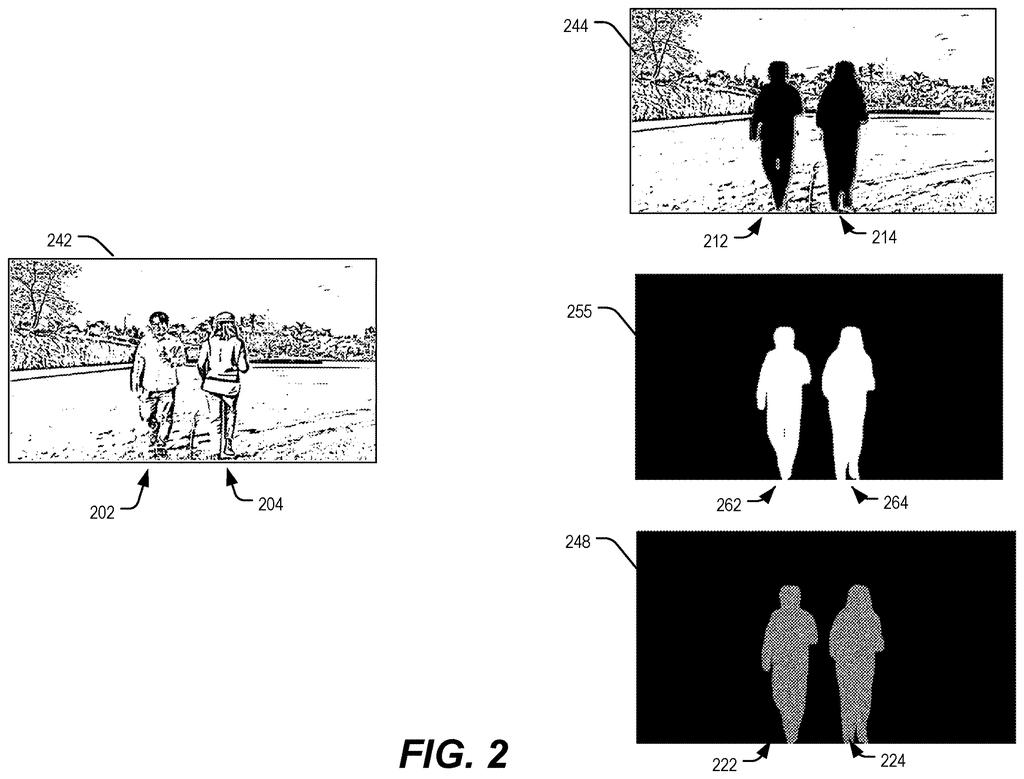
The system starts by finding the part of each video frame that needs protecting. Qualcomm calls this a region of interest (ROI). It is picked by looking for a type of object you set in advance, such as a face, a license plate, a document or a whiteboard. Detection can use a neural network (an AI model that spots patterns) or older image-analysis methods.
The device then makes three things at once:
- A masked frame: the region is blurred, painted a solid color, striped, or filled with scrambled pixels.
- Encrypted content: the original pixels are locked with a key using format-preserving encryption (a scrambling method where the output is the same size as the input).
- A map: a black-and-white segmentation frame that records exactly where the region sits, so it can be put back later.
The masked frame is compressed using a quantization parameter (QP), a setting for how much detail gets thrown away. Blocks inside the masked region get a higher QP, reaching the maximum of 51 in one example. Blocks outside get a lower one, so the visible parts keep more detail. The locked content and the map are stored losslessly (nothing lost) and flagged as no-display, all in one bitstream.
On the receiving end, a player without the key shows the masked video. A device with the key decrypts the content and pastes it back into the masked frame. The filing's second set of claims covers that decoding side.
… generate output media data comprising a single encoded bitstream that includes the encoded image data and the encrypted ROI content.
Translation: Everything is packed into one final video file that keeps the hidden parts locked away.
Why this matters for dashcams and body cameras
If you record video for work or for safety, you could share one file widely and still keep the original recoverable for yourself. The filing points to dashcams, body cameras, in-cabin car monitoring and surveillance, where rules about showing people's faces differ from country to country. It also mentions worry that personal footage may end up training AI models.
Smaller files help too. Since the hidden areas are squeezed harder, the rest of the picture can keep more detail for the same size, and there is no second copy to store. The filing lists phones, smart glasses, headsets, cameras, cars and delivery drones as places this could run, though it describes no specific product.
This is the 22nd Qualcomm filing we've tracked since July in our on-device AI privacy watch, building on earlier work around noisy signal accuracy and catching garbled training data.
Cameras now sit in police uniforms, car dashboards and consumer glasses, and the rules on what a company must hide before sharing footage vary by country, job and context. Managing that legally is expensive, and the storage and power costs of locking down full video at scale are real.
Qualcomm's approach matches the size of that problem fairly well. It protects only the small areas that need it, squeezes those areas harder to recover the space, and delivers one file that satisfies both the people who need access and the ones who do not.
The approach lives or dies on whether the software correctly spots every face or plate before any of this runs. A single miss leaves a real person exposed, and the filing offers no accuracy figures for that detection step. That is the question worth pressing.
Get our take in your Top Stories
Liked this breakdown? Add Patentlyze as a preferred source on Google, and our plain-English take shows up more often in your Top Stories the next time Qualcomm patent news breaks.
There are more where this came from
We read every patent application Big Tech publishes and send you the ones worth knowing. Plain English, free, every week.
The drawings
14 drawing sheets from US 2026/0343001 A1 · click any drawing to enlarge


Show the other 6 sheets


Want this weekly breakdown for a company we don't cover? Patentlyze Pro →
2 comments
Am I supposed to say all I can or will you contact me.
It’s an open (public) comment section. You can say whatever you want as long as it’s related to this patent.