
Qualcomm Files Patent for Teaching AI on Phones Without Collecting Your Data
Your phone could help train an AI without ever uploading your photos, but the data on every phone looks different. Qualcomm's patent application adds a step where the model guesses which device each piece of data came from.
What Qualcomm's device-guessing patent does
A phone sits on a nightstand overnight, its photo library packed with pictures no one else will ever see. Those pictures could help train an AI, but only if they never leave the phone.
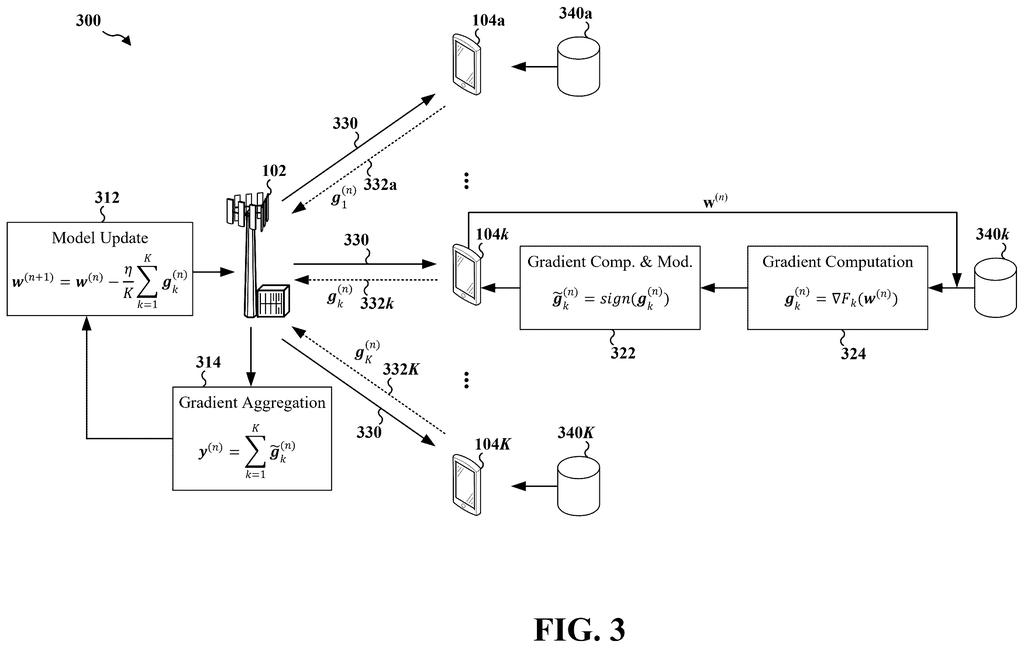
That is the idea behind federated learning: each device trains a shared AI model on its own data and sends back only what the model learned, not the data itself. The catch, according to Qualcomm's filing, is that everyone's data looks different. Your photos might be mostly pets, someone else's mostly landscapes, and that mismatch makes one popular kind of training work poorly.
Qualcomm's patent application adds a small extra step. While the model studies a photo, a second part tries to guess which device the photo came from, and the system scores how often that guess is right. That score is tracked alongside the usual training score.
inputting a data point into a first neural network configured to output a feature of the data point; inputting the feature into a second neural network and a third neural network …
Translation: Feeding user data into multiple neural networks to extract and process specific features locally.
How the extra network guesses where data came from
The patent covers a way to train an AI model across many devices using contrastive learning (a method that teaches a model by showing it which examples are alike and which are different, with no human labels needed) inside a federated setup (where each device trains on its own data and shares only model updates).
The claimed method has three steps:
- A first neural network (a feature extractor) reads a data point, such as an image, audio clip or text, and outputs a feature, a compact list of numbers (a tensor) describing it.
- That feature goes into two more networks at once. One feeds the usual contrastive loss computation (a score of how well the model recognizes similar items). The other predicts a client identifier, a guess at which device the data came from.
- The system outputs both the contrastive loss and a client ID loss, which compares the guess with the real source.
In the example described, the contrastive part works like SimCLR, which makes altered copies of a data point (cropped, resized, rotated, color-shifted) and learns that they show the same thing. The client ID steps run in parallel with that process.
A fourth network can add label prediction for supervised or semi-supervised training, for example grouping a phone's pictures labeled 'cat' or 'dog' and training on each group. The work can run on a phone or at a base station.
… wherein the second neural network is configured to output a predicted client identifier based on the feature, wherein the predicted client identifier is indicative of a predicted source of the data point …
Translation: One part of the system tries to guess the data source while keeping the actual user identity hidden.
What this means for AI that learns on your phone
If your phone is going to learn from what you photograph or say, the privacy-friendly route is to train on the device and share only updates. Most of what sits on a phone has no labels, so a method built for unlabeled photos, audio and text, without uploading any of it, fits the real mess of personal data.
Qualcomm's filing frames this around wireless nodes: phones and base stations coordinating over a cellular network. That fits Qualcomm's position in phone chips and modems, though the patent names no product. What you would notice, if anything, is on-device features improving without your files going to a server.
Qualcomm's 18th filing we've tracked since July in our on-device AI privacy watchlist builds on earlier applications covering training AI across phones and verifying identity across devices.
Shipping this needs no new hardware. It is a change to how an AI model is trained, so the shortest route to a product is a software update to a federated training setup that a phone maker or network operator already runs.
What has to exist first is that setup itself: a server, a pool of willing phones, and enough battery and processing power to train overnight. The filing describes the pieces and the flow but includes no test results, so you cannot tell from the document how much the training improves.
My read: routine but sensible engineering. One small guessing network and one extra score are easy to bolt onto existing training, which makes it cheap to try. You would never see it as a feature; at most, your photo or voice tools might get better over time.
Get our take in your Top Stories
Liked this breakdown? Add Patentlyze as a preferred source on Google, and our plain-English take shows up more often in your Top Stories the next time Qualcomm patent news breaks.
There are more where this came from
We read every patent application Big Tech publishes and send you the ones worth knowing. Plain English, free, every week.
The drawings
8 drawing sheets from US 2026/0310987 A1 · click any drawing to enlarge


Want this weekly breakdown for a company we don't cover? Patentlyze Pro →
Be the first to weigh in