
Samsung Patents a Ring Wearable That Reads Your Health and Your Finger Gestures at Once
Samsung is designing a ring-shaped wearable where the display panel itself does double duty — firing light inward to read your pulse and outward to track finger gestures. One ring, two entirely different sensing jobs, handled by a single curved panel.
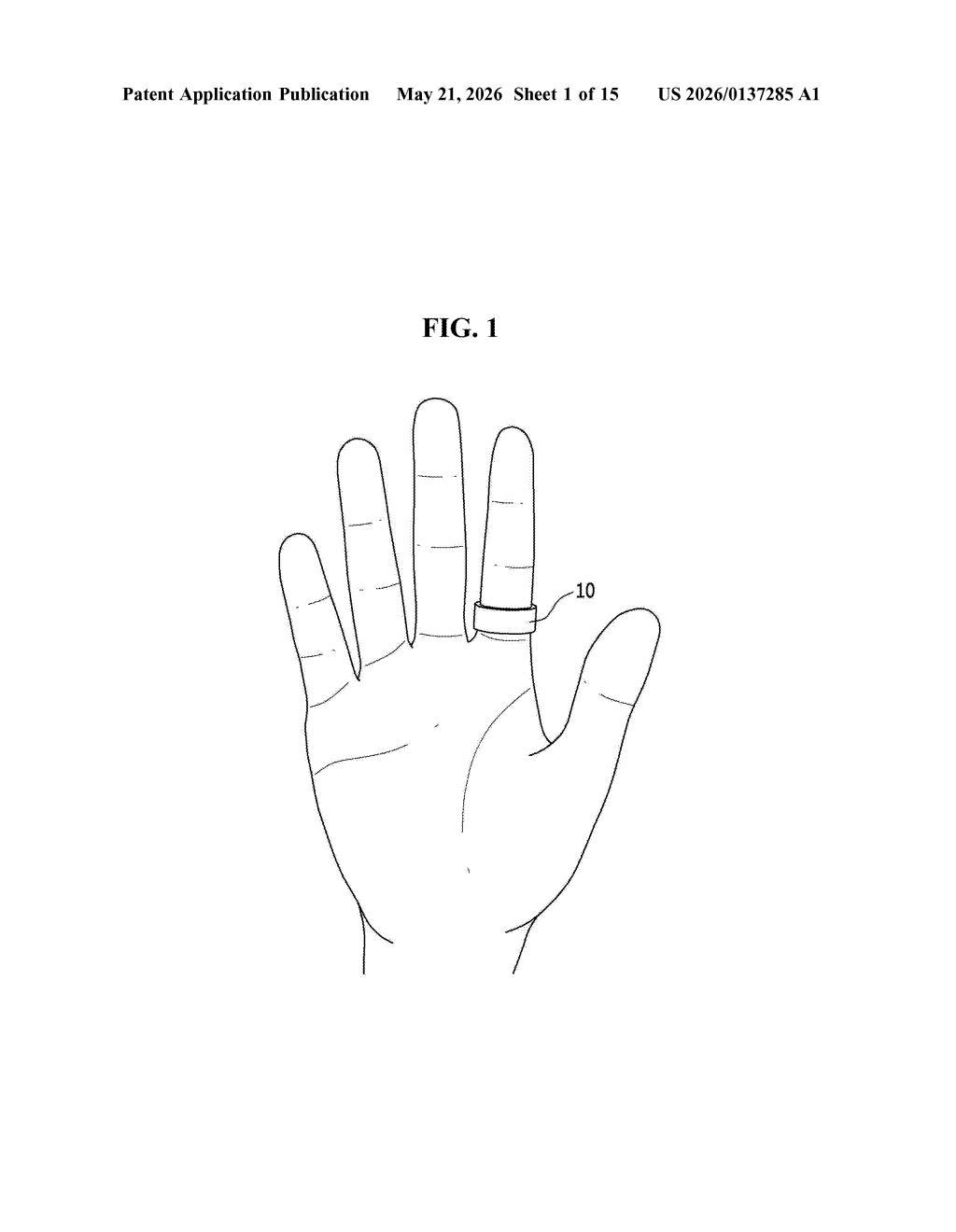
What Samsung's dual-direction ring sensor actually does
Imagine slipping a ring onto your finger that can simultaneously check your heart rate and detect when your other hand's finger is hovering or tapping near it. That's the basic idea here.
Samsung's patent describes a ring (or small cylinder) where the display panel is curved to line the inside of the housing. Light sensors on the inner face point toward your skin — that's how the device reads your pulse wave and other biometric data. A separate set of sensors on the outer face points away from your body to catch touch movements happening outside the ring, like a tap or swipe gesture from another finger.
The clever part is that both sensing jobs come from the same display panel — Samsung isn't cramming in a separate sensor module for each function. The panel is just doing two things at once depending on which direction its light is pointing.
How the inward and outward light channels split their jobs
The patent describes a wearable housing shaped as a ring or short cylinder. Inside that housing, a display panel is curved to follow the shape — so instead of a flat screen, you have a loop of display material wrapping around the interior.
That panel handles two distinct sensing modes simultaneously:
- Inward sensing (first direction): Light is emitted toward the center of the ring — i.e., toward your finger. The reflected signal is read back as a pulse wave signal (photoplethysmography, or PPG — the same light-bounce trick used in most smartwatch heart-rate monitors). From this, the device derives biometric data like heart rate or blood oxygen.
- Outward sensing (second direction): Light is emitted away from the housing, outward into the air. When a part of the user's body — say, a fingertip from the other hand — moves near the ring, the reflected signal is captured as a touch movement, enabling gesture input without physical contact on the device surface itself.
A main driver circuit coordinates both channels, separating the inward biometric read from the outward gesture detection. The patent doesn't detail how the circuit disambiguates the two signals, but the directional separation is presumably the key mechanism — the panel knows which way each emitter/receiver pair is pointed.
What this means for the Samsung Galaxy Ring roadmap
Ring-form-factor wearables like the Samsung Galaxy Ring are already on the market, but today they're largely passive health trackers — they read your body but don't take input from you. If Samsung can build reliable outward-facing gesture sensing into the same ring, your finger becomes a controller, not just a sensor target. That's a meaningful jump in utility for a device category that's currently pretty limited in interactivity.
For you as a user, this could mean answering a call, skipping a track, or dismissing an alert with a small finger gesture — no need to reach for your phone or tap a smartwatch. Whether Samsung can make the outward gesture detection accurate enough in real-world conditions (sleeves, varying light, involuntary movement) is the hard part, and this patent doesn't address that.
This is a genuinely interesting architectural idea — using the display panel itself as a bidirectional sensor array rather than bolting on separate biometric and gesture modules. It's compact, it's elegant on paper, and it addresses one of the real weaknesses of current smart rings: they're read-only devices. The execution challenge is substantial, but the concept is worth watching closely given Samsung's active Galaxy Ring line.
There are more where this came from
We read every patent application Big Tech publishes and send you the ones worth knowing. Plain English, free, every week.
Want this weekly breakdown for a company we don't cover? Patentlyze Pro →