
Intel Patent Removes Need for Buffer Hardware in OLED Display Sync
Every OLED screen pulses with tiny light cycles invisible to the naked eye. Intel's new patent describes a way to synchronize incoming video frames to those pulses using the main processor alone, cutting out the dedicated hardware chip that normally handles the job.
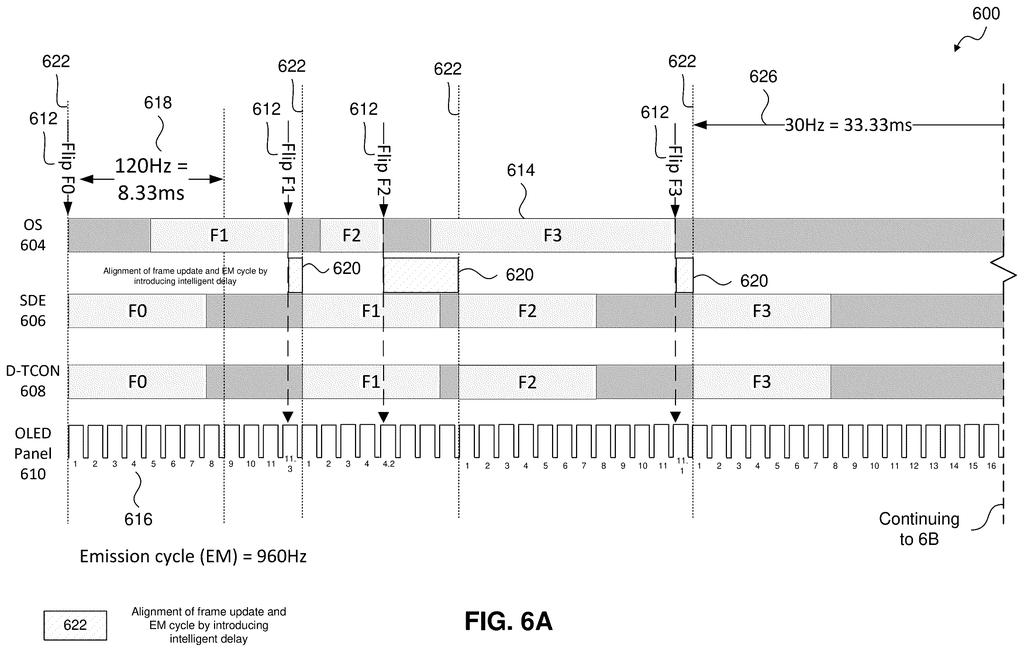
What Intel's display timing trick actually does
Imagine a strobe light blinking hundreds of times per second inside your phone's OLED screen. For video to look smooth, new frames of video have to land at exactly the right moment in that blink cycle. Right now, a small dedicated chip inside the display's controller hardware manages that timing job.
Intel's patent describes moving that job out of the display entirely and into the main processor. The processor watches how many blink cycles have passed since the last frame was delivered, calculates a short waiting period, then sends the next frame at precisely the right instant to land on a blink-cycle boundary. No extra chip required.
The practical payoff is that OLED screens with variable refresh rates (where the screen speeds up or slows down based on what's happening on screen) could work without the buffer hardware that currently makes them more expensive and physically thicker.
determine, based on emission cycle information of a display, a number of emission cycles since a previous frame update; determine a time delay based on the number of emission cycles; and provide, based on the determined time delay, a next frame to the display to align the next frame with an emission cycle boundary of the display.
Translation: The processor counts display cycles since the last update and calculates a delay to sync the new frame perfectly.
How the processor counts emission cycles to time frames
OLED panels emit light in discrete pulses called emission cycles. When a new video frame arrives between two emission cycle boundaries, the display can show a partial or misaligned image, causing flicker or visual tearing. Variable refresh rate (VRR) displays, which adjust how often they redraw the screen, make this timing problem harder because the cycle boundaries shift constantly.
Intel's patent describes a processor-side algorithm that tracks these cycles in real time. Specifically, the processor:
- Reads emission cycle information directly from the display
- Counts how many full cycles have elapsed since the last frame was delivered
- Calculates a time delay based on whether that count is a whole number or a fraction, and whether it's within the expected frame window
- Holds the next frame for exactly that delay, then releases it so it lands on the next clean emission boundary
The key distinction is that this logic lives in the source processor (the GPU or SoC sending video data) rather than in a dedicated frame buffer inside the display's timing controller (the chip that manages the screen's internal schedule). That removes a piece of hardware from the display module itself.
Source-side synchronization may enable VRR operation on OLED displays without requiring frame buffer hardware in the display timing controller.
Translation: This method allows variable refresh rates on OLED screens without needing extra memory hardware inside the display itself.
What this means for thinner, cheaper OLED devices
Removing the frame buffer hardware from the display timing controller could lower the cost and thickness of OLED panels, which matters most in thin laptops, tablets, and phones. It also means a wider range of OLED displays could support variable refresh rates without being redesigned around specialized buffer chips, potentially making smooth, adaptive refresh technology available in more affordable screens.
For you as a user, the goal is that fast-scrolling text, gaming, and video all look cleaner on OLED without the screen needing to be a more expensive component. Intel is essentially proposing that the intelligence for this kind of timing lives in the PC or device's processor rather than being baked into every display panel separately.
This is a genuinely practical piece of display engineering. Moving VRR synchronization logic from display hardware into the source processor is a real architectural shift, and if it works at scale, it could bring better OLED refresh-rate behavior to more affordable panels. It won't excite anyone at a party, but it's the kind of unglamorous optimization that improves the screens people stare at all day.
There are more where this came from
We read every patent application Big Tech publishes and send you the ones worth knowing. Plain English, free, every week.
The drawings
8 drawing sheets from US 2026/0229193 A1 · click any drawing to enlarge


Want this weekly breakdown for a company we don't cover? Patentlyze Pro →
Be the first to weigh in