
Salesforce Patents a Fake Caller to Test AI Phone Assistants Before Real Customers Do
Salesforce's patent application describes an AI caller that plays impatient, accented, or noisy-café customers to put voice bots through their paces before real people ever dial in.
What Salesforce's fake-caller test does
A caller with a strong accent phones a support line from a noisy café. She is already annoyed, and she cuts in before the automated voice finishes its first sentence. If you have ever shouted representative at a phone menu, you know how this goes.
Salesforce's patent application describes a way to test voice AI agents against exactly that kind of caller before real customers dial in. Instead of paying people to phone the bot all day, a second AI plays the caller. It follows a persona (say, an impatient customer or a busy executive) in a scenario (say, booking an appointment), and it can add background noise.
Then the system scores how the voice agent did: how short and quick its answers were, how it handled being interrupted, and how much empathy it showed. You get a report, and the company can tweak the bot and test again.
mapping, to a plurality of voice-based interaction scenarios, a plurality of personas that each indicate a plurality of respective voice-based interaction characteristics that are based at least in part on a subset of stored training data that are representative of the plurality of respective voice-based interaction characteristics …
Translation: The system matches different caller personalities to various conversation situations using past data.
How the AI caller grills a voice agent
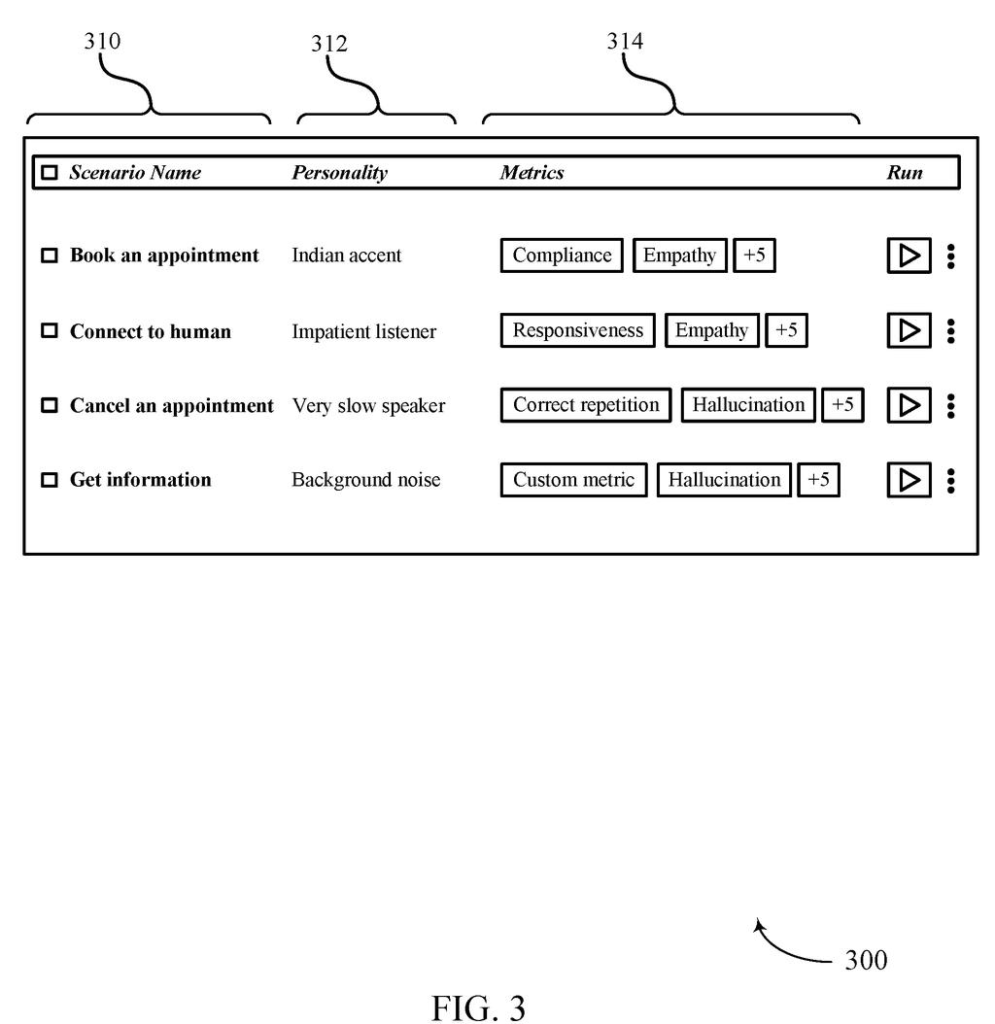
The patent application describes an automated test lab for voice-based AI agents (the bots that answer phone calls for a business). A system keeps a library of personas, which are caller profiles built from stored training data, and maps them to scenarios, such as booking an appointment or asking to be connected to a human. A persona can carry a mood, a role, a tone, an emotion, or interruption events.
Next, the system trains an AI testing model (a second AI that plays the caller) to act out a chosen scenario in the voice of a chosen persona. Under a testing protocol (the plan for which calls to run), that caller talks to the agent being tested. The filing says background noise, like a café, can be injected into the call.
The conversation is then scored. The filing lists these voice metrics:
- Conciseness: does the agent get to the point without rambling?
- Responsiveness: how fast and natural are its replies? One example target is a delay under 1 second.
- Interruption handling: does it keep its place and return to what it was saying?
- Empathy: does it respond politely to frustration? One example goal is 4.5 out of 5 on user-rated scores.
- Sentiment analysis: how well it reads the caller's mood.
A report collects the scores. Users can pick personas and scenarios or build their own, and the report can be used to adjust the agent's settings before the tests run again.
… provoke, in accordance with a testing protocol, a first voice-based interaction between the artificial intelligence (AI) testing model and the AI agent …
Translation: The testing tool starts a simulated phone call with the AI assistant to see how it performs.
Why voice bots need a mock-caller exam
If a company puts a voice bot on its support line, the bot will meet impatient people, heavy accents, bad connections and callers who talk over it. This filing describes a way to rehearse all of that ahead of time, so the awkward moments happen in a test before they happen on your call. It matters most to businesses, but you would feel it as a bot that answers quickly and does not lose its place when you interrupt.
The background section ties this to Salesforce's customer-relationship software, where AI agents already talk to clients by voice. The filing says text-based testing misses tone, emotion, noise and interruptions, which is why it proposes voice-specific scores. Whether it ever gets used is unknown. This is a patent application, and the text gives its target numbers only as examples.
Salesforce's fourth filing in the Voice & speech AI patents we cover since August follows earlier work on checkout voice guidance and spoken-answer knowledge bases.
Claim 1 is wide. It asks for five steps: pair caller personas with scenarios, train a simulated caller on them, let that caller talk to the voice bot under a testing plan, score the conversation on one or more voice metrics, and write a report. It does not name a single metric, accent, or kind of noise.
Those details show up only in the narrower claims hanging off it. The list of conciseness, responsiveness, interruption handling and empathy scores sits in claim 6, and background noise sits in claim 10. If granted as written, the core claim would reach any team that tests a voice bot with a persona-driven AI caller, whatever it chooses to measure.
Because the claim leaves the metrics open, the net is wide, and the apparatus and storage-medium versions in claims 12 and 20 repeat the same five steps. For the rest of us, it's quality control for voice bots, a job someone has to do before a bot answers your call.
Get our take in your Top Stories
Liked this breakdown? Add Patentlyze as a preferred source on Google, and our plain-English take shows up more often in your Top Stories the next time Salesforce patent news breaks.
There are more where this came from
We read every patent application Big Tech publishes and send you the ones worth knowing. Plain English, free, every week.
The drawings
8 drawing sheets from US 2026/0311686 A1 · click any drawing to enlarge


Want this weekly breakdown for a company we don't cover? Patentlyze Pro →
Be the first to weigh in