
Salesforce Patents a Knowledge Base Built Specifically for Spoken AI Answers
Most AI knowledge bases are built for text, and it shows when a bot reads out an answer that sounds like a footnote. Salesforce's new patent tackles that problem at the source by building a knowledge base designed from the ground up for how people actually speak.
How Salesforce's voice knowledge base works for you
Imagine calling a customer support line and the AI bot reads you a long, clunky sentence full of bullet points and parenthetical notes. That's the current reality for many AI phone agents. The text answers they pull from were written for screens, not ears.
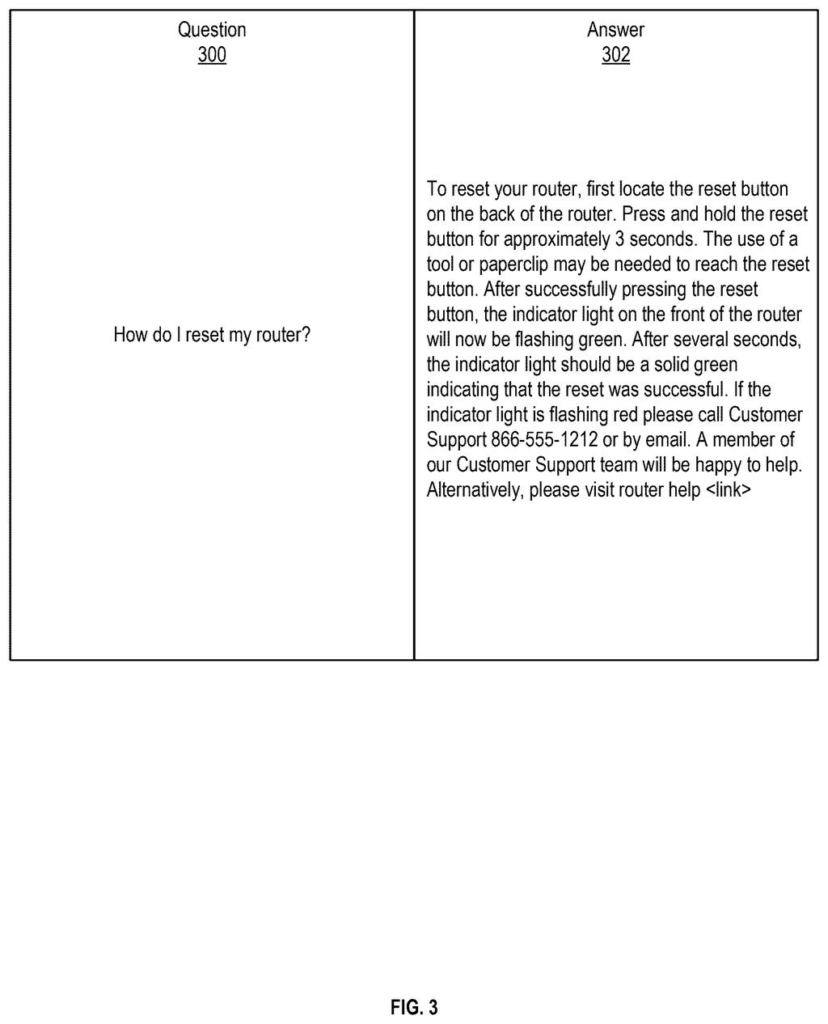
Salesforce's patent describes a system that pre-builds a separate knowledge base specifically for voice. The answers stored there are short, natural, and free of the kinds of phrases that sound awkward when spoken aloud. When you ask a question, the system matches it to one of these clean spoken-word answers.
What makes it go further: the system also tries to predict what you're likely to ask next, based on how similar conversations have gone before. So the AI isn't just reacting to your last question, it's getting ready for your next one.
receiving, by a voice-based agent service, voice data representing a question; identifying a node in a conversation graph of a voice-ready knowledge base corresponding to the question; retrieving an answer based on the node; providing a voice response corresponding to the answer …
Translation: The system listens to your spoken question, finds the right spot in its map, and reads the answer aloud to you.
How the conversation graph predicts your next question
The patent describes a voice-ready knowledge base built offline, before any calls happen. This pre-processing step filters out or rewrites content that causes problems when converted to speech, things like long parenthetical clauses, abbreviations, or list formatting that a text-to-speech engine might mangle.
Answers in this knowledge base are organized inside a conversation graph, a map where each node represents a question-answer pair and edges between nodes represent natural conversation flows. When a caller asks something, the system finds the matching node and retrieves its pre-cleaned answer.
The interesting part is what happens next. A conversation model looks at which nodes have already been visited during the call and uses that history to predict which node the conversation is likely to move to. This means the system is pre-loading likely follow-up answers rather than waiting for the caller to ask.
- Voice data (the caller's question) comes in and is matched to a graph node
- A pre-written, speech-friendly answer is retrieved and spoken back
- The model predicts the next likely node based on conversation history
- The process repeats through the conversation
The voice-ready knowledge base has been generated offline such that it includes concise answers without language that results in artifacts when converted to voice.
Translation: Answers are pre-written to sound natural when spoken by a computer instead of sounding robotic.
What this means for AI-powered customer service calls
Customer service AI is a huge business, and one of the biggest complaints about phone bots is that they sound robotic and often stumble over their own answers. Salesforce building voice-specific answer formatting into its AI platform could give its enterprise clients noticeably cleaner call experiences without requiring them to manually rewrite every knowledge base article.
For Salesforce customers running contact centers on products like Service Cloud, this kind of patent points toward AI agents that handle calls more naturally. The graph-based prediction layer also matters because it means the AI can handle multi-turn conversations, where you ask a follow-up, and then another follow-up, without losing the thread.
This is practical infrastructure work, not a flashy AI demo. Salesforce is solving a real and underappreciated problem: the gap between written and spoken language in AI agents. If this ships into Service Cloud or Agentforce, it could raise the floor on what enterprise phone bots sound like.
There are more where this came from
We read every patent application Big Tech publishes and send you the ones worth knowing. Plain English, free, every week.
The drawings
7 drawing sheets from US 2026/0229221 A1 · click any drawing to enlarge


Want this weekly breakdown for a company we don't cover? Patentlyze Pro →
Be the first to weigh in