
Samsung Patents a Two-Model AI System for Producing Realistic 3D Lighting in Images
Getting 3D graphics to look truly realistic comes down to one brutally hard problem: simulating how light scatters off every surface in a scene. Samsung's new patent uses two connected AI models to split that calculation up and solve it faster.
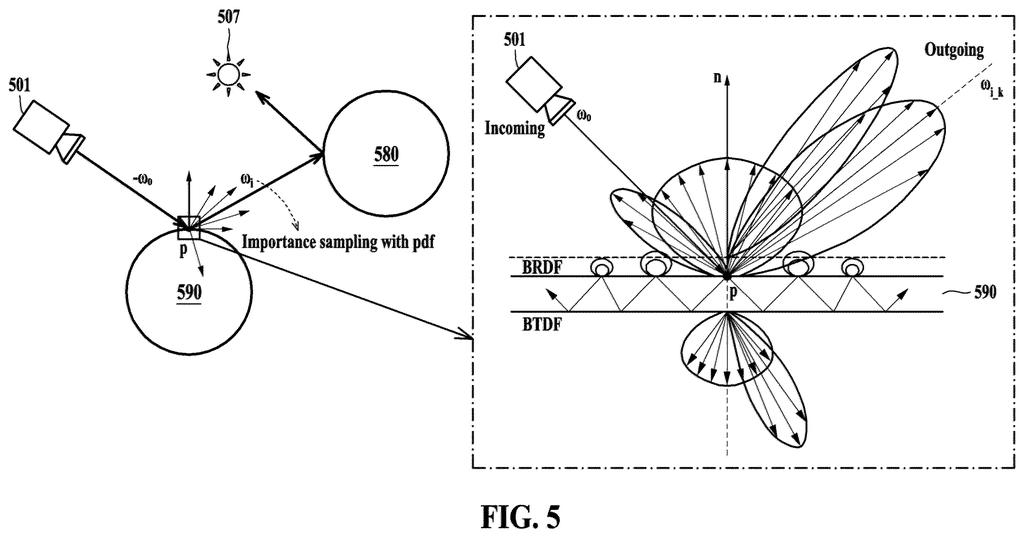
How Samsung's AI calculates light bouncing off surfaces
Imagine you're playing a video game or watching a rendered movie scene. Every surface you see, whether it's a shiny countertop, a rough concrete wall, or a person's skin, has to behave correctly when light hits it. That calculation is enormously complex, and doing it in real time on a device has always involved trade-offs between quality and speed.
Samsung's patent describes a system where two AI models work together to figure out how light scatters off surfaces in a 3D scene. One model picks a point in the scene and starts computing how light bounces from your viewing angle. The second model then picks up where the first left off, filling in the rest of the calculation. Together, they produce a complete picture of how that surface should look.
The end result is a rendered image where each pixel's color is determined by combining those AI-generated light values with a statistical formula that accounts for the probability of light traveling in any given direction. In short: more accurate lighting, computed more efficiently.
… obtain a second partial BSDF value using a second machine learning-based model, wherein the second machine learning-based model is connected to the first machine learning-based model, determine a full BSDF value for the ray direction at the 3D point based on the first partial BSDF value and the second partial BSDF value …
Translation: Two connected AI models work together to calculate how light interacts with materials in the scene.
How the two BSDF models divide and combine light data
The core of this patent is a technique for computing a Bidirectional Scattering Distribution Function (BSDF), which is the mathematical description of how a surface scatters light. If a surface is shiny, matte, translucent, or textured, the BSDF captures all of that behavior. Realistic rendering requires computing BSDFs for potentially thousands of points in a scene.
Samsung's approach splits the BSDF calculation between two machine learning models that are connected in series:
- The first model selects a 3D point in the scene and computes a "partial" BSDF value using the viewer's direction, a sampled ray direction (the path light is considered to travel), and the material properties of the surface.
- The second model takes that partial result and computes the remaining portion of the BSDF, completing the picture of how light behaves at that point.
- Both partial values are combined into a full BSDF value, which is then used alongside a probability density function (PDF) to determine the final color of the pixel on screen.
The PDF (a statistical tool that weights how likely light is to travel in a particular direction) helps make the sampling process efficient, so the system doesn't have to evaluate every possible light path, only the statistically meaningful ones.
… generate an image corresponding to the scene by determining a value of a pixel corresponding to the view direction based on the sampled ray direction, the full BSDF value, and a probability density function (PDF) value.
Translation: The system renders the final image by combining light calculations with mathematical probabilities.
What this means for real-time 3D graphics on Samsung devices
Rendering realistic 3D scenes is one of the most computationally demanding tasks in consumer electronics, from gaming to AR to video production apps. By breaking the lighting calculation across two coordinated AI models, Samsung may be looking for a way to get higher-quality rendering without demanding more raw processing power from a device.
This approach matters most if Samsung is planning to bring higher-fidelity 3D rendering to mobile devices or XR hardware, where power and thermal limits are real constraints. Better light simulation at lower computational cost is exactly the kind of thing that separates a genuinely immersive experience from one that looks slightly off.
This is a focused, technically specific patent in a field, physically-based rendering, where real performance gains are genuinely valuable. It's not flashy consumer news, but for anyone watching Samsung's push into XR or high-end mobile graphics, it's a signal worth logging. The two-model split approach is a concrete architectural idea, not just a vague AI claim.
There are more where this came from
We read every patent application Big Tech publishes and send you the ones worth knowing. Plain English, free, every week.
The drawings
12 drawing sheets from US 2026/0228933 A1 · click any drawing to enlarge


Want this weekly breakdown for a company we don't cover? Patentlyze Pro →
Be the first to weigh in