
Intel Patents Chip Design That Speeds Up Complex Math on Graphics Hardware
Intel wants GPUs to handle some of the trickiest math operations faster by cleverly reusing hardware that's already sitting inside the chip, rather than building new circuits from scratch.
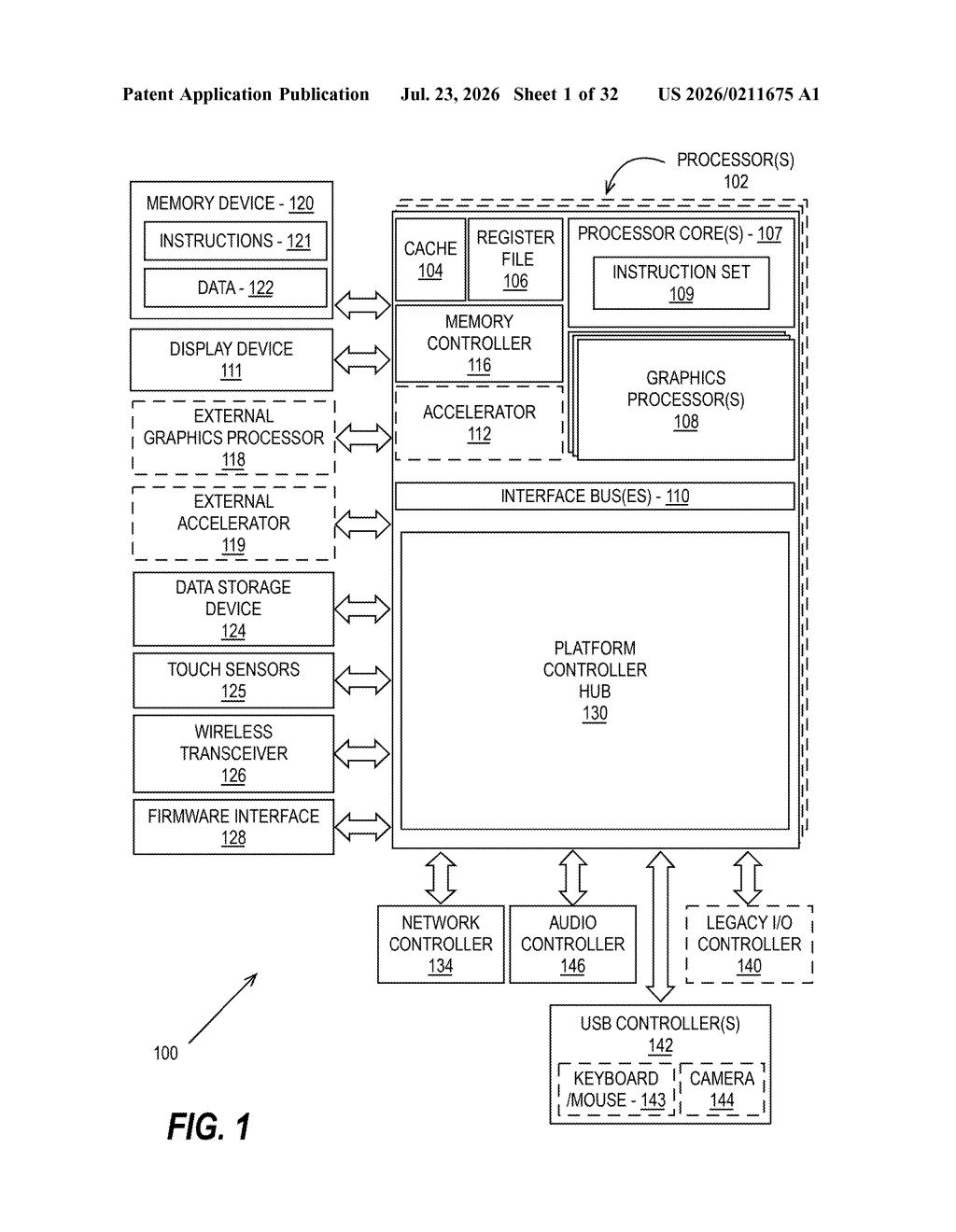
How Intel speeds up GPU math without new hardware
Imagine your calculator already has a built-in chip that handles multiplication and addition together. Intel's idea is to teach that same chip to also handle a few other related math jobs without adding any new hardware.
GPUs are packed with units called FMA engines (short for fused multiply-add) that crunch numbers at high speed. Normally, when a GPU needs to compute something like a logarithm or an exponential function, it runs a long sequence of software instructions to get there. Intel's patent describes a shortcut: add a few special instructions that let the FMA hardware extract specific parts of a number directly, cutting down the amount of code needed to reach the same answer.
The practical payoff is that math-heavy applications, things like scientific simulations, weather modeling, or physics engines, could run faster without changing the underlying chip design much. Less code means fewer steps, and fewer steps means faster results.
How the FMA unit handles special-case numbers natively
The patent focuses on three new instructions: get exponent, get mantissa, and scale. To understand why these matter, a quick note on how computers store numbers: a floating-point number (any number with a decimal) is stored in two parts, an exponent (the magnitude, like the power of 2 the number sits near) and a mantissa (the significant digits). These new instructions let code pull those parts out directly, rather than computing them indirectly through a chain of operations.
The key engineering move is that Intel routes these new instructions through the existing FMA (fused multiply-add) execution unit hardware already present in its GPU cores. The patent describes a pre-processing stage within the FMA unit that catches special-case inputs (like zero, infinity, or not-a-number values) before they hit the main calculation pipeline, then handles them immediately and skips the rest of the unit.
This matters because functions like logarithm, exponential, and division are normally emulated in software using long sequences of machine instructions. By giving the hardware native shortcuts for extracting exponents and mantissas, those emulation routines can be rewritten with significantly fewer instructions, and the code can also be made branch-free (meaning it avoids the slow conditional jumps that trip up a processor's pipeline when it can't predict which path comes next).
The target workloads are HPC (high-performance computing) applications, including scientific computing, financial modeling, and any simulation that calls math functions millions of times per second.
What this means for scientific and HPC workloads
For researchers and engineers running large simulations on Intel GPUs, this kind of optimization compounds quickly. A logarithm function called billions of times per second gets meaningfully faster if each call takes fewer instructions to complete. The fact that Intel achieves this by reusing existing hardware rather than adding new silicon also means the improvement could appear in chips that are already designed, through a firmware or driver update that exposes the new instructions.
More broadly, this is part of a long-running competition between GPU makers to make their chips more capable at scientific math. Nvidia's GPUs have had native transcendental function support for years, and Intel's Arc and data-center GPU lines have been working to close that gap. This patent is a specific engineering answer to that challenge, even if the all-claims-canceled status of the filing means the legal picture is complicated.
This is a competent, unglamorous piece of chip engineering that solves a real problem: Intel's GPU math libraries carry more overhead than they should. The approach of reusing FMA hardware rather than adding new logic is exactly the kind of pragmatic tradeoff that shows up in production silicon. The fact that all 20 claims were canceled in this publication is a red flag worth noting though; this patent may have hit prior-art walls.
There are more where this came from
We read every patent application Big Tech publishes and send you the ones worth knowing. Plain English, free, every week.
The drawings
32 drawing sheets from US 2026/0211675 A1 · click any drawing to enlarge


Want this weekly breakdown for a company we don't cover? Patentlyze Pro →
Be the first to weigh in